

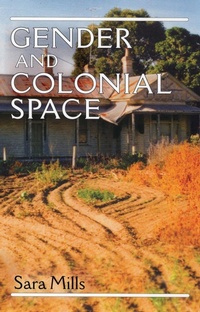
Gender and Colonial Space
11th Edition
Published on 19. July 2013
212 pages
978-1-84779-521-2 (ISBN)
Description

Gender and colonial space is a trenchant analysis of the complex relation between social relations - including notions of class, nationality and gender - and spatial relations, landscape, architecture and topography - in post-colonial contexts.
Arguing against much of the psychoanalytic focus of much current post-colonial theory, Mills aims to set out in a new direction, drawing on a wide range of literary and non-literary texts to develop a more materialist approach. She foregrounds gender in this field where it has often been marginalised by the critical orthodoxies, demonstrating its importance not only in spatial theorising in general, but in the post-colonial theorising of space in particular.
Concentrating on the period of 'high' British colonialism at the close of the nineteenth century, she adroitly examines a range of contexts, looking at a range of colonial contexts such as India, Africa, America, Canada, Australia and Britain, illustrating how relations must be analysed for the way in which different colonial contexts define and constitute each other. -- .
Arguing against much of the psychoanalytic focus of much current post-colonial theory, Mills aims to set out in a new direction, drawing on a wide range of literary and non-literary texts to develop a more materialist approach. She foregrounds gender in this field where it has often been marginalised by the critical orthodoxies, demonstrating its importance not only in spatial theorising in general, but in the post-colonial theorising of space in particular.
Concentrating on the period of 'high' British colonialism at the close of the nineteenth century, she adroitly examines a range of contexts, looking at a range of colonial contexts such as India, Africa, America, Canada, Australia and Britain, illustrating how relations must be analysed for the way in which different colonial contexts define and constitute each other. -- .
More details
Other editions
Additional editions
Sara Mills
Gender and Colonial Space
Book
06/2009
Manchester University Press
€27.30
Shipment within 15-20 days
Person
Sara Mills is Research Professor in Linguistics at Sheffield Hallam University -- .
Content
1. Introduction
2. Colonial subjectivity, gender and space
3. Knowing and viewing landscape
4. Public and domestic colonial architecture
5. Indigenous spatiality within the colonial sphere
6. Conclusions
Bibliography -- .
2. Colonial subjectivity, gender and space
3. Knowing and viewing landscape
4. Public and domestic colonial architecture
5. Indigenous spatiality within the colonial sphere
6. Conclusions
Bibliography -- .
