

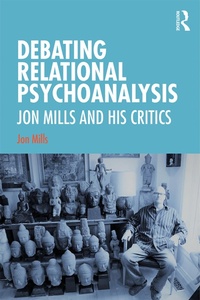
Debating Relational Psychoanalysis
Jon Mills and his Critics
1st Edition
Published on 10. June 2020
212 pages
978-1-000-06801-6 (ISBN)
Description

In Debating Relational Psychoanalysis, Jon Mills provides an historical record of the debates that had taken place for nearly two decades on his critique of the relational school, including responses from his critics.
Since he initiated his critique, relational psychoanalysis has become an international phenomenon with proponents worldwide. This book hopes that further dialogue may not only lead to conciliation, but more optimistically, that relational theory may be inspired to improve upon its theoretical edifice, both conceptually and clinically, as well as develop technical parameters to praxis that help guide and train new clinicians to sharpen their own theoretical orientation and therapeutic efficacy. Because of the public exchanges in writing and at professional symposiums, these debates have historical significance in the development of the psychoanalytic movement as a whole simply due to their contentiousness and proclivity to question cherished assumptions, both old and new. In presenting this collection of his work, and those responses of his critics, Mills argues that psychoanalysis may only advance through critique and creative refinement, and this requires a deconstructive praxis within the relational school itself.
Debating Relational Psychoanalysis will be of interest to psychoanalysts of all orientations, psychotherapists, mental health workers, psychoanalytic historians, philosophical psychologists, and the broad disciplines of humanistic, phenomenological, existential, and analytical psychology.
Since he initiated his critique, relational psychoanalysis has become an international phenomenon with proponents worldwide. This book hopes that further dialogue may not only lead to conciliation, but more optimistically, that relational theory may be inspired to improve upon its theoretical edifice, both conceptually and clinically, as well as develop technical parameters to praxis that help guide and train new clinicians to sharpen their own theoretical orientation and therapeutic efficacy. Because of the public exchanges in writing and at professional symposiums, these debates have historical significance in the development of the psychoanalytic movement as a whole simply due to their contentiousness and proclivity to question cherished assumptions, both old and new. In presenting this collection of his work, and those responses of his critics, Mills argues that psychoanalysis may only advance through critique and creative refinement, and this requires a deconstructive praxis within the relational school itself.
Debating Relational Psychoanalysis will be of interest to psychoanalysts of all orientations, psychotherapists, mental health workers, psychoanalytic historians, philosophical psychologists, and the broad disciplines of humanistic, phenomenological, existential, and analytical psychology.
Reviews / Votes
"Imagine a book on psychoanalysis that gets your heart racing and your own critical mind aroused into action! Jon Mills and his critics hold nothing back in their critique of the relational model and of each other. The reader has a front seat to a theoretical and practical boxing match that vitalizes the conversation, sharpens our theories and practices, prompting further debate and dialogue. In this provocative, deeply stirring and academically rigorous collection, we are challenged to be as thoughtful and thorough in our own theorizing and practices, as is Jon Mills and his contributors. This is a text that clarifies, informs and ultimately inspires."Roy Barsness, PhD, Professor, The Seattle School of Theology & Psychology and the Brookhaven Institute of Psychoanalysis; author of Core Competencies in Relational Psychoanalysis.
"This is an exhilarating, refreshing, and brave volume. Why? Because Jon Mills is not afraid to challenge dogma and theoretical hegemony, to ask the reader to think with (or for that matter, against) him. Mills' commanding and passionate rhetorical and intellectual skills shine through as he engages both his sophisticated interlocutors and the vexing conundrums and aporias at the heart of contemporary psychoanalytic relational theorizing. The best kind of psychoanalytic journey, Debating Relational Psychoanalysis, offers a vigorous, rigorous, and ultimately compassionate and redemptive conversation between Mills, the critic, and Mills' critics, in which familiar thought is tested, and one's truths are turned over, maybe tossed aside, maybe reaffirmed with renewed (and newly philosophically grounded) conviction."
Jill Gentile, PhD, NYU Postdoctoral Program in Psychotherapy and Psychoanalysis; author of Feminine Law.
"Jon Mills tells us "There is nothing more exciting than a clash of ideas, except for, perhaps, sex." I think that says it all. His controversial critique of Relational Psychoanalysis is provocative on many grounds. And the often-heated responses by his critics reveal both intellectual differences and personal affronts. In the end, it is the reader who benefits from this unique dialogue between intellectuals nimbly defending their own ideas. It will force you to think harder, and feel more deeply, not only about what you believe, but also how you practice."
Karen J. Maroda, PhD, ABPP, author of Psychodynamic Techniques
More details
Edition
1. Auflage
Language
English
Place of publication
London
United Kingdom
Publishing group
Taylor & Francis Ltd
Target group
College/higher education
Professional and scholarly
ISBN-13
978-1-000-06801-6 (9781000068016)
Copyright in bibliographic data and cover images is held by Nielsen Book Services Limited or by the publishers or by their respective licensors: all rights reserved.
Schweitzer Classification
Other editions
Additional editions
Book
06/2020
1st Edition
Routledge
€52.90
Shipment within 15-20 days
Book
06/2020
1st Edition
Routledge
€196.00
Shipment within 15-20 days
Person
Jon Mills, PsyD, PhD, ABPP is a philosopher, psychoanalyst, and clinical psychologist. He is a faculty member in the postgraduate programs in psychoanalysis and psychotherapy, Gordon F. Derner School of Psychology, Adelphi University, emeritus professor of psychology and psychoanalysis, Adler Graduate Professional School, and runs a mental health corporation in Ontario, Canada. Recipient of numerous awards for his scholarship, he is the author and editor of over 20 books in psychoanalysis, philosophy, psychology, and cultural studies.
Content
Foreword by Arnold D. Richards. Introduction: (Re)visioning Relational Psychoanalysis, Jon Mills. 1. A Critique of Relational Psychoanalysis, Jon Mills 2. Contextualizing is not Nullifying: Reply to Mills, Robert D. Stolorow, George E. Atwood, & Donna M. Orange 3. Assertions of Therapeutic Excess: A Reply to Mills, Marilyn S. Jacobs 4. "Neither Fish nor Flesh": Commentary on Jon Mills, Stuart A. Pizer 5. A Response to my Critics, Jon Mills 6. Conundrums: A Critique of Contemporary Psychoanalysis Interview on New Books in Psychoanalysis ,Jon Mills & Tracy D. Morgan 7. Fine-Tuning Problems in Relational Psychoanalysis: New Directions in Theory and Praxis, Jon Mills 8. Introduction to The Relational Approach and its Critics: A Conference with Dr. Jon Mills, Aner Govrin 9. Challenging Relational Psychoanalysis: A Critique of Postmodernism and Analyst Self- Disclosure, Jon Mills 10. Straw Men, Stereotypes, and Constructive Dialogue: A Response to Mills' Criticism of the Relational Approach, Chana Ullman 11. On Multiple Epistemologies in Theory and Practice: A Response to Jon Mills' "Challenging Relational Psychoanalysis: A Critique of Postmodernism and Analyst Self-Disclosure", Shlomit Yadlin-Gadot 12. Relational Psychoanalysis and the Concepts of Truth and Meaning: Response to Jon Mills, Boaz Shalgi 13. Projective Identification and Relatedness: A Kleinian Perspective, Merav Roth 14. Psychoanalysis and Postmodernism: A Response to Dr. Jon Mills' "Challenging Relational Psychoanalysis: A Critique of Postmodernism and Analyst Self-Disclosure", Liran Razinsky 15. Relational Psychoanalysis Out of Context: Response to Jon Mills , Steven Kuchuck & Rachel Sopher 16. Challenging Relational Psychoanalysis: A Reply to My Critics Jon Mills
