

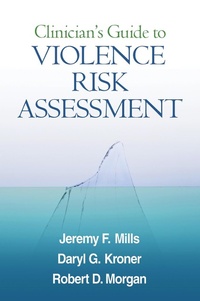
Clinician's Guide to Violence Risk Assessment
Description

Clinical psychologists, psychiatrists, and clinical social workers who may be called on to conduct violence risk assessments. May serve as a supplemental text in graduate-level courses.
More details
Other editions
Additional editions
Persons
Jeremy F. Mills, PhD, CPsych, is a psychologist with a practice in forensic, correctional, and counseling psychology in Kingston, Ontario, Canada. In addition, he serves as Adjunct Research Professor in the Department of Psychology at Carleton University in Ottawa. A Fellow of the American Psychological Association, Dr. Mills's research interests include violence risk assessment, violence risk communication, and the assessment of suicide risk. Dr. Mills provides consultation and training in the area of violence risk assessment. Daryl G. Kroner, PhD, CPsych, is Assistant Professor in the Department of Criminology and Criminal Justice at Southern Illinois University Carbondale. Previously, he was a prison psychologist. Dr. Kroner's research interests include correctional mental health, dynamic risk assessment during community supervision, and the social-context aspects of risk assessment. Robert D. Morgan, PhD, is Associate Professor in the Department of Psychology at Texas Tech University in Lubbock, Texas. In addition, he is Director of Clinical and Forensic Services at Lubbock Regional Mental Health Mental Retardation Center. Dr. Morgan's research interests include correctional mental health, forensic psychology, and professional development and training.
Content
1. Violence Risk Assessment: An Introduction2. Violence Risk Factors3. Risk Appraisal Instruments4. Issues in Risk Assessment5. An Integrated?Actuarial Approach to the Assessment and Management of Risk for Violence6. The Risk Assessment Process7. Telling the Story: An Outline for the ReportAppendix. Sample Violence Risk Assessment
