

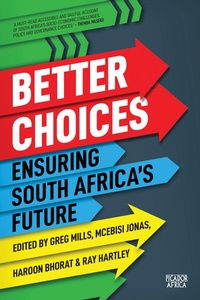
Better Choices
Ensuring South Africa's Future
Published on 1. April 2022
373 pages
978-1-77010-754-0 (ISBN)
Description

'A must-read, accessible and skilful account of South Africa's socio-economic challenges, policy and governance choices.' - THEMBA MASEKO
All the numbers on South Africa's crisis dashboard are blinking red. The economy is failing to grow and more and more young people find themselves on the outside looking in as education falters and jobs disappear. Energy and transport are in crisis. Governance is floundering as debt mounts and government runs out of money.
Better Choices is a collection by South Africa's top thinkers on the political economy, providing an unflinching account of the myriad challenges the country faces. The picture that emerges is of a nation on the brink of a catastrophic slide into failure unless better, if tough, policy choices are made.
As stark as these problems are, their solutions are tantalisingly close at hand. The chapters in this book outline exactly the solutions - those 'better choices'- that need to be made by leadership to alter the country's bleak trajectory.
South Africa cannot talk its way out of trouble. Key to success is removing the sources of friction - the red tape, over-regulation and rents - that slow down investment. This is only possible if a more effective, focused government acts decisively.
Compiled by The Brenthurst Foundation, Africa's leading think tank on economic development, Better Choices is for those who want to build a positive, inclusive future for South Africa.
All the numbers on South Africa's crisis dashboard are blinking red. The economy is failing to grow and more and more young people find themselves on the outside looking in as education falters and jobs disappear. Energy and transport are in crisis. Governance is floundering as debt mounts and government runs out of money.
Better Choices is a collection by South Africa's top thinkers on the political economy, providing an unflinching account of the myriad challenges the country faces. The picture that emerges is of a nation on the brink of a catastrophic slide into failure unless better, if tough, policy choices are made.
As stark as these problems are, their solutions are tantalisingly close at hand. The chapters in this book outline exactly the solutions - those 'better choices'- that need to be made by leadership to alter the country's bleak trajectory.
South Africa cannot talk its way out of trouble. Key to success is removing the sources of friction - the red tape, over-regulation and rents - that slow down investment. This is only possible if a more effective, focused government acts decisively.
Compiled by The Brenthurst Foundation, Africa's leading think tank on economic development, Better Choices is for those who want to build a positive, inclusive future for South Africa.
More details
Language
English
Place of publication
Craighall
South Africa
Publishing group
Pan Macmillan South Africa
Target group
Reading Age: From 16 to 99 years, Interest Age: From 16 to 99 years
Product notice
Reflowable
File size
4,11 MB
ISBN-13
978-1-77010-754-0 (9781770107540)
Copyright in bibliographic data and cover images is held by Nielsen Book Services Limited or by the publishers or by their respective licensors: all rights reserved.
Schweitzer Classification
Other editions
Additional editions
Book
04/2022
Picador Africa
Unfortunately, price unknown
Available (delivery time upon request)
Persons
GREG MILLS, MCEBISI JONAS, HAROON BHORAT and RAY HARTLEY are the editorial team for Better Choices.
The contributors, in order of their chapters, are: Greg Mills; Ivan Pillay, Sri Kesavan and Yolisa Pikie; Gareth Newham; Haroon Bhorat and Ben Stanwix; Andrew Murray; David Francis and Imraan Valodia; Mcebisi Jonas; Liberty Mncube; Dennis Davis; Andrew Donaldson; Michael Sachs; Alan Hirsch; Ray Hartley; Derek Thomas; Wandile Sihlobo and Gracelin Baskaran; Anthony Black; Kate Rivett-Carnac; Annabel Bishop; and Tim Harris.
The contributors, in order of their chapters, are: Greg Mills; Ivan Pillay, Sri Kesavan and Yolisa Pikie; Gareth Newham; Haroon Bhorat and Ben Stanwix; Andrew Murray; David Francis and Imraan Valodia; Mcebisi Jonas; Liberty Mncube; Dennis Davis; Andrew Donaldson; Michael Sachs; Alan Hirsch; Ray Hartley; Derek Thomas; Wandile Sihlobo and Gracelin Baskaran; Anthony Black; Kate Rivett-Carnac; Annabel Bishop; and Tim Harris.
Content
- Intro
- Better Choices
- Ensuring South Africa's Future
- Foreword
- Jonathan Oppenheimer
- Preface and Acknowledgements
- Abbreviations
- Introduction
- Better Choices for South Africa
- Greg Mills
- High roads, low roads, a fork in the road?
- The political conundrum
- Plans, plans, plans - policy rich, priority and implementation poor?
- More than agency
- Conclusion: A path to better choices
- Chapter 1
- Governance Choices
- Ivan Pillay, Sri Kesavan and Yolisa Pikie
- Background
- A systems view of organisations
- State of systems in the state
- Most state institutions perform very poorly
- A basic operating system
- How does governance fit in?
- Understanding governance operationally
- Does the presence of four lines of defence ensure compliance?
- Building a solution
- The hard choice
- Implementing the solution: A Governance Improvement Plan
- Conclusion
- Chapter 2
- Crime and the Justice System
- Gareth Newham
- The impact of state capture on the criminal justice system
- Decline of the criminal justice system
- The consequence for public safety
- Why is South Africa so violent?
- What has been done?
- What can be done?
- Chapter 3
- Policy Choices for the Labour Market
- Haroon Bhorat and Ben Stanwix
- A nation in search of jobs
- Structural shifts
- The public sector, union membership and wages
- Labour market institutions
- Dispute resolution systems
- Bargaining councils
- The informal sector
- Scarce skills and the sectoral training system
- The SETA system
- Critical skills and immigration constraints
- Direct employment creation
- Conclusions and recommendations
- Chapter 4
- Service Delivery at Sub-National Level
- Andrew Murray
- The role of provincial government
- Governance performance
- Service delivery performance: Education
- Service delivery performance: Health
- Local government and service delivery
- Conclusion, thoughts and solutions
- Chapter 5
- The Informal Economy and Informal Employment in South Africa
- David Francis and Imraan Valodia
- Definitional issues
- The size and shape of the informal economy in South Africa
- The informality conundrum in South Africa
- Policy proposals - what can be done?
- Conclusions and three critical actions
- Chapter 6
- The Politics of the Political Economy
- Mcebisi Jonas
- Conceptual framework
- Reconciliation
- Renationalisation
- Capture
- Reform
- Conclusion
- Chapter 7
- Competition Policy and Excessive Market Power
- The Other Path
- Liberty Mncube
- The stack of the deck: Excessive market power
- The challenge: COVID-19 crisis and the doom loop
- The choices
- Conclusion
- Chapter 8
- Fixing SARS
- An Institution Dismantled by State Capture
- Dennis Davis
- The Nugent Commission final report, 2018
- The first turnaround: The Gordhan era
- The Moyane era
- The challenges facing the new Commissioner
- Towards solutions
- Chapter 9
- Social Insurance
- Building Better Institutions
- Andrew Donaldson
- The Road Accident Fund
- Pension, death and disability coverage
- National health insurance
- Employment, unemployment and basic income support
- Conclusion
- Chapter 10
- The Origins of the Fiscal Crisis
- Michael Sachs
- The road to crisis
- Political transition
- Incoherent policy
- The political economy elements of a chronic fiscal crisis
- Conclusion
- Chapter 11
- The Role of SOEs in Development in South Africa
- Alan Hirsch
- A brief history
- The rise of statism in the ANC
- The damage done
- Crisis and response in the South African SOE landscape
- Why is it hard to get what you expect out of SOEs?
- How to think about SOEs
- Conclusions and recommendations
- Chapter 12
- Eskom and the Great Power Puzzle
- Ray Hartley
- Panic stations
- Hyenas at the door
- Crisis point
- Can a new broom sweep clean?
- Balancing the books
- The structural challenge
- Are we there yet?
- The big energy choices
- Chapter 13
- Transnet on the Line
- Derek Thomas
- SOEs and the South African growth imperative
- Transnet: Drivers of the current position
- Improving Transnet
- Private sector participation in Transnet
- Better policy choices for Transnet
- Chapter 14
- Agriculture in South Africa
- Policy Reforms to Stimulate Growth and Employment
- Wandile Sihlobo and Gracelin Baskaran
- Transformation and redistribution
- Addressing structural inefficiencies in South Africa's agriculture
- South Africa's agricultural growth and employment
- Policy recommendations
- Concluding remarks
- Chapter 15
- Creating Employment
- Can Labour-Intensive Manufacturing Work?
- Anthony Black
- The poor performance of light manufacturing
- Is labour-intensive manufacturing still a viable development strategy?
- What accounts for poor performance?
- What is the way forward?
- Conclusion
- Chapter 16
- Getting Tourism Flying
- Kate Rivett-Carnac
- Recent tourism performance
- Why the low growth rates?
- COVID impacts: An existential crisis
- The Tourism Sector Recovery Plan
- Three priority actions for tourism recovery
- Conclusion
- Chapter 17
- The Financial Services Sector and Its Support to the Economy
- Annabel Bishop
- South Africa's banking sector in perspective to GDP
- Recent history and the current state of the banking sector
- The negative impact of government debt on the banking sector
- Climate change and the responsibility of the banking system
- Early-stage financing
- Conclusion: The imperative for better choices
- Chapter 18
- Tech and Business Process Outsourcing
- Tim Harris
- Background
- A 250-year-old trend worth tapping into
- An increasingly remote world
- The 'offshorability' of service sector jobs
- BPO and other exported services
- Tech now rules the world
- Better policy choices for tech and BPO
- Three critical actions
- About the Contributors
