

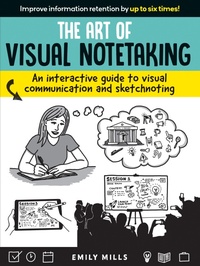
Art of Visual Notetaking
An interactive guide to visual communication and sketchnoting
Published on 7. March 2019
128 pages
978-1-63322-623-4 (ISBN)
Description

Improve your bullet journals, to-do lists, class notes, and everything in between with The Art of Visual Notetaking and its unique approach to taking notes in the twenty-first century.
Visual notetaking is the perfect skill for journaling, class lectures, conferences, and any other time that retaining information is key. Also referred to as sketchnoting, visual notetaking is ideal for documenting processes, planning projects, outlining ideas, and capturing information. And as you'll learn in The Art of Visual Notetaking, this approach doesn't require advanced drawing or hand-lettering skills; anyone can learn how to use simple lines, connectors, shapes, and text to take dynamic notes.
In The Art of Visual Notetaking, aspiring sketchnoters and journalers will find helpful "Getting Started" pages of icons and badges for common note-taking purposes, with tips and encouragement for creating you own unique icons. You'll go on to discover instruction and how-to techniques, tips, and tutorials that focus on visual notetaking for different settings, from a business meeting, workshop, or convention, to a college lecture or sermon. Expert instruction from a professional sketchnote artist and educator demonstrates how to visually arrange and compile ideas, focal points, and key concepts.
Visual notetaking is the perfect skill for journaling, class lectures, conferences, and any other time that retaining information is key. Also referred to as sketchnoting, visual notetaking is ideal for documenting processes, planning projects, outlining ideas, and capturing information. And as you'll learn in The Art of Visual Notetaking, this approach doesn't require advanced drawing or hand-lettering skills; anyone can learn how to use simple lines, connectors, shapes, and text to take dynamic notes.
In The Art of Visual Notetaking, aspiring sketchnoters and journalers will find helpful "Getting Started" pages of icons and badges for common note-taking purposes, with tips and encouragement for creating you own unique icons. You'll go on to discover instruction and how-to techniques, tips, and tutorials that focus on visual notetaking for different settings, from a business meeting, workshop, or convention, to a college lecture or sermon. Expert instruction from a professional sketchnote artist and educator demonstrates how to visually arrange and compile ideas, focal points, and key concepts.
More details
Language
English
Place of publication
Beverly
United States
Publishing group
Quarto Publishing Group USA Inc
Illustrations
450 color illustrations
ISBN-13
978-1-63322-623-4 (9781633226234)
Copyright in bibliographic data and cover images is held by Nielsen Book Services Limited or by the publishers or by their respective licensors: all rights reserved.
Schweitzer Classification
Other editions
Additional editions
Book
03/2019
Walter Foster Publishing
€21.00
Shipment within 3-4 weeks
Person
Emily Mills is a freelance illustrator and teaches online sketchnoting classes at SketchnoteAcademy.com. When she's not teaching or serving her clients, you can find her traveling all over the country taking visual notes for The Sketch Effect. Emily lives just outside Nashville, TN with her husband, Joseph. You can subscribe at SketchnoteAcademy.com to get her visual notetaking articles and exercises delivered to your inbox.
Content
- Cover
- Half Title
- Title
- Copyright
- TABLE OF CONTENTS
- INTRODUCTION
- How to Use This Book
- THE BASICS: WHAT ARE VISUAL NOTES?
- Why Are Visual Notes Important?
- Who Can Take Visual Notes?
- Types of Visual Notes?
- How Can I Use Visual Notes?
- TOOLS: THE VISUAL NOTETAKING ARSENAL OF SKILLS
- Surfaces
- Writing and Drawing Tools
- Miscellaneous Supplies
- Considerations When Choosing Your Tools
- Mindset
- PREP WORK: BEFORE YOU BEGIN
- LISTENING
- Listening Cues
- WRITING
- Cursive
- Block Letters
- Serif Letters
- Embellishments
- HIERARCHY & COMPOSITION?
- DRAWING
- The Basics
- Imagination and Association
- Leveling Up
- Figures
- Hands
- Cartoon-Style Faces
- Putting It All Together
- VISUAL DIRECTION
- Containers
- Numbers
- Arrows
- FINDING INFORMATION FAST
- Icons
- Indexing
- VISUALIZING INFORMATION IN DIAGRAMS
- YOUR VISUAL LIBRARY
- VISUAL METAPHORS
- HEADERS
- How to Create a Header
- LAYOUTS
- Types of Layouts
- Choosing the Best Layout
- Time Blocking
- REFINING
- What to Refine
- Spelling Issues
- Guiding Shapes
- Shadows
- Color
- WHAT MAKES VISUAL NOTES "GOOD?"
- Looking "Good"
- SHARING YOUR VISUAL NOTES
- Capturing the Best Image
- The Value of Sharing
- When Should You Share?
- IMPROVING YOUR CRAFT : TRACK YOUR TRENDS
- Tips for Left-Handed People
- PROFESSIONAL & EDUCATIONAL VISUAL NOTETAKING
- ABOUT THE AUTHOR
