

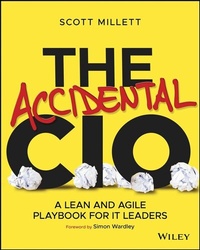
The Accidental CIO
Description

Many books on modern IT leadership focus solely on supporting innovation and disruption. In practice these must be balanced with the need to support waste reduction in existing processes and capabilities while keeping the foundation operational, secure, compliant with regulations, and cost effective.
In The Accidental CIO, veteran software developer-turned-executive Scott Millett delivers an essential playbook to becoming an impactful, strategic leader at any stage of your IT leadership journey from your earliest aspirations to long time incumbents in director and C-suite roles. You'll find a wealth of hands-on advice for tackling the many challenges and paradoxes that face technology leaders, from creating an aligned IT strategy, defining a target architecture, designing a balanced operating model, and leading teams and executing strategy.
After the foreword from Simon Wardley, The Accidental CIO will help you:
* Understand problem contexts you will face using the Cynefin decision making framework, and how the philosophies of agile, lean and design thinking can help manage them.
* Design an adaptive and strategically aligned operating model by applying the appropriate ways of working and governance approaches depending on each unique problem context.
* Organize a department using a blend of holacratic and hierarchical principles, and leveraging modern approaches such as Team Topology and Socio-technical patterns.
* Develop and deploy an effective and aligned IT Strategy using Wardley mapping based on a deep knowledge of your business architecture.
With this knowledge you'll be ready to create an empowered IT organization focused on solving customer problems and generating enterprise value. You'll understand the science behind what motivates teams and changes behavior. And you'll show your skills as a business leader thinking beyond IT outputs to impactful business outcomes.
More details
Other editions
Additional editions
Person
Content
- Cover
- Title Page
- Copyright Page
- About the Author
- Acknowledgments
- Contents at a Glance
- Contents
- Foreword
- Introduction
- Why Should You Care? The CIO Challenge
- Taking Action: Becoming a Strategic Leader
- What Will You Learn?
- Part I A New System of Work
- Chapter 1 Why We Need to Change The System
- The Age of Digital Disruption
- Disruptive Technology
- The Rise of Customer Expectations and Influence
- Adaptive Organizations
- New Business Models
- Operating in a Volatile, Uncertain, Complex, and Ambiguous Business Environment
- Leading IT in a Complex and Adaptive World
- Decision-Making with the Cynefin Framework
- IT Needs to Operate in Both the Ordered and Unordered Problem Spaces
- Summary
- Chapter 2 Philosophies for a New System
- Philosophies vs. Methodologies
- Discovering Value Using Design Thinking
- Eliminating Waste with Lean
- Lean Production: The Toyota Production System and The Toyota Way
- Lean Enterprise
- Achieving Flow with the Theory Of Constraints
- Managing Complexity in Software Development with Agile
- The Manifesto for Agile Software Development
- The Values of the Agile Manifesto
- The Principles of the Agile Manifesto
- Strategic Decision-Making Using Wardley Mapping
- Maps
- Doctrine
- Summary
- Chapter 3 How to Change the System
- Being Agile vs. Doing Agile
- Why Only Adopting the Practices of Agile Won't Work
- Use Systems Thinking to Change Behavior
- The Fundamentals of Systems Thinking
- Tools for Exploring and Understanding Systems
- Applying Systems Thinking to Organizational Change
- Changing Leaders' Mental Models
- Systems Thinking vs. Linear Thinking
- The Problems with Command-and-Control Leadership and Management
- The Beyond Budgeting Movement
- Leadership Principles to Instill Intrinsic Motivation
- Emergent and Adaptive Management Processes
- Instilling Drive through Purpose, Mastery, and Autonomy
- Summary
- Part II Designing An Adaptive Operating Model
- Chapter 4 The Anatomy of an Operating Model
- The Anatomy of an Operating Model
- The Themes of an Adaptable Operating Model
- A Focus on Impacts and Outcomes over Output
- Structured for Intrinsic Motivation
- A Focus on Being Agile, Not Just Doing Agile
- Manage the Flow of Work
- Lead the People
- Summary
- Chapter 5 How We Are Organized
- Organizational Structure
- Hierarchy
- Holacracy
- The Need for a Balanced Design
- Supporting an Ambidextrous Organization
- Understanding the Influence of Conway's Law and the Cognitive Load Theory on Team Performance
- Conway's Law
- Cognitive Load Theory
- Product-Centric Development Teams
- The Definition of a Product
- Comparing to Project Teams
- Defined Boundaries of Responsibility
- Clarity of Purpose
- Autonomous and Self-Sufficient
- Appropriately Sized Teams
- The Benefits of Product Teams
- Defining Product Team Boundaries
- Organizing the Product Portfolio Using a Product Taxonomy
- Portfolio Level
- Product Group Level
- Product Level
- Modeling Product Team Boundaries with Team Topology Patterns
- The Need to Constantly Evolve Teams
- An Example of a Team Topology
- Evolving to Business and IT Fusion Teams
- Managing Cross Team Dependency
- Summary
- Chapter 6 How We Work
- IT Management Frameworks
- How to Solve Problems from Discovery to Delivery
- Problem-Solving Methodologies
- Focused on Exploring: Design Thinking and the Double Diamond Model
- Focused on the Removal of Waste: Lean and PDCA
- Focused on Quality and Consistency: Six Sigma and DMAIC
- Discovery Tools for Understanding the Problem Space
- Discovery Tools to Address Customer Experience
- Jobs to Be Done
- User Journey Mapping
- User Research
- Discovery Tools for Process Optimization
- Service Blueprints
- Domain Discovery with Event Storming
- Identifying Waste with Value Stream Mapping
- Root Cause Analysis with the Five Whys and Cause-Effect Diagrams
- Visualizing Problem Discovery and Definition with Impact Mapping
- Approaches to Manage the Solution Space
- Solution Delivery Life Cycles
- Project Delivery Life Cycle
- Continuous Delivery Life Cycle
- Exploratory Life Cycle
- Delivery Management
- Waterfall / BDUF
- Scrum
- Kanban
- Development Methodologies
- Extreme Programming (XP)
- Lean Principles in Software Development
- Operations Methodologies: Devops
- Summary
- Chapter 7 How We Govern
- What Is Governance?
- Alignment: Linking Work to Strategic Intent
- Managing Demand: Visualizing Work
- Capturing Demand
- A3 Reports
- DIBB and Amazon's Press Release
- Visualizing Work Using Kanban
- Visualize
- Limit Work in Progress
- Manage Flow
- Make Policies Explicit
- Implement Feedback Loops
- Improve Collaboratively
- Prioritization: Focusing on the Things That Matter
- Prioritizing Strategic Objectives
- Prioritizing Tactical Initiatives
- The Importance of Having a Clear Strategy and Tactical Plan
- Prioritizing Operational Action
- Helping Others
- Prioritizing BAU vs. Strategic Work
- Methods of Prioritization
- Highest Value for Lowest Complexity
- Weighted Shortest Job First or CD3
- Technical Debt and Risks
- Using Judgement as Well as Data
- Measurement: Defining and Cascading Value and Measures
- Types of Value
- Types of Measure
- Cascading Value into the Work
- Defining Value
- Strategic Level: Business Goals and Strategic Objectives
- Tactical Level: Business Outcomes
- Operational Level: Sub-Outcomes, Programs, and Projects
- Investment: Funding for Outcomes
- Setting Investment Targets
- Allocating Funding to Initiatives
- Using the Right Investment Method for Initiatives
- Product Funding: Using a Venture Capital Approach to Investment in Complex Problem Domains
- Project Funding: Using a Project-Led Approach in Simple Contexts
- Investing in Team Capacity
- Annual Investment in Product Team Capacity Based on Strategic Need
- Invest in the Capacity to Manage BAU as Well
- Reviewing Funding Allocation
- Allocating Team Capacity to Deliver Outcomes, Projects, and Programs
- Quicker to Adapt
- Trusting Teams to Manage Funds
- Decision Rights: Empowering People
- Strategic Level: Setting Intent
- Tactical Level: Determine the Outcomes to Invest In
- Operational Level: Delivering the Outcomes
- You Build It, You Run It
- Trusting People to Make Decisions
- Project and Program Managers
- Everyone Is Responsible for Enterprise Value
- Performance: Monitoring Value
- Value-Driven Projects: Govern for Value, Not for Predictability
- The Illusion of Control
- Value Review
- Plan-Driven Projects: Govern for Adherence to a Plan
- Summary
- Chapter 8 How We Source and Manage Talent
- Sourcing Strategy
- Recruiting
- Be Clear on Your Value Proposition
- Hire for Attitude as Well as Aptitude
- The Need for T-shaped as Well as I-shaped People
- Explorers, Villagers, and Town Planners
- Hire for Diversity in Thinking
- Developing
- Invest in Mastery through Coaching, Training, and Mentoring
- Develop A Growth Mindset
- Reduce Cognitive Load
- Retaining
- Create a Flexible Environment
- Create a Career Path
- Ensure a Continuous Talent Development
- Summary
- Chapter 9 How We Lead
- Adopting New Leadership Behaviors
- Embracing Servant Leadership
- Instilling Intrinsic Motivation
- Clarify Purpose and Ensure Alignment
- Empower People Through Trust
- Develop Mastery in People
- Encouraging Growth and Development
- Adopt a Curious and Adaptive Approach to Problem Solving
- Focus on Continuous Learning and Development
- Provide a Safe Environment
- Focusing on Improving the System
- Lead by Example
- Remove Impediments
- Go and See the Work
- Break Down Silos
- Summary
- Part III Strategy to Execution
- Chapter 10 Understanding Your Business
- Business Anatomy
- Why IT Leaders Need to Understand the Anatomy of a Business
- Purpose: Starting with Why and Understanding Your North Star
- The Business Model: The System of Capturing Value
- What Value Do We Offer?
- How Do We Make Money?
- How Do We Reach and Interact with Our Customers?
- Who Are Our Customers?
- Operating Model: How We Do the Work
- How We Deliver Value: Key Value Streams
- Types of Value Stream
- The Value of Thinking in Value Streams and Journeys
- What We Need to Do: Business Capabilities
- How We Do It: People, Process, and Technology
- Business Context: Understanding What Can Impact Us
- Internal Context: Portfolio Analysis
- The Demand: Customers and the Market
- The Supply: The Competition and Porter's Five Forces
- The Wider Context: PESTEL Analysis
- Business Strategy: The Choices We Make to Win
- Aspirations, Objectives, and Goals
- The Where-to-Play and How-to-Win Strategies
- The Value Disciplines Model
- The Value Proposition Canvas
- What Capabilities Are Required
- Porter's Value Chain
- Wardley Maps
- What Improvements to the Management Systems Are Required
- Capturing and Communicating Business Strategy
- OGSM as a Framework for Strategy Communication
- Strategy Maps as a Framework for Strategy Communication
- Summary
- Chapter 11 IT Strategic Contribution
- Linking IT Execution to Business Strategy Using Enterprise Architecture
- Strategic Level
- Tactical Level
- Operational Level
- Strategy Nomenclature
- Creating an IT Strategy
- Inputs
- Process
- Outputs
- Determining IT Contribution to Addressing BAU Challenges and Achieving the Strategic Objectives
- Using Value Streams to Clarify Capability Improvements Required to Achieve the Strategic Objectives
- Mapping the Business Capabilities
- Strategic Objective: Improve Corporate Events Online Booking Conversion
- Strategic Objective: Increase Caterer Sign-Ups
- Building the Capability Model
- Identifying Barriers and Opportunities Preventing Us from Achieving the Strategic Objectives
- What Actions Must IT and the Rest of the Business Take to Remove the Obstacles?
- Understanding Operational Essential (BAU) Capability Needs
- Defining Principles to Guide Technical Solutions
- Determining Strategic Actions for IT Capability Maturity Improvements
- Measuring Contribution in Terms of Business Outcomes
- Communicating IT Strategic Contribution
- Full Document
- How Would McKinsey Do It?
- The Introduction, Situation, Complication, and Question
- The IT Strategic Contribution Executive Summary
- What Are the Obstacles We Must Overcome?
- In What Way Will IT Contribute?
- What Other Actions Will IT Take?
- What Are Our Guiding Principles?
- The One-Pager
- Summary
- Chapter 12 Tactical Planning: Deploying Strategy
- Planning Considerations
- Creating a Strong Vision to Guide Our Planning
- Embracing Flexible Planning Horizons
- Building in the Ability to Adapt Both Plans and Strategy
- Following Hoshin Kanri to Deploy Strategy
- Creating a Tactical Plan
- Inputs
- Process
- Clarify the Business Needs
- Review the Technology Landscape
- Review the IT Operating Model
- Identify the IT initiatives Needed to Address Business Needs
- Prioritize the IT Initiatives Guided by the Investment Strategy
- Output
- Clarify the Business Needs: Where Do We Need to Focus Our Investment?
- Review the Technology Landscape: What Do We Need to Optimize?
- Capturing and Assessing the Application Landscape
- Reviewing the Security, Data, and Infrastructure Layers
- How Do We Fill the Gaps: Should We Build or Buy?
- What Technologies Should We Use?
- How Do We Guide Build Efforts and Emergent Design?
- The Target State Suggestions
- Review the IT Operating Model: What Do We Need to Change?
- How Wardley Maps Can Help Inform Target Architecture and Operating Model Choices
- Observe Needs and Capabilities
- Orientate and Determine Focus and Direction
- Decide on IT Technical Architecture and Operating Model Choices
- Defining and Prioritizing the IT Initiatives
- Determine the IT Initiatives Required to Address Capability Gaps
- Exploring IT Initiatives to Address Business Needs
- Exploring IT Initiatives to Address IT Capability Needs
- Documenting Initiatives as Business Outcomes
- Phasing Approaches
- Communicating the IT Tactical Investment Road Map
- The Introduction, Situation, Complication, and Question: The Business and IT Strategy
- The Answer: Tactical Road Map
- Why? The Target States
- How So? The AS-IS States
- How So? The Recommended Approach
- Appendix: Portfolio of Initiatives and Supporting Documentation
- Summary
- Chapter 13 Operational Planning: Execution, Learning and Adapting
- Operational Considerations
- Leading Through Intent
- Objectives and Key Results
- Operational Planning
- Inputs
- Process
- Distilling Large Tactical Initiatives
- Project Portfolio Management
- Solution Designs
- Implementation Plans
- Output
- Feedback, Learning, and Adapting
- Tactical and Operational Review: Use Nested PDCA Loops to Deliver Strategic Goals
- Strategic Review: Using the OODA Loop and Wardley's Strategic Cycle to React and Adapt to Contextual Changes
- Integrated Feedback Loops
- Creating a Clear Line of Sight from Strategy to Execution
- A Worked Example: From Strategy to Tactics to Operational Execution
- The Strategic Objective
- Defining the IT Strategic Actions
- Enterprise Architecture Suggestions
- AS-IS
- TO-BE
- Operating Model Suggestions
- Defining the Tactical Initiatives
- Operational Plans and Solution Design
- Feedback
- Summary
- Index
- EULA
Introduction
If there is no struggle, there is no progress.
-Frederick Douglass
Be yourself. Everyone else is taken.
-Oscar Wilde
How do you get to Carnegie Hall? - Practice, practice, practice
-Anonymous
We think too much and feel too little. More than machinery, we need humanity; more than cleverness, we need kindness and gentleness. Without these qualities, life will be violent and all will be lost.
-Charlie Chaplin
It was my first day on my new job, and it hit me like a bucket of ice-cold water. It wasn't that I had imposter syndrome. I just didn't know what to do.
Back in January of 2015 I received an offer from Iglu.com, an online travel agent for the cruise and ski markets, to become its first IT director. I wanted a change from Wiggle.co.uk, where I had been the first full time developer working along the founder, development manager, and most recently an enterprise architect. The new role was a step up, but I was confident in my technical ability. After all, it was only another form of e-commerce, and I was comfortable with that. But I wasn't prepared for a role as the most senior leader in IT and one that was part of the exec group-one that not only needed to lead and inspire an IT department, ensuring day-to-day reliable operational running, but one that had a pivotal role in contributing to the organization's digital transformation. It was a role that required me to be a business leader as well as a technical leader. I realized I had a lot to learn. Over the following years I studied and grew professionally. I learned both the theory and how to put it into practice. I had begun my journey to become a strategic CIO.
This book is the codification of all the knowledge I acquired, a playbook that I hope will be useful on your journey as you transition to a CIO or an IT leadership role. My context, like yours, is unique; the challenges you experience will differ from what I faced. However, if like me you have found yourself in an IT leadership position where you were unsure on your next move, then this book will provide you the guidance to help your orientation as you navigate the trials and tribulations of a life as a CIO.
Why Should You Care? The CIO Challenge
Becoming a CIO is a hugely rewarding role and one that is critical to nearly all modern businesses. Because of their unique position in the organization, CIOs understand the constraints and opportunities of the business as well as having knowledge of how to mitigate or capitalize on them. This makes them best placed to take a more active role in digital transformation projects, moving beyond implementing new technologies to spearheading organizational transformation and driving business value. However, it's still a relatively new role that's not very well understood by the rest of the business and the board; it is stressful and rapidly evolving. All of this is occurring within an environment of accelerated transformation, emerging technology, constant disruptions, rising customer expectations, against a backdrop of huge sociopolitical challenges. In short, a lot is expected from IT leaders and CIOs in this most turbulent of times.
The evolving expectations of the CIO to lead, disrupt and transform, run, mitigate risk, consolidate, and grow can appear to be contradictory based on the archetypes of IT leaders we have come to know. These contradictions form what Martha Heller calls the CIO Paradox as detailed in her book The CIO Paradox: Battling the Contradictions of IT Leadership (Routledge 2012):
- The "Innovator's Dilemma" paradox refers to the conflict of having to manage the balance between the requirement to stay operationally stable, secure, reliable, and compliant with the need to innovate, experiment, and take chances.
- The "Business-IT Alignment" paradox alludes to the need for CIOs to be technical experts as well as understand the business to ensure strategic alignment and coordination. This is difficult due to the complexity and rapid evolution of technology, the speed of business needs, and the time it takes to deliver technology.
- The "Digital Literacy" paradox relates to the challenges that CIOs face caused by other executives' ignorance of the consequences of technology choices and how it affects the company.
- The "Influence" paradox refers to the difficulty of acquiring authority to make decisions inside the business when they are often considered a service provider or an overhead.
- The "Blame" paradox speaks to the difficulty of CIOs accepting accountability for the outcomes of technological projects when they don't have complete control over decision-making. This is chiefly caused by asking CIOs to deliver defined scope or output rather than outcomes.
This set of conflicting forces is deeply embedded in the operating and mental models of organizations that have been formed within contexts that are no longer relevant today. The problem is that the purpose the system (the IT operating model) was designed for has changed. The old system is based on archetypes of CIOs that are mutually exclusive in that either they specialize in running efficient operations (the service provider, order taking, stable, secure, process-oriented) or they are focused on innovation (the disruptor, adaptable, innovative, lightweight governance, and fast). CIOs don't need to be innovators or operational; they need to focus on innovation and operational stability. They need to manage digital transformation, digital optimization, and operation efficiency. A good CIO can make or break a company. However, boards hire or promote technologists. What they need are strategic leaders who specialize in technology.
Taking Action: Becoming a Strategic Leader
Great CIOs are sought after; they are partners, cocreators, consultants, and advisors. They are business leaders first, ones that just happen to be accountable for the technology within an organization. They report to the CEO, have a seat at the top table, contribute, and sometimes lead an organization to digital transformation and strategic success. They achieve this by balancing and adapting to meet the variety of challenges they face. These are the core behaviors that they exhibit:
- Coauthor strategy.
Great CIOs are not order takers. They coauthor strategy and focus on what matters, namely generating enterprise value. They can achieve this because of their deep knowledge of the business and operating models. They understand the context that the business operates in and the material factors that can affect the organization. They know what the business needs to do to be successful-where it will play and how it will win. They interpret where technology contributes and where it can lead.
- Focus on outcomes over output.
It doesn't matter what you do if it doesn't make an impact. Great CIOs bridge the gap between business impact and technology output by focusing on what business outcomes are required for success, how technology can be used to achieve them, and how best to organize teams to execute them.
- Structure teams for intrinsic motivation.
Great CIOs know that they are only as good as their team. Great CIOs excel in recruiting, developing, and retaining talent. They do this by ensuring teams are motivated to solve complex problems and deliver value. They achieve this by designing an operating model to support people's need for purpose, autonomy, and mastery.
- Focus on being agile, not doing agile.
Great CIOs know that to bridge the paradoxes, they need to be adaptable. There is no single way of doing something. Agile is appropriate for some problems, whereas big upfront design is suitable for others. Failure is expected when exploring uncharted problem spaces but not when working in well-known and understood areas. Sometimes it's best to buy and sometimes it makes sense to build. Great CIOs adapt their methods and team dynamics depending on context.
- Manage the flow of work, not people.
Great CIOs work on the system, not in it. They leverage their power to remove impediments and inspire teams with an aligned vision, using their strategic, social, and relationship skills to influence and lead in change and innovation. They manage the flow of work; they lead the people.
CIOs that show aptitude in these areas will have an impact greater than any other exec on business success. However, to get there you will need the right attitude. You will need to embrace a growth mindset. You need to continuously learn, adapt, and develop. Picking up this book is your first step on that journey.
What Will You Learn?
I am going to show you how I became a strategic CIO. I'll walk you through, step-by-step, how to create an IT strategy and a tactical plan to execute it. I will show you how to design an operating model to deliver results. You'll discover how to create an IT organization that is empowered and focused on solving customer problems and generating enterprise value. You'll learn to adapt your methods depending on the context of the problem you are facing. You'll understand the science behind what motivates teams and how to change behavior. You'll be taught how to think like a business leader and focus on impactful...
