

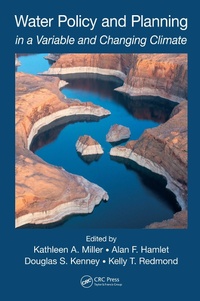
Water Policy and Planning in a Variable and Changing Climate
Published on 19. December 2017
452 pages
978-1-4822-2798-7 (ISBN)
Description

Water Policy and Planning in a Variable and Changing Climate addresses the current challenges facing western water planners and policy makers in the United States and considers strategies for managing water resources and related risks in the future. Written by highly-regarded experts in the industry, the book offers a wealth of experience, and explains the physical, socioeconomic, and institutional context for western water resource management. The authors discuss the complexities of water policy, describe the framework for water policy and planning, and identify many of the issues surrounding the subject.
A provocative examination of policy issues surrounding western water resources, this book:
Considers the implications of natural climate variability and anthropogenic climate change for the region's water resources, and explains limitations on the predictability of local-scale changes
Stresses linkages between climate patterns and weather events, and related hydrologic impacts
Describes the environmental consequences of historical water system development and the challenges that climate change poses for protection of aquatic ecosystems
Examines coordination of drought management by local, state and national government agencies
Includes insights on planning for climate change adaptation from case studies across the western United States
Discusses the challenges and opportunities in water/energy/land system management, and its prospects for developing climate change response strategies
Presents evidence of changes in water scarcity and flooding potential in the region and identifies a set of adaptation strategies to support the long-term sustainability of irrigated agriculture and urban communities
Draws upon Colorado's experience in defining rights for surface and tributary groundwater use to explain potential conflicts and challenges in establishing fair and effective coordination of water rights for these resources
Assesses the role of policy in driving flood losses
Explores policy approaches for achieving equitable and environmentally responsible planning outcomes despite multiple sources of uncertainty
Water Policy and Planning in a Variable and Changing Climate
describes patterns of water availability, existing policy problems and the potential impacts of climate change in the western United States, and functions as a practical reference for the student or professional invested in water policy and management.
A provocative examination of policy issues surrounding western water resources, this book:
Considers the implications of natural climate variability and anthropogenic climate change for the region's water resources, and explains limitations on the predictability of local-scale changes
Stresses linkages between climate patterns and weather events, and related hydrologic impacts
Describes the environmental consequences of historical water system development and the challenges that climate change poses for protection of aquatic ecosystems
Examines coordination of drought management by local, state and national government agencies
Includes insights on planning for climate change adaptation from case studies across the western United States
Discusses the challenges and opportunities in water/energy/land system management, and its prospects for developing climate change response strategies
Presents evidence of changes in water scarcity and flooding potential in the region and identifies a set of adaptation strategies to support the long-term sustainability of irrigated agriculture and urban communities
Draws upon Colorado's experience in defining rights for surface and tributary groundwater use to explain potential conflicts and challenges in establishing fair and effective coordination of water rights for these resources
Assesses the role of policy in driving flood losses
Explores policy approaches for achieving equitable and environmentally responsible planning outcomes despite multiple sources of uncertainty
Water Policy and Planning in a Variable and Changing Climate
describes patterns of water availability, existing policy problems and the potential impacts of climate change in the western United States, and functions as a practical reference for the student or professional invested in water policy and management.
Reviews / Votes
"... presents a synthesis of what leading scientists, lawyers, political scientists and other water professionals know about the likely adverse impacts on the region and how the West might make the hard choices to cope with its changed climate. The book covers the latest scientific understanding of climate change and its impact on the region's hydrology. It gives equal weight to both ends of the risk spectrum-stressed water availability for consumptive and non-consumptive environmental uses as well as more extreme flood events. ... essential reading for all water professionals and anyone interested in the fate of the American West."-Dan Tarlock, Chicago-Kent College of Law, Illinois Institute of Technology, USA
"We have always lived with considerable variability in water supply in the western United States. Now the range of uncertainty in water supply planning has increased markedly as a consequence of climate change. This new book provides valuable contributions from a wide array of perspectives to help us better understand the challenges we now face and the responses that will be necessary under these conditions."
-Lawrence J. MacDonnell, Senior Fellow, Getches-Wilkinson Center, University of Colorado, Boulder, USA
"... the contributors embrace uncertainty in the physical and social systems shaping future water options. This is liberating because it enables new ways of thinking about adaptively managing water sector risks under climate change. They also provide well-grounded and thoughtful critiques of the most significant technical and policy challenges ahead. Most importantly, they give hope to those faced with the daunting task of reforming water planning by giving plenty of examples of how this can be done in practice."
-Professor Robert L. Wilby, Department of Geography, Loughborough University, Leicestershire, UK
More details
Series
Language
English
Place of publication
London
United Kingdom
Publishing group
Taylor & Francis Ltd
Target group
College/higher education
Professional and scholarly
This book is intended for academics and senior graduate and undergraduate students in environmental management, natural resource economics, policy sciences, environmental law and related fields and water resource and environmental managers. It would also be helpful to professionals and experts involved in stream restoration and watershed management, public policy professionals and citizens interested in water resource management.
Illustrations
62 s/w Abbildungen, 20 farbige Abbildungen, 22 s/w Tabellen
22 Tables, black and white; 20 Illustrations, color; 62 Illustrations, black and white
File size
17,54 MB
ISBN-13
978-1-4822-2798-7 (9781482227987)
Copyright in bibliographic data and cover images is held by Nielsen Book Services Limited or by the publishers or by their respective licensors: all rights reserved.
Schweitzer Classification
Other editions
Additional editions
Kathleen A. Miller | Alan F. Hamlet | Douglas S. Kenney
Water Policy and Planning in a Variable and Changing Climate
in a Variable and Changing Climate
Book
03/2018
1st Edition
CRC Press
€122.00
Shipment within 10-20 days
Kathleen A. Miller | Alan F. Hamlet | Douglas S. Kenney
Water Policy and Planning in a Variable and Changing Climate
in a Variable and Changing Climate
Book
06/2016
1st Edition
CRC Press
€273.50
Article not available for order
Persons
Kathleen A. Miller is an economist working at the National Center for Atmospheric Research, in the Climate Science and Applications Program. She conducts research on climate impacts, vulnerability, and adaptation. Her work focuses especially on natural resource governance and adaptation planning under uncertainty and on modeling interactions between human strategic behavior and dynamic natural systems. She is the author of numerous papers on the management of water, fisheries, and other natural resources in the context of climate variability and prospective climate change.
Douglas S. Kenney has been with the University of Colorado's Getches-Wilkinson Center for Natural Resources, Energy and the Environment since 1996 where he directs the Western Water Policy Program. He researches and writes extensively on several water-related issues, including law and policy reform, river basin- and watershed-level planning, the design of institutional arrangements, water resource economics, and climate change adaptation. Dr. Kenney has also served as a consultant to a variety of local, state, multistate, and federal agencies, and has made presentations in 20 U.S. states, seven countries, and four continents.
Alan F. Hamlet is an assistant professor in the Department of Civil & Environmental Engineering & Earth Sciences, College of Engineering, at University of Notre Dame. Dr. Hamlet's research is focused on the integrated modeling of climate variability and change, surface water hydrology, water resource systems, the built environment, and aquatic and terrestrial ecosystems. He has been actively involved in stakeholder education and outreach programs in the Pacific Northwest for many years and is a leader in the development of decision support systems and sustainable climate change adaptation strategies in the water sector.
Kelly T. Redmond is the deputy director and regional climatologist at the Western Regional Climate Center at the Desert Research Institute, Reno, Nevada. He has played an active role nationally in development of the climate services sector. Dr. Redmond is currently working on several projects for the National Integrated Drought Information System (NIDIS). He is closely involved in the NOAA Regional Integrated Sciences and Assessment (RISA) Program and the Department of Interior Climate Science Center Program. He has also served on and contributed to approximately a dozen committees for the National Academy of Sciences and National Research Council.
Douglas S. Kenney has been with the University of Colorado's Getches-Wilkinson Center for Natural Resources, Energy and the Environment since 1996 where he directs the Western Water Policy Program. He researches and writes extensively on several water-related issues, including law and policy reform, river basin- and watershed-level planning, the design of institutional arrangements, water resource economics, and climate change adaptation. Dr. Kenney has also served as a consultant to a variety of local, state, multistate, and federal agencies, and has made presentations in 20 U.S. states, seven countries, and four continents.
Alan F. Hamlet is an assistant professor in the Department of Civil & Environmental Engineering & Earth Sciences, College of Engineering, at University of Notre Dame. Dr. Hamlet's research is focused on the integrated modeling of climate variability and change, surface water hydrology, water resource systems, the built environment, and aquatic and terrestrial ecosystems. He has been actively involved in stakeholder education and outreach programs in the Pacific Northwest for many years and is a leader in the development of decision support systems and sustainable climate change adaptation strategies in the water sector.
Kelly T. Redmond is the deputy director and regional climatologist at the Western Regional Climate Center at the Desert Research Institute, Reno, Nevada. He has played an active role nationally in development of the climate services sector. Dr. Redmond is currently working on several projects for the National Integrated Drought Information System (NIDIS). He is closely involved in the NOAA Regional Integrated Sciences and Assessment (RISA) Program and the Department of Interior Climate Science Center Program. He has also served on and contributed to approximately a dozen committees for the National Academy of Sciences and National Research Council.
Editor
Department of Civil and Environmental Engineering and Earth Sciences, University of Notre Dame, Indiana, USA
The Getches-Wilkinson Center for Natural Resources, Energy, and the Environment, University of Colorado, Boulder, USA
Western Regional Climate Center, at the Desert Research Institute, Nevada, USA
Content
OVERVIEW AND BACKGROUND. WATER POLICY ISSUES RELATED TO CLIMATE VARIABILITY AND CHANGE. CASE STUDIES: REGIONAL ISSUES AND INSIGHTS ON ADAPTATION PATHWAYS.
