
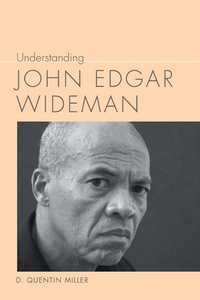
Understanding John Edgar Wideman
Description
Alles über E-Books | Antworten auf Fragen rund um E-Books, Kopierschutz und Dateiformate finden Sie in unserem Info- & Hilfebereich.
A complete overview of an innovative and analytical author who rose from poverty
Among the many gifted African American authors who emerged in the 1970s and 80s, John Edgar Wideman is one of the most challenging and innovative. His analytical mind can turn almost any topic into an intellectual adventure, whether it is playground basketball, the blues, the prison experience, father-son relationships, or the stories he lived or heard growing up in the impoverished section of Pittsburgh known as Homewood. In Understanding John Edgar Wideman, D. Quentin Miller offers a comprehensive overview of Wideman's writings, which range from the critically acclaimed books of the Homewood Trilogy to lesser known writings such as the early novels A Glance Away and The Lynchers. Notably Miller includes the first scholarly analysis of Writing to Save a Life, Wideman's recently published meditation on the military trial and execution of the father of civil rights martyr Emmett Till.
In his fiction, nonfiction, and works that artfully combine both forms, Wideman has employed a multilayered and often difficult writing style in order to explore a wide range of topics. Miller tackles such topics as African American folk history, the intersection of personal and public history, the confluence of oral and written traditions, and the quest for meaning in nihilistic urban settings where black families struggle against crime, poverty, and despair. Miller also shows how Wideman's singular personal history is interwoven into his writings. His impressive accomplishments, including an Ivy League education and numerous literary honors, have come alongside family tragedies. By the time his sixth novel was published, both his brother and son were serving life sentences for murder, a source of anguish that he wrestled with in Brothers and Keepers and Fatheralong.
Wideman writes with such authority on so many subjects that readers frequently have no idea what to expect with a new publication. Understanding John Edgar Wideman is thus a necessary guide to a prolific, varied, and essential oeuvre.
All prices
More details
Other editions
Additional editions
Person
D. Quentin Miller chairs the Department of English at Suffolk University in Boston and is the author, editor, or coeditor of ten books, including, most recently, The Routledge Introduction to African American Literature. His interest in Wideman stemmed from teaching writing in prisons in the 1990s, which in turn led to a fascination with works by prisoners and about the prison experience.
Content
- Cover
- UNDERSTANDING JOHN EDGAR WIDEMAN
- Title
- Copyright
- Dedication
- CONTENTS
- Series Editor's Preface
- Acknowledgments
- Chapter 1 Understanding John Edgar Wideman
- Chapter 2 The First Three Novels
- Chapter 3 Homewood Bound
- Chapter 4 Brothers and Fathers
- Chapter 5 Enter Philadelphia
- Chapter 6 Creolizing Genres
- Chapter 7 Wideman's Short Fiction
- Notes
- Bibliography
- Index

System requirements
File format: ePUB
Copy protection: Adobe-DRM (Digital Rights Management)
System requirements:
- Computer (Windows; MacOS X; Linux): Install the free reader Adobe Digital Editions prior to download (see eBook Help).
- Tablet/smartphone (Android; iOS): Install the free app Adobe Digital Editions or the app PocketBook before downloading (see eBook Help).
- E-reader: Bookeen, Kobo, Pocketbook, Sony, Tolino and many more (not Kindle).
The file format ePub works well for novels and non-fiction books – i.e., „flowing” text without complex layout. On an e-reader or smartphone, line and page breaks automatically adjust to fit the small displays.
This eBook uses Adobe-DRM, a „hard” copy protection. If the necessary requirements are not met, unfortunately you will not be able to open the eBook. You will therefore need to prepare your reading hardware before downloading.
Please note: We strongly recommend that you authorise using your personal Adobe ID after installation of any reading software.
For more information, see our ebook Help page.
File format: PDF
Copy-Protection: Adobe-DRM (Digital Rights Management)
System requirements:
- Computer (Windows; MacOS X; Linux): Install the free reader Adobe Digital Editions prior to download (see eBook Help).
- Tablet/smartphone (Android; iOS): Install the free app Adobe Digital Editions or the app PocketBook before downloading (see eBook Help).
- E-reader: Bookeen, Kobo, Pocketbook, Sony, Tolino and many more (only limited: Kindle).
The file format PDF always displays a book page identically on any hardware. This makes PDF suitable for complex layouts such as those used in textbooks and reference books (images, tables, columns, footnotes). Unfortunately, on the small screens of e-readers or smartphones, PDFs are rather annoying, requiring too much scrolling.
This eBook uses Adobe-DRM, a „hard” copy protection. If the necessary requirements are not met, unfortunately you will not be able to open the eBook. You will therefore need to prepare your reading hardware before downloading.
Please note: We strongly recommend that you authorise using your personal Adobe ID after installation of any reading software.
For more information, see our eBook Help page.
File format: ePUB
Copy protection: Watermark-DRM (Digital Rights Management)
System requirements:
- Computer (Windows; MacOS X; Linux): Use a reading software that can process the file format ePUB: e.g., Adobe Digital Editions or FBReader – both free (see eBook Help).
- Tablet/Smartphone (Android; iOS): Before downloading, install the free app Adobe Digital Editions (see eBook Help).
- E-reader: Bookeen, Kobo, Pocketbook, Sony, Tolino and many more (not Kindle).
The file format ePUB works well for novels and non-fiction books – i.e., „flowing” text without complex layout. On an e-reader or smartphone, line and page breaks automatically adjust to fit the small displays.
This eBook uses Watermark-DRM, a „soft” copy protection. This means that there are no technical restrictions to prevent illegal distribution. However, there is a personalised watermark embedded in the eBook that can be used to identify the purchaser of the eBook in the event of misuse and to provide evidence for legal purposes.
For more information, see our eBook Help page.
