

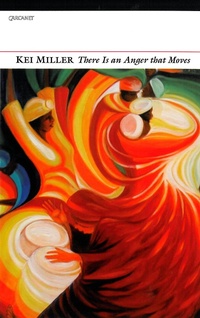
There is an Anger That Moves
Published on 27. July 2012
96 pages
978-1-84777-602-0 (ISBN)
Description

The six sequences of There Is an Anger that Moves travel from Jamaica to England and back. A mother's heart is broken; men fall in love secretly; people dance until they die. Religion haunts these disbelieving poems which move sometimes to the measure of a hymn, sometimes to the cadence of a Baptist sermon. Each swells with its own conviction, even when that conviction is doubt. Miller makes us believe in the power of unexpected things: the colour orange, broken coffins, ice cream and in the transforming power of poetry.
From this book Kei Miller emerges as one of the most compelling and subtle new voices from the Caribbean.
From this book Kei Miller emerges as one of the most compelling and subtle new voices from the Caribbean.
Reviews / Votes
'Miller's charming second collection [There Is an Anger that Moves] is an affectionately jaunty glimpse of a life caught between the cold and baffling England he has adopted and the fiery warmth of his Jamaican home.'No. 7 in 'The Ten Best New poetry collections' - The Independent, 2007 'Raise high the roofbeams, here comes a strong new presence in poetry...Kei Miller's is a voice we will hear much more of, for it speaks and sings with rare confidence and authority.'
Lorna Goodison 'Some of the most exciting poetry I've read in years. Radiant utterance that speaks of island experiences and gender politics from a deep well of understanding, with empathy, humour and insight. An extraordinary new voice singing with clarity and grace.'
Olive Senior In the Jamaican poet Kei Miller's second collection, published since his move to the UK, the first and strongest sequence, 'In This New Country', is a tribute to the strangeness of arriving in a Britain already colonised by Jamaicans 'in reverse' (the term is Louise Bennett's): 'Walking through Peckham / in London, West Moss Road in Manchester, / you pass green and yellow shops / where tie-headwomen bargain over the price / of dasheen'. Similar contradictions abound. The speaker, who is only a mediocre dancer back home, 'can dance / dances that have fallen out / of season, like mangoes in February' yet be adored as some exotic god: 'in this country, you move like fire / amongst the cane, you move like sugar / and like ocean'. The collection is full of such haunting images, and as in the prolific Miller's earlier books (the short stories in Fear of Stones and a previous collection of poems, Kingdom of Empty Bellies) the sacred and the profane commingle: 'you say bomboclawt / softly, like a prayer'. Most shockingly, a whimsical rhapsody on the 'revolutionary properties' of Ben & Jerry's ice cream suddenly plunges into darker terrain:
Rory's story begins in New York
in a parlour that does not sell swirls
or double cones, one flavour atop another.
A sign at the door says: No Mixing!
And when he was in love with a black man
they went to this store and thought
the sign was for them -
that the owner was upset not because
they were gay, but because one was a nigger-lover,
and the other a nigger.
This ability to reveal seething and hybrid impulses beneath the mask of identity is Miller's greatest strength in this poised, sardonic volume of poems. Though at times overly self-conscious, his writing shows that Caribbean poetry can move beyond the strictures of modernism without ghettoising itself into either the 'black' or 'performance' markets. In the Jamaican poet Kei Miller's second collection, published since his move to the UK, the first and strongest sequence, 'In This New Country', is a tribute to the strangeness of arriving in a Britain already colonised by Jamaicans 'in reverse' (the term is Louise Bennett's): 'Walking through Peckham / in London, West Moss Road in Manchester, / you pass green and yellow shops / where tie-headwomen bargain over the price / of dasheen'. Similar contradictions abound. The speaker, who is only a mediocre dancer back home, 'can dance / dances that have fallen out / of season, like mangoes in February' yet be adored as some exotic god: 'in this country, you move like fire / amongst the cane, you move like sugar / and like ocean'. The collection is full of such haunting images, and as in the prolific Miller's earlier books (the short stories in Fear of Stones and a previous collection of poems, Kingdom of Empty Bellies) the sacred and the profane commingle: 'you say bomboclawt / softly, like a prayer'. Most shockingly, a whimsical rhapsody on the 'revolutionary properties' of Ben & Jerry's ice cream suddenly plunges into darker terrain:
Rory's story begins in New York
in a parlour that does not sell swirls
or double cones, one flavour atop another.
A sign at the door says: No Mixing!
And when he was in love with a black man
they went to this store and thought
the sign was for them -
that the owner was upset not because
they were gay, but because one was a nigger-lover,
and the other a nigger.
This ability to reveal seething and hybrid impulses beneath the mask of identity is Miller's greatest strength in this poised, sardonic volume of poems. Though at times overly self-conscious, his writing shows that Caribbean poetry can move beyond the strictures of modernism without ghettoising itself into either the 'black' or 'performance' markets.
More details
Language
English
Place of publication
United Kingdom
Publishing group
Carcanet Press Ltd
File size
0,53 MB
ISBN-13
978-1-84777-602-0 (9781847776020)
Copyright in bibliographic data and cover images is held by Nielsen Book Services Limited or by the publishers or by their respective licensors: all rights reserved.
Schweitzer Classification
Other editions
Additional editions

Kei Miller
There is an Anger That Moves
Book
10/2007
Carcanet Press Ltd
€13.00
Shipment within 3-4 weeks
Person
Kei Miller was born in Jamaica in 1978 and has written several books across a range of genres. His 2014 collection, The Cartographer Tries to Map a Way to Zion, won the Forward Prize for Best Collection while his 2017 Novel, Augustown, won the Bocas Prize for Caribbean Literature, the Prix Les Afriques, and the Prix Carbet de la Caraibe et du Tout-Monde. He is also an award-winning essayist. In 2010, the Institute of Jamaica awarded him the Silver Musgrave medal for his contributions to Literature and in 2018 he was awarded the Anthony Sabga medal for Arts & Letters. Kei has an MA in Creative Writing from Manchester Metropolitan University and a PhD in English Literature from the University of Glasgow. He has taught at the Universities of Glasgow, Royal Holloway and Exeter. He is the 2019 Ida Beam Distinguished Visiting Professor to the University of Iowa and is a Fellow of the Royal Society of Literature.
Author photo (c) Christine Fourie.
Kei Miller has a page on the Poetry Archive website, where you can listen to recordings of his poetry and access other useful resources. Click here.
Author photo (c) Christine Fourie.
Kei Miller has a page on the Poetry Archive website, where you can listen to recordings of his poetry and access other useful resources. Click here.
