

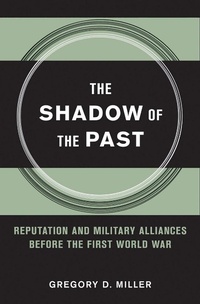
The Shadow of the Past
Reputation and Military Alliances Before the First World War
Published on 9. December 2011
248 pages
978-0-8014-6460-7 (ISBN)
Description

In The Shadow of the Past, Gregory D. Miller examines the role that reputation plays in international politics, emphasizing the importance of reliability-confidence that, based on past political actions, a country will make good on its promises-in the formation of military alliances. Challenging recent scholarship that focuses on the importance of credibility-a state's reputation for following through on its threats-Miller finds that reliable states have much greater freedom in forming alliances than those that invest resources in building military force but then use it inconsistently.
To explore the formation and maintenance of alliances based on reputation, Miller draws on insights from both political science and business theory to track the evolution of great power relations before the First World War. He starts with the British decision to abandon "splendid isolation" in 1900 and examines three crises-the First Moroccan Crisis (1905-6), the Bosnia-Herzegovina Crisis (1908-9), and the Agadir Crisis (1911)-leading up to the war. He determines that states with a reputation for being a reliable ally have an easier time finding other reliable allies, and have greater autonomy within their alliances, than do states with a reputation for unreliability. Further, a history of reliability carries long-term benefits, as states tend not to lose allies even when their reputation declines.
To explore the formation and maintenance of alliances based on reputation, Miller draws on insights from both political science and business theory to track the evolution of great power relations before the First World War. He starts with the British decision to abandon "splendid isolation" in 1900 and examines three crises-the First Moroccan Crisis (1905-6), the Bosnia-Herzegovina Crisis (1908-9), and the Agadir Crisis (1911)-leading up to the war. He determines that states with a reputation for being a reliable ally have an easier time finding other reliable allies, and have greater autonomy within their alliances, than do states with a reputation for unreliability. Further, a history of reliability carries long-term benefits, as states tend not to lose allies even when their reputation declines.
Reviews / Votes
A volume in the series "Cornell Studies in Security Affairs", The Shadow of the Past is an important read for anyone interested in the origins of the Great War or in the general problem of how wars begin.(The NYMAS Review)
More details
Series
Language
English
Place of publication
Ithaca
United States
Product notice
Reflowable
Illustrations
2 line drawings, 11 tables, 1 chart/graph - 1 Line drawings, black and white
ISBN-13
978-0-8014-6460-7 (9780801464607)
Copyright in bibliographic data and cover images is held by Nielsen Book Services Limited or by the publishers or by their respective licensors: all rights reserved.
Schweitzer Classification
Other editions
Additional editions
Gregory D. Miller
The Shadow of the Past
Reputation and Military Alliances Before the First World War
Book
12/2011
Cornell University Press
€64.38
Shipment within 10-20 days
Person
Gregory D. Miller has taught courses in international relations and terrorism at the College of William & Mary and the University of Oklahoma and served as director of the Summer Workshop on Teaching about Terrorism. He currently teaches at Oklahoma State University.
