

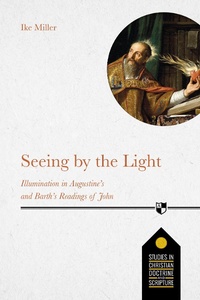
Seeing by the Light
Description

How can we understand God's revelation to us?
Throughout the church's history, theologians have often answered this question by appealing to a doctrine of illumination whereby the Holy Spirit shapes our knowledge and understanding of Scripture. Without denying the role of the Holy Spirit or the cognitive role of illumination, Ike Miller casts a broader vision of divine illumination and its role in the Christian life. In his constructive approach, Miller argues for a fully trinitarian view of illumination that forms not just our intellect, but also appeals to the affections and encourages our ethical action.
In order to develop this theology of illumination, Miller explores both Augustine's and Karl Barth's readings of the Gospel and Epistles of John, including Barth's previously untranslated lectures on the Gospel of John. In the light of his careful study of both the Johannine literature and the theologies of two giants from Christian history, Miller contends for a doctrine of illumination whereby we are enabled to know God and participate in Christ by the power of the Holy Spirit.
More details
Other editions
Additional editions
Person
Lead pastor and church planter of Bright City Church. He lives in Durham, North Carolina, with his wife and their three children. PhD, Trinity Evangelical Divinity School.
Content
- Intro
- Acknowledgments
- Series Introduction
- Studies in Christian Doctrine and Scripture (SCDS)
- Abbreviations
- ONE
- Seeing by the Light
- Structure
- Two Moments of Illumination
- Objectives
- A Final Note
- Part One
- Augustine's Reading of John and Doctrine of Illumination
- TWO
- Augustine's Method of Theological Interpretation
- Augustine's Theory of Representation
- The Inspiration of Scripture, the Communication of Illumination
- Augustine's Priorities in Interpretation
- History and Spiritual Interpretation
- Conclusion
- THREE
- Illumination in Augustine's Theological Interpretation of John
- Philosophical Considerations
- Incarnation and Illumination: An Introductory Note
- John 1:1-18
- Light and Logos in the Prologue: Some Preliminary Observations
- Illumination and Intellectus: Reordering the Soul
- The Salve of Illumination
- Conclusion
- FOUR
- Augustine's Doctrine of Illumination
- Proposals for Augustine's Doctrine of Illumination
- The Biblical/Systematic Theological Contribution of the Homilies
- Conclusion: Participation in the Divine Light
- Part Two
- Barth's Reading of John and Doctrine of Illumination
- FIVE
- Barth's Method of Theological Interpretation
- Backstory: Barth's Hermeneutical Revolution
- Key Elements of Barth's Interpretive Method in John
- "Landing" on an Interpretation
- Method and Meaning: A Demonstration
- Conclusion
- SIX
- Illumination in Barth's Theological Interpretation of John
- John 1:1-18
- John 2:23-3:21
- John 4:1-42
- John 8:12
- John 9
- Conclusion
- SEVEN
- Barth's Doctrine of Illumination
- The Root of the Doctrine of Illumination
- The Nature of the Logos as Light
- Illumination and Revelation
- Pneumatology and Christology
- The Challenge of a Barthian Doctrine of Illumination
- Illumination and Regeneration
- Participation as Repetition
- Illumination and the Bible
- Conclusion
- Part Three
- A Theology of Illumination
- EIGHT
- John as a Narrative of Illumination
- Illumination and the Doctrine of God
- Coming to See the Light and Walking in It: Regeneration, Faith, and Obedience in Johannine Theology
- Excursus
- The Economy of Illumination in the Broader Canon
- NINE
- Coming to See the Light and Walking in It
- Economy
- Participation
- Illumination
- Conclusion
- TEN
- The Human Experience of Illumination
- The Event of Illumination in the Reading of Scripture
- The Event of Illumination in Human Experience
- Determination
- Acknowledgment
- Conclusion
- Bibliography
- Search items for authors
- Search items for subjects
- Search items for Scripture references
- Notes
