

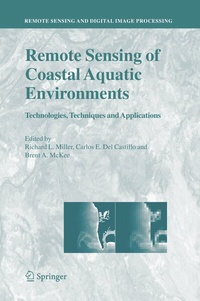
Remote Sensing of Coastal Aquatic Environments
Description

Coastal waters are important ecological systems and vital assets for many nations. Coastal waters are also complex, dynamic environments where a vast array of coupled biological, chemical, geological, and physical processes occurs over multiple time and space scales. The optical environment of coastal waters is particularly complex. There is considerable interest in studying coastal waters to gain a better understanding of earth system processes for climatic change research or environmental factors for management decisions. Consequently, there is a need for robust, effective technologies and methods for studying these important complex environments.
Remote sensing from aircraft and space-based platforms offers unique large-scale synoptic data to address the intricate nature of coastal waters. However, many researchers wishing to apply remote sensing to a dynamic coastal environment are faced with the challenge of learning a technology laden with new and often confusing terminology, data, and methods of processing and analysis. To gain an adequate understanding of remote sensing generally involves scouring countless technical manuals, reports, and scientific papers. Hence the major goal of writing this work was to produce a comprehensive resource for those involved in various studies of coastal aquatic environments. With its primary focus on optical remote sensing using passive instruments, the editors have indeed succeeded in creating a book the scientific community has been waiting for.
More details
Other editions
Additional editions
Persons
Dr. Richard Miller received the Ph.D. in biological oceanography from North Carolina State University in 1984. He is currently the Chief Scientist at the National Aeronautics and Space Administration (NASA) at the Stennis Space Center. His research interests include the role that river-dominated coastal margins play in the global cycling of materials including carbon. He is involved in developing field instruments and computational technologies for the application of remote sensing to coastal environments. He has co-authored more than 80 papers in international journals and conferences.
Dr. Carlos Del Castillo received his Ph.D. in Oceanography from the Department of Marine Science, University of South Florida. In his dissertation work he described the optical properties of Colored Dissolved Organic Matter in waters of the Eastern Caribbean, Gulf of Mexico and the Arabian Sea. Current research interest include how changes in chemical composition of Colored Dissolved Organic Matter affect optical properties of water, and the use of remote sensing to study transport of organic carbon by river plumes. Dr. Del Castillo is a researcher at NASA Stennis Space Center.
Brent McKee is a graduate of the University of North Carolina-Chapel Hill with a Ph.D. from North Carolina State University. He is currently a Full Professor at Tulane University.
