

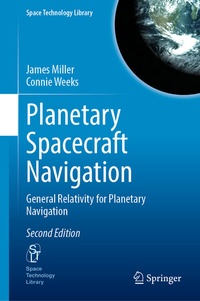
Planetary Spacecraft Navigation
Description

In this new edition, the authors James Miller and Connie Weeks dive deeper into how computer programming has assisted with planetary spacecraft navigation; evaluating real-world results and relying on complex mathematical theory to observe advancements made in this rapidly accelerating field.
This textbook introduces the theories and practical procedures used in planetary spacecraft navigation. Written by a former member of NASA's Jet Propulsion Laboratory (JPL) navigation team with his co-author, it delves into the mathematics behind modern digital navigation programs, as well as the numerous technological resources used by JPL as a key player in the field.
In addition, the text offers an analysis of navigation theory application in recent missions, with the goal of showing students the relationship between navigation theory and the real-world orchestration of mission operations.
More details
Other editions
Additional editions
Persons
James Miller:
James Miller worked as the Assistant Navigation Team Chief on NASA's Viking Mission to Mars in 1976. In 2000, he received the Mechanics and Control of Flight medal from the American Institute of Aeronautics and Astronautics (AIAA) for his design of the navigation system used on the first spacecraft to orbit and land on the asteroid Eros. Furthermore, Miller designed a trajectory to leave Earth and orbit the Moon with no propulsive maneuvers whatsoever. This was the first practical solution of the four-body problem, and it has since been used on the space exploration missions Hiten, Genesis, and Grail.
Connie Weeks:
Connie Weeks' interest in control theory and estimation theory while working towards her undergraduate degree at Harvey Mudd College lead her to ultimately earn a PhD in mathematics from the University of Southern California. Her deep passion for undertaking complex tasks with the use of mathematical analysis lead her to understand the technicalities involved with orbit determination and spacecraft navigation. This was exactly the kind of problem solving required to adapt to her crucial roles with NASA JPL where she worked on shape estimation for two and three dimensional systems. Connie later went off to teach mathematics at Loyola Marymount University and published several research papers with the support of the NASA Jove research grant.
Content
Chapter 1 Equations of Motion.- Chapter 2 Force Models.- Chapter 3 Trajectory Design.- Chapter 4 Trajectory Optimization.- Chapter 5 Probability and Statistics.- Chapter 6 Orbit Determination.- Chapter 7 Measurements and Calibrations.- Chapter 8 Navigation Operations.- Chapter 9 Einstein Field Equations.- Chapter 10 Schwarzschild Solution for Spherical Symmetry.- Chapter 11 Comparison of Numerical Integration and Analytic Solutions.- Chapter 12 General Relativity Time Delay Experiment.- Chapter 13 Navigation Analysis.- Chapter 14 Navigation System Summary.
