

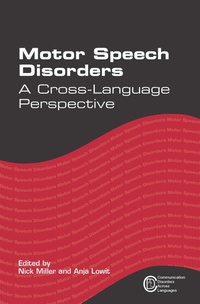
Motor Speech Disorders
A Cross-Language Perspective
Published on 21. July 2014
280 pages
978-1-78309-234-5 (ISBN)
Description

Motor speech disorders are a common accompaniment of a whole range of neurological conditions, from stroke, brain injury and Parkinson's disease through to many rarer conditions. This book aims to aid understanding of the nature of motor speech disorders from a cross-language perspective, in contrast to the largely English-centric nature of research and practice recommendations to date. The book looks not just at how these motor speech disorders are assessed and treated in other countries, but also examines how underlying speech impairments differ according to the language someone speaks. The book studies the underlying neurological, neurophysiological and neurophonetic characteristics of motor speech disorders in different language contexts, and discusses the implications these have for clinical rehabilitation. This significantly adds to debates around the theoretical understanding and clinical management of motor speech disorders.
Reviews / Votes
This text will surely become regarded as a seminal text in the area of Motor Speech Disorders (MSDs). Despite the clear emphasis on providing cross-language insights, the researcher or clinician whose work is very much grounded in English-speakers would stand to benefit hugely from reviewing the opening chapters to gain new insight and direction into linguistic approaches to the description, diagnosis and treatment of MSDs. -- Christopher Plant, Griffith University, Australia * LINGUIST List, 26.2999, 2015 * This is a fascinating, well-written and informative book...Reading this has left me energised, enthusiastic and excited about the potential in this area. The authors highlight that further research is essential across many languages. This will be exciting and innovative, so watch this space. -- Sandra Polding, SLT, National Child Psychiatry In-Patient Unit for Scotland * Bulletin of the Royal College of Speech Language Therapists, April 2015 * This is a ground-breaking seminal work which assesses the state of knowledge in a wide variety of languages, lays the theoretical foundations for future research and is a much-needed complement to research in aphasia. It greatly enriches our understanding of the representation and organization of speech and language in the human brain. * Jack Ryalls, University of Central Florida, USA * The real goal of speech motor control is communication, so to understand motor speech disorders we have to study them in context - in the full diversity of human languages in which they arise. This ground-breaking, engaging book will foster identification of universal and language-specific symptoms of motor speech disorders, and stimulate research on their assessment and treatment. * Karen Croot, The University of Sydney, Australia *More details
Series
Language
English
Place of publication
Bristol
United Kingdom
Publishing group
Channel View Publications Ltd
Target group
Professional and scholarly
ISBN-13
978-1-78309-234-5 (9781783092345)
Copyright in bibliographic data and cover images is held by Nielsen Book Services Limited or by the publishers or by their respective licensors: all rights reserved.
Schweitzer Classification
Other editions
Additional editions
Book
07/2014
Multilingual Matters
€151.50
Shipment within 10-20 days
Persons
Nick Miller is Professor of Motor Speech Disorders at Newcastle University, UK. His main research interests include apraxia, dysarthria and dysphagia and the psychosocial impact of neurogenic communication disorders.
Anja Lowit is Reader in Speech and Language Therapy at Strathclyde University, UK. Her research interests include dysarthria, prosodic disorders, acoustic analysis of disordered speech, treatment effectiveness and the development of outcome measures.
Anja Lowit is Reader in Speech and Language Therapy at Strathclyde University, UK. Her research interests include dysarthria, prosodic disorders, acoustic analysis of disordered speech, treatment effectiveness and the development of outcome measures.
Content
List of contributors
1. Nick Miller and Anja Lowit: Foreword
Section 1
2. Nick Miller, Anja Lowit and Anja Kuschmann: Introduction: Cross-Language Perspectives on Motor Speech Disorders
3. Anja Lowit, Nick Miller and Anja Kuschmann: Motor Speech Disorders: What are they?
4. Anja Kuschmann, Anja Lowit and Nick Miller: Motor Speech Disorders: Issues in Assessment and Management
5. Michael Vitevitch, Kit Ying Chan and Rutherford Goldstein: Using English as a "Model Language" to Understand Language Processing
6. Martha Tyrone: Cross-Language Studies in Deaf Signers
7. Marina Laganaro and Mary Overton Vennett: Apraxia of Speech in Bilingual Speakers as a Window into the Study of Bilingual Speech Motor Control
8. Dora Colaco, Ana Mineiro and Alexandre Castro-Caldas: Phonological and Speech Output in Adult Nonliterate Groups
Section 2
9. Anita van der Merwe and Mia LeRoux: Dysarthria and Apraxia of Speech in Selected African Languages: Zulu and Tswana
10. Tara Whitehill and Joan Ma: Motor Speech Disorders in Chinese
11. Roel Jonkers, Hayo Terband, and Ben Maassen: Diagnosis and Therapy in Adult Acquired Dysarthria and Apraxia of Speech in Dutch
12. Danielle Duez: Some Segmental and Prosodic Aspects of Motor Speech Disorders in French
13. Bettina Brendel and Ingrid Aichert: German Language Contributions to the Understanding of Acquired Motor Speech Disorders
14. R. Manjula and Naresh Sharma: Motor Speech Disorders in Languages of the Indian Subcontinent: Some Perspectives from Hindi and Kannada
15. Masaki Nishio: Dysarthria and Apraxia of Speech in Japanese Speakers
16. Karin Zazo Ortiz, Maysa Luchesi Cera, and Simone dos Santos Barreto: The Nature, Assessment and Treatment of Dysarthria and Apraxia of Speech in Portuguese
17. Natalia Melle Hernandez, Maria-Teresa Martin-Aragoneses and Carlos Gallego: The Nature, Assessment and Treatment of Dysarthria and Apraxia of Speech in Spanish
18. Ellika Schalling: The Nature, Assessment and Treatment of Dysarthria and Apraxia of Speech in Swedish
19. Anja Lowit and Nick Miller: Afterword
Index
1. Nick Miller and Anja Lowit: Foreword
Section 1
2. Nick Miller, Anja Lowit and Anja Kuschmann: Introduction: Cross-Language Perspectives on Motor Speech Disorders
3. Anja Lowit, Nick Miller and Anja Kuschmann: Motor Speech Disorders: What are they?
4. Anja Kuschmann, Anja Lowit and Nick Miller: Motor Speech Disorders: Issues in Assessment and Management
5. Michael Vitevitch, Kit Ying Chan and Rutherford Goldstein: Using English as a "Model Language" to Understand Language Processing
6. Martha Tyrone: Cross-Language Studies in Deaf Signers
7. Marina Laganaro and Mary Overton Vennett: Apraxia of Speech in Bilingual Speakers as a Window into the Study of Bilingual Speech Motor Control
8. Dora Colaco, Ana Mineiro and Alexandre Castro-Caldas: Phonological and Speech Output in Adult Nonliterate Groups
Section 2
9. Anita van der Merwe and Mia LeRoux: Dysarthria and Apraxia of Speech in Selected African Languages: Zulu and Tswana
10. Tara Whitehill and Joan Ma: Motor Speech Disorders in Chinese
11. Roel Jonkers, Hayo Terband, and Ben Maassen: Diagnosis and Therapy in Adult Acquired Dysarthria and Apraxia of Speech in Dutch
12. Danielle Duez: Some Segmental and Prosodic Aspects of Motor Speech Disorders in French
13. Bettina Brendel and Ingrid Aichert: German Language Contributions to the Understanding of Acquired Motor Speech Disorders
14. R. Manjula and Naresh Sharma: Motor Speech Disorders in Languages of the Indian Subcontinent: Some Perspectives from Hindi and Kannada
15. Masaki Nishio: Dysarthria and Apraxia of Speech in Japanese Speakers
16. Karin Zazo Ortiz, Maysa Luchesi Cera, and Simone dos Santos Barreto: The Nature, Assessment and Treatment of Dysarthria and Apraxia of Speech in Portuguese
17. Natalia Melle Hernandez, Maria-Teresa Martin-Aragoneses and Carlos Gallego: The Nature, Assessment and Treatment of Dysarthria and Apraxia of Speech in Spanish
18. Ellika Schalling: The Nature, Assessment and Treatment of Dysarthria and Apraxia of Speech in Swedish
19. Anja Lowit and Nick Miller: Afterword
Index
