

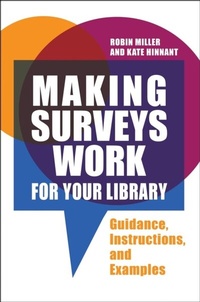
Making Surveys Work for Your Library
Guidance, Instructions, and Examples
1st Edition
Published on 1. December 2018
128 pages
978-1-4408-6108-6 (ISBN)
Description

Instead of using expensive off-the-shelf surveys or relying on a poorly worded survey, read Making Surveys Work for Your Library and design your own that collect actionable data.
Library listservs and websites are littered with examples of surveys that are too long, freighted with complex language, and generally poorly designed. The survey, however, is a widely used tool that has great potential if designed well. Libraries can implement surveys for a variety of purposes, including planning, program evaluation, collection development, and space design.
Making Surveys Work for Your Library: Guidance, Instructions, and Examples offers librarians a contemporary and practical approach to creating surveys that answer authentic questions about library users. Miller and Hinnant have experience designing, deploying, and analyzing quantitative and qualitative data from large-scale, web-based user surveys of library patrons as well as smaller survey instruments targeted to special populations. Here, they offer library professionals a guide to developing-and examples of-concise surveys that gather the data they need to make evidence-based decisions, define the scope of future research, and understand their patrons.
Library listservs and websites are littered with examples of surveys that are too long, freighted with complex language, and generally poorly designed. The survey, however, is a widely used tool that has great potential if designed well. Libraries can implement surveys for a variety of purposes, including planning, program evaluation, collection development, and space design.
Making Surveys Work for Your Library: Guidance, Instructions, and Examples offers librarians a contemporary and practical approach to creating surveys that answer authentic questions about library users. Miller and Hinnant have experience designing, deploying, and analyzing quantitative and qualitative data from large-scale, web-based user surveys of library patrons as well as smaller survey instruments targeted to special populations. Here, they offer library professionals a guide to developing-and examples of-concise surveys that gather the data they need to make evidence-based decisions, define the scope of future research, and understand their patrons.
More details
Edition
1. Auflage
Language
English
Place of publication
United States
Publishing group
Bloomsbury Publishing Plc
Target group
Interest Age: From 7 to 17 years
ISBN-13
978-1-4408-6108-6 (9781440861086)
Copyright in bibliographic data and cover images is held by Nielsen Book Services Limited or by the publishers or by their respective licensors: all rights reserved.
Schweitzer Classification
Other editions
Additional editions
Robin Miller | Kate Hinnant
Making Surveys Work for Your Library
Guidance, Instructions, and Examples
Book
12/2018
Libraries Unlimited Inc
€53.90
Shipment within 10-20 days
Persons
Robin Miller is associate professor and assessment and instruction librarian at the University of Wisconsin-Eau Claire, in Eau Claire, Wisconsin.
Kate Hinnant is associate professor and head of instruction and communication at the University of Wisconsin-Eau Claire, in Eau Claire, Wisconsin.
Kate Hinnant is associate professor and head of instruction and communication at the University of Wisconsin-Eau Claire, in Eau Claire, Wisconsin.
Content
Acknowledgmentsix
Chapter 1. The Value of Surveys, and Why They're Hard to Get Right
Chapter 2. Planning a Library Survey
Chapter 3. Survey Methods That Work for Libraries
Chapter 4. Scopes of Experience
Chapter 5. Writing Survey Questions
Chapter 6. Survey Populations
Chapter 7. Survey Distribution
Chapter 8. Analysis of Results
Chapter 9. Taking Action
Appendix A. Sample Demographic Questions
Appendix B. Sample Questions About Services
Appendix C. Sample Questions About Spaces
Appendix D. Sample Questions About Communication
Appendix E. Sample Questions About Collections
Appendix F. Sample Programming Questions
Appendix G. Additional Resources
References
Index
Chapter 1. The Value of Surveys, and Why They're Hard to Get Right
Chapter 2. Planning a Library Survey
Chapter 3. Survey Methods That Work for Libraries
Chapter 4. Scopes of Experience
Chapter 5. Writing Survey Questions
Chapter 6. Survey Populations
Chapter 7. Survey Distribution
Chapter 8. Analysis of Results
Chapter 9. Taking Action
Appendix A. Sample Demographic Questions
Appendix B. Sample Questions About Services
Appendix C. Sample Questions About Spaces
Appendix D. Sample Questions About Communication
Appendix E. Sample Questions About Collections
Appendix F. Sample Programming Questions
Appendix G. Additional Resources
References
Index
