

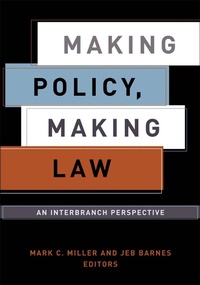
Making Policy, Making Law
Description

The functioning of the U.S. government is a bit messier than Americans would like to think. The general understanding of policymaking has Congress making the laws, executive agencies implementing them, and the courts applying the laws as written-as long as those laws are constitutional. Making Policy, Making Law fundamentally challenges this conventional wisdom, arguing that no dominant institution-or even a roughly consistent pattern of relationships-exists among the various players in the federal policymaking process. Instead, at different times and under various conditions, all branches play roles not only in making public policy, but in enforcing and legitimizing it as well. This is the first text that looks in depth at this complex interplay of all three branches.
The common thread among these diverse patterns is an ongoing dialogue among roughly coequal actors in various branches and levels of government. Those interactions are driven by processes of conflict and persuasion distinctive to specific policy arenas as well as by the ideas, institutional realities, and interests of specific policy communities. Although complex, this fresh examination does not render the policymaking process incomprehensible; rather, it encourages scholars to look beyond the narrow study of individual institutions and reach across disciplinary boundaries to discover recurring patterns of interbranch dialogue that define (and refine) contemporary American policy.
Making Policy, Making Law provides a combination of contemporary policy analysis, an interbranch perspective, and diverse methodological approaches that speak to a surprisingly overlooked gap in the literature dealing with the role of the courts in the American policymaking process. It will undoubtedly have significant impact on scholarship about national lawmaking, national politics, and constitutional law. For scholars and students in government and law-as well as for concerned citizenry-this book unravels the complicated interplay of governmental agencies and provides a heretofore in-depth look at how the U.S. government functions in reality.
More details
Other editions
Additional editions
Persons
Mark C. Miller is an associate professor and chair of the Department of Government and International Relations, and director of the Law and Society Program at Clark University, and author of The High Priests of American Politics: The Role of Lawyers in American Political Institutions.
Jeb Barnes is assistant professor in the Department of Political Science at the University of Southern California, and author of Overruled? Legislative Overrides, Pluralism, and Contemporary Court-Congress Relations.
Content
Contributors
Foreword
Judge Robert A. Katzmann
Acknowledgements
Part I: Setting the Stage: Themes and Concepts
Putting the Pieces Together: American Lawmaking from an Interbranch Perspective
Jeb Barnes and Mark C. Miller
1. American Courts and the Policy Dialogue: The Role of Adversarial Legalism
Robert A. Kagan
2. Adversarial Legalism, the Rise of Judicial Policymaking, and the Separation-of-Powers Doctrine
Jeb Barnes
Part II: A Closer Look at Interbranch Perspectives
3. The View of the Courts from the Hill: A Neoinstitutional Perspective
Mark C. Miller
4. The View from the President
Nancy Kassop
5. Courts and Agencies
R. Shep Melnick
Part III: Statutory Construction: The Interbranch Perspective Applied
6. The Supreme Court and Congress: Reconsidering the Relationship
Lawrence Baum and Lori Hausegger
7. The Judicial Implementation of Statutes: Three Stories about Courts and the Americans with Disabilities Act
Thomas F. Burke
8. The City of Boerne: Two Tales of One City
Stephen G. Bragaw and Mark C. Miller
Part IV: Constitutional Interpretation: The Interbranch Perspective Applied
9. Judicial Finality or an Ongoing Colloquy?
Louis Fisher
10. Constitutional Interpretation from a Strategic Perspective
Lee Epstein, Jack Knight, and Andrew D. Martin
11. Is Judicial Policymaking Countermajoritarian?
Neal Devins
12. Governance as Dialogue
Jeb Barnes and Mark C. Miller
Bibliography
