
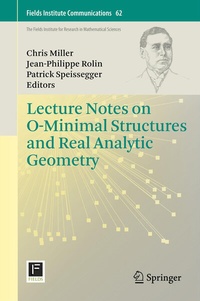
Lecture Notes on O-Minimal Structures and Real Analytic Geometry
Description
Alles über E-Books | Antworten auf Fragen rund um E-Books, Kopierschutz und Dateiformate finden Sie in unserem Info- & Hilfebereich.
This volume was produced in conjunction with the Thematic Program in o-Minimal Structures and Real Analytic Geometry, held from January to June of 2009 at the Fields Institute. Five of the six contributions consist of notes from graduate courses associated with the program: Felipe Cano on a new proof of resolution of singularities for planar analytic vector fields; Chris Miller on o-minimality and Hardy fields; Jean-Philippe Rolin on the construction of o-minimal structures from quasianalytic classes; Fernando Sanz on non-oscillatory trajectories of vector fields; and Patrick Speissegger on pfaffian sets. The sixth contribution, by Antongiulio Fornasiero and Tamara Servi, is an adaptation to the nonstandard setting of A.J. Wilkie's construction of o-minimal structures from infinitely differentiable functions. Most of this material is either unavailable elsewhere or spread across many different sources such as research papers, conference proceedings and PhD theses.
This book will be a useful tool for graduate students or researchers from related fields who want to learn about expansions of o-minimal structures by solutions, or images thereof, of definable systems of differential equations.
More details
Other editions
Additional editions

Content
System requirements
File format: PDF
Copy protection: Watermark-DRM (Digital Rights Management)
System requirements:
- Computer (Windows; MacOS X; Linux): Use the free software Adobe Reader, Adobe Digital Editions, or any other PDF viewer of your choice (see eBook Help).
- Tablet/Smartphone (Android; iOS): Install the free app Adobe Digital Editions or another reading app for eBooks, e.g., PocketBook (see eBook Help).
- E-reader: Bookeen, Kobo, Pocketbook, Sony, Tolino and many more (only limited: Kindle).
The file format PDF always displays a book page identically on any hardware. This makes PDF suitable for complex layouts such as those used in textbooks and reference books (images, tables, columns, footnotes). Unfortunately, on the small screens of e-readers or smartphones, PDFs are rather annoying, requiring too much scrolling.
This eBook uses Watermark-DRM, a „soft” copy protection. This means that there are no technical restrictions to prevent illegal distribution. However, there is a personalised watermark embedded in the eBook that can be used to identify the purchaser of the eBook in the event of misuse and to provide evidence for legal purposes.
For more information, see our eBook Help page.