

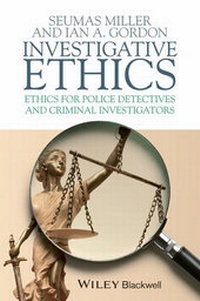
Investigative Ethics
Description

Reviews / Votes
"Liberally illustrated with challenging cases, this volumemarshals and discusses the many ethical problems encountered bypolice investigators. In an area that tends to be governed bypragmatic considerations, it provides an important check on thedesire and pressure for results." --John Kleinig, John Jay College of Criminal Justice "Rarely has the publication of a work exploring moderncrime investigation shown such a thorough grasp of the myriadchallenges, many of them ethical, facing tenaciousinvestigators." --Sir Dan Crompton, Former UK Police Chief and HM Inspectorof Police "Investigative Ethics is applied philosophy of the bestsort. Its thoughtful analysis of foundational issues in policeethics--at once sophisticated and accessible--willprovide a valuable resource for philosophers, legal academics, andpolice practitioners." --Stuart Green, Rutgers Law School "Investigative Ethics makes a valuable contribution tothe growing body of critical and informed literature on criminalinvestigative practice. While aimed at police detectives andcriminal investigators, it has much to offer professionaladministrative investigators. Highly recommended." --Nigel Savidge, Lead Integrity Specialist, AsianDevelopment BankMore details
Other editions
Additional editions
Persons
Content
Introduction
Ethics and the Role of the Investigator
This book is an applied philosophical study of some of the main ethical issues that arise in the context of investigations of crime by police detectives. As such, it is not a general guide to best practice in police investigations, so it will not provide novice investigators with technical expertise.1 Nor is it a contribution to ethical theory per se – although it does offer philosophical theories of various aspects of criminal investigations, for example, knowledge as the defining occupational end of detectives, and the collective moral responsibility of detectives, prosecutors, jurors, and others for the outcomes of trials in the context of what we refer to as the “chain of moral responsibility.” It will not, therefore, enable novice philosophers to become advanced ethical theorists either.2 Rather it occupies the conceptual space where ethics or morality and police investigations intersect, and it attempts to shed intellectual light on some of the practical ethical problems in that space. Accordingly, if the book succeeds, it will assist police investigators to have a greater understanding of the ethical underpinnings of their work, and to reflect more profitably on the ethical issues that arise in the course of it. Moreover, it might coax more philosophers to seriously engage with criminal investigators and the complex and important ethical and philosophical problems that their work gives rise to.
While the book is serviceable as a text both for graduate and advanced undergraduate students and for police detectives, non-police crime and corruption investigators, and other criminal justice practitioners, it does offer an array of novel arguments, ethical analyses, and philosophical perspectives. This was inevitable given the paucity of scholarly work in investigative ethics and given, also, the intellectual complexity of many of the issues. We leave it to others to judge whether or not the content of the book is sometimes illuminating rather than merely novel.
Investigation
Combating crime and corruption and enforcing the criminal law involves conducting criminal investigations. The categories of crime in question include crimes against the person such as homicide, rape, and assault (Chapter 5), and property crimes such as theft, burglary, and fraud (Chapter 6). Terrorism (Chapter 7) is a crime that is typically a crime against the person (detonating a bomb in a crowded train and thereby murdering innocent passengers), a property crime (destruction of the train carriage) and a political crime (committed with the intent of undermining the authority of the state). “Corruption” (Chapter 8), on the other hand, is a generic term that covers a wide range of moral offenses that are not always crimes, that is, legal offenses. (For the distinction and relation between the law and morality, see Chapter 1.) These offenses include bribery, nepotism, cheating, and abuse of authority. Our discussion in Chapter 8 focuses on police corruption.
In contemporary settings, the investigative capacity typically resides with the police service and, for major crimes, criminal investigation units within the police service. However, large public and private sector organizations often have their own investigative units, for example, fraud units, and in many jurisdictions bodies with the specific responsibility to deal with corruption have been established, for example, independent commissions against corruption.
Criminal investigators require knowledge (e.g., of the law), skills (e.g., how to conduct interviews), and experience (e.g., of efficiently and effectively conducting a successful investigation leading to prosecution). They also have to have legal powers, such as the power to question witnesses and suspects.
The various specialist areas within criminal investigation, like homicide, drugs, and terrorism, all require the exercise of generic investigative skills that are transferable from one area to another. However, each of these areas also requires a degree of specialized knowledge – for example, knowledge, on the part of drug investigators, of specific drugs and their means of production and distribution. Moreover, with the advent of computers, the growth of transnational organized crime, and so on, there is a greater need for specialized knowledge. Increasingly, therefore, investigators are required to undertake formal training and education programs.
The ethical issues that arise for criminal investigators are manifold. They include: investigative independence (Chapter 4); the use of criminals as informants (Chapter 9); deception and the infringement of privacy rights in surveillance operations (Chapter 10), profiling (Chapter 5), undercover operations (Chapter 11) and the use of traps or “sting” operations (Chapter 11); and the use of deception and/or coercion in interviewing (Chapter 12).
Prior to the nineteenth century, law enforcement agencies had no detectives as such. Indeed, in the United Kingdom, the United States, and elsewhere people were deeply suspicious of the notion of a detective, or at least of those people who undertook some of the kinds of work associated with the modern detective. These early forerunners of the detective were, for the most part, entrepreneurs working for themselves, and they undertook a variety of forms of investigative work. They functioned as informants for the public police service, thief takers (a kind of bounty hunter), and agents provocateurs (who infiltrated and trapped suspects, including underground political groups).
The public, the government, and the ordinary police were understandably unhappy with these private entrepreneurs who often used dubious methods for private, or even political, interests. At the same time it was acknowledged that they played an important investigative role or roles.
Accordingly, in the second half of the nineteenth century in England – partly at the instigation of Richard Mayne, who was (jointly with Charles Rowan) the first commissioner of the Metropolitan Police,3 a new vocational role was carved out, namely, the role of the detective. Moreover, it was a role destined to attract an enormous amount of attention from writers and film-makers. The image of the modern detective, far from that of his or her contemptible forerunners, is one of glamour and mystique. Indeed, even in reality detectives have often come to see themselves as an elite group within police services. Investigative agencies, such as the Federal Bureau of Investigation (FBI) in the United States, are known worldwide and have been the subject of numerous films, TV series, and the like.4
Here it is important to resist stereotypes and self-serving images, and focus on what the role of detectives ought to be, both within the police organization and within the wider criminal justice system. Note also that we are distinguishing between the de facto role and the role as it ought to be. (On these matters of occupational role see Chapters 1 and 2.)
There are a host of questions about the optimal forms of organization for police services. This has led to various institutional design initiatives. Thus there has been, and there continues to be, restructuring of criminal investigations departments/bureaux for purposes of specialization (e.g., into organized crime units), decentralization, a strengthening of the investigative capacity of patrol police (e.g., team policing) and (at times) a reinforcement of accountability (e.g., breaking up perceived powerful and/or corrupt detective groups). The desirability or undesirability of particular organizational changes is not our concern here. Suffice it to state the obvious. The best organizational structures and mechanisms of cooperation are those that facilitate the purposes of, in this case, criminal investigations. Restructuring ought not to be simply the vehicle of some internal or external factional or political interest.
Particular organizational structures and cultures can either facilitate or impede police work, including criminal investigations work. For example, an “us–them” mentality can set police management against operational police, patrol police against detectives, and so on, thereby obstructing effective policing.
Again, the need for, and the dangers of, police discretion are things that organizational structures and mechanisms must accommodate. Curtailing discretion can simply disempower police. On the other hand, wide discretionary powers, especially in a context in which there is a lack of accountability in respect of their use, can be a recipe for disaster in high-risk areas, for example, corruption in drug investigations work.
In addition to the utility of particular forms of organization for criminal investigations within the police service, there is the question of the role and organization of criminal investigations in the larger context of the criminal justice system.
Principles of justice are inevitably imperfectly embodied in specific criminal justice systems and in the actual practices of criminal investigators. Arguably, the current criminal justice systems in the United States, United Kingdom, Australia, and elsewhere are in need of significant redesign in a number of respects. For one thing, certain kinds of crime, including in the drug and fraud area, are not being adequately combated. For another, incarceration rates over the past few decades appear to have risen inexorably in, for example, the United States, and yet the prisons in question do not...
