

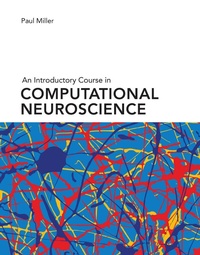
An Introductory Course in Computational Neuroscience
Description

This introductory text teaches students to understand, simulate, and analyze the complex behaviors of individual neurons and brain circuits. It is built around computer tutorials that guide students in producing models of neural behavior, with the associated Matlab code freely available online. From these models students learn how individual neurons function and how, when connected, neurons cooperate in a circuit. The book demonstrates through simulated models how oscillations, multistability, post-stimulus rebounds, and chaos can arise within either single neurons or circuits, and it explores their roles in the brain.
The book first presents essential background in neuroscience, physics, mathematics, and Matlab, with explanations illustrated by many example problems. Subsequent chapters cover the neuron and spike production; single spike trains and the underlying cognitive processes; conductance-based models; the simulation of synaptic connections; firing-rate models of large-scale circuit operation; dynamical systems and their components; synaptic plasticity; and techniques for analysis of neuron population datasets, including principal components analysis, hidden Markov modeling, and Bayesian decoding.
Accessible to undergraduates in life sciences with limited background in mathematics and computer coding, the book can be used in a "flipped” or "inverted” teaching approach, with class time devoted to hands-on work on the computer tutorials. It can also be a resource for graduate students in the life sciences who wish to gain computing skills and a deeper knowledge of neural function and neural circuits.
More details
Other editions
Additional editions
Person
Content
- Intro
- Contents
- Series Foreword
- Acknowledgments
- Preface
- 1 Preliminary Material
- 2 The Neuron and Minimal Spiking Models
- 3 Analysis of Individual Spike Trains
- 4 Conductance-Based Models
- 5 Connections between Neurons
- 6 Firing-Rate Models and Network Dynamics
- 7 An Introduction to Dynamical Systems
- 8 Learning and Synaptic Plasticity
- 9 Analysis of Population Data
- References
- Index
- Computational Neuroscience
