

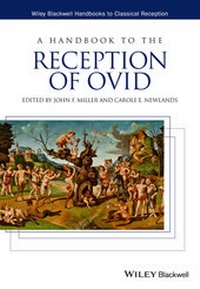
A Handbook to the Reception of Ovid
Description

Reviews / Votes
"The multi-authored Handbook to the Reception of Ovidis far more wide-ranging, and considers the whole field of Ovidian influence on literature, education, the visual arts, and film, from antiquity to the present day." (Translation and Literature, 1 May 2015) "While readers will also want to consult works by Doody (1985), Hopkins (2010), Oakley-Brown (2006) and Martindale (1988) -- among many others, too numerous to list -- this new Handbookis highly recommended as a scholarly introduction to the reception of Ovid." (Eighteenth-century Studies and Eighteenth-century Literature, 1 October 2014)More details
Other editions
Additional editions
Persons
Content
Notes on Contributors
Paul Barolsky is Commonwealth Professor of the History of Art at the University of Virginia, where he teaches courses in Italian Renaissance art and literature. He is the author of such books as Infinite Jest (1978), Michelangelo's Nose (1990), Why Mona Lisa Smiles (1991), and A Brief History of the Artist from God to Picasso (2010). He has also published extensively on Ovid's Metamorphoses, especially in the journal Arion.
Gordon Braden is Linden Kent Memorial Professor of English at the University of Virginia, author of Renaissance Tragedy and the Senecan Tradition (1985), Petrarchan Love and the Continental Renaissance (1999), and co-editor of volume 2 of The Oxford History of Literary Translation in English (2010).
Sarah Annes Brown (Anglia Ruskin University) has published widely on the reception of Ovid and other classical writers. Her publications include The Metamorphosis of Ovid: Chaucer to Ted Hughes (1999) and A Familiar Compound Ghost: Allusion and the Uncanny (2012).
Sergio Casali teaches Latin philology at the University of Rome Tor Vergata. He has published a commentary on Ovid, Heroides 9 (1995), and articles and reviews on Ovid, Virgil, and the Roman epic tradition.
Jill H. Casid is Professor of Visual Studies in the Department of Art History at the University of Wisconsin-Madison. Her books include Sowing Empire (2004) and Shadows of Enlightenment: Reason, Magic, and Technologies of Projection (forthcoming). She is also the co-editor of Art History in the Wake of the Global Turn (2014).
Diskin Clay is Distinguished Professor of Classical Studies Emeritus at Duke University. He has written two essays on Dante and, after his retirement in 2008, has written two books on Dante: The Art of Hell: From Dante's Inferno to Rodin's The Gate of Hell and Dante's Parnassus: The Pagan Poetry of the Divine Comedy.
Frederick A. de Armas is Andrew W. Mellon Distinguished Service Professor in the Departments of Comparative Literature and Romance Languages and Literatures at the University of Chicago. He studies the literature of early modern Spain from a comparative perspective. His volumes related to classical antiquity include Cervantes, Raphael and the Classics (1998), and Ovid in the Age of Cervantes (2010).
Marilynn Desmond is Distinguished Professor of English and Comparative Literature at Binghamton University. She is the author of Reading Dido: Gender, Textuality and the Medieval Aeneid (1994) and Ovid's Art and the Wife of Bath: The Ethics of Erotic Violence (2006); she was also the guest editor of a special issue of Mediaevalia (1987), "Ovid in the Middle Ages." She is currently working on the reception of the matter of Troy in the medieval West.
Andrew Feldherr is Professor of Classics at Princeton University. He is the author most recently of Playing Gods: Ovid's Metamorphoses and the Politics of Fiction (2010).
Ian Fielding is a Teaching Fellow in Classical Literature at the University of Warwick, where he was awarded his PhD in 2011. He is currently writing a monograph, based on his doctoral dissertation, on the reception of Ovidian elegy in the fifth and sixth centuries CE.
Jamie C. Fumo is Associate Professor of English at McGill University in Montreal. She is the author of The Legacy of Apollo: Antiquity, Authority, and Chaucerian Poetics (2010), co-editor of Vehicles of Transmission, Translation, and Transformation in Medieval Textual Culture (2012), and has published widely on Chaucer and medieval Ovidianism.
Andrew Galloway is Professor of English at Cornell University where he has taught since receiving his PhD from University of California, Berkeley in 1991. He has written widely on medieval English literature and culture, especially Chaucer, Gower, and Piers Plowman.
Rainer Godel teaches German Literature at the University Halle-Wittenberg and serves as Academic Coordinator and Deputy Director of the Research Center "Aufklärung-Religion-Wissen." His main research areas are the literature, philosophy, and anthropology of the European Enlightenment and Weimar classicism; early modern and Enlightenment controversies; nationalist and Nazi literature; contemporary literature, especially Christoph Ransmayr and winners of the the Ingeborg-Bachmann Award.
Mandy Green is a lecturer in the English Department at the University of Durham where she read Latin and English as an undergraduate. Her research interests center on classical presences in English Literature with a particular focus on Milton and Ovid. Her monograph Milton's Ovidian Eve was published in 2009.
Philip Hardie is a Senior Research Fellow at Trinity College, Cambridge. He has recently published Rumour and Renown: Representations of Fama in Western Literature (2012), and is currently completing a commentary on Ovid, Metamorphoses 13-15 (Fondazione Valla), and co-editing the volume on the Renaissance in the Oxford History of Classical Reception in English Literature. The Last Trojan Hero, a short book on the reception of the Aeneid, is forthcoming.
Stephen Harrison is Professor of Latin Literature at the University of Oxford and Fellow and Tutor in Classics at Corpus Christi College. He has written extensively on Augustan poetry (e.g. Generic Enrichment in Vergil and Horace, 2007), on Apuleius (e.g. Apuleius: A Latin Sophist, 2000), and on the reception of Latin literature in later periods.
Gregory Hays is Associate Professor of Classics at the University of Virginia. He has published various articles on late and medieval Latin, as well as a translation of Marcus Aurelius's Meditations (2002). He is currently finishing an edition of Fulgentius, with translation and commentary.
Dan Hooley is Professor of Classics at the University of Missouri. He has written books and articles on Roman satire, Latin poetry generally, and literary reception.
James M. Horowitz received his PhD in English language and literature from Yale University, and teaches at Sarah Lawrence College. His dissertation was entitled "Rebellious Hearts and Loyal Passions: Imagining Civic Consciousness in Ovidian Writing on Women, 1680-1819." He is currently working on a series of articles on Ovid and eighteenth-century culture, as well as a book project on gender and political writing from 1680 to 1720.
Heather James is Associate Professor of English and Comparative Literature at the University of Southern California. She is the author of Shakespeare's Troy: Drama, Politics, and the Translation of Empire (1997) and has written widely on Virgil and Ovid, Shakespeare and Marlowe, and classical transmission in early modern poetry, prose, and drama. She was also co-editor of the Norton Anthology of World Literature (2003). Her other publishing interests include poetry and politics, comparative studies (especially in the Italian Renaissance), commonplaces and sententiae, Continental humanism, and feminism and gender.
Andrew Kahn is Professor of Russian Literature in the University of Oxford, and Fellow and Tutor, St Edmund Hall. He has degrees from Harvard and Oxford in Russian and Classics. He has written about Pushkin and also works on Enlightenment literature in Russia and Europe, the comparative reception of European culture in Russia, the history of translation, and twentieth-century poetry.
Catherine Keen is Senior Lecturer in Italian at University College London. She is the author of Dante and the City (2003) and of numerous articles on medieval Italian lyric poetry, Dante, Cino da Pistoia, and the cultural traditions of medieval Florence and Tuscany.
Sean Keilen is Associate Professor of Literature and Provost of Porter College at University of California Santa Cruz, where he teaches courses about Shakespeare and Ovid and studies the relationship between the humanities and the arts. His book, Vulgar Eloquence: On the Renaissance Invention of English Literature, was published in 2006.
Alison Keith teaches Classics and Women and Gender Studies at the University of Toronto. She has written extensively on the intersection of gender and genre in Latin literature and on Ovid's Metamorphoses and its reception. A past Editor of Phoenix (2002-2007) and President of the Classical Association of Canada (2010-2012), she has held fellowships at Clare Hall Cambridge, Freiburg Universität in Germany, and the National Humanities Center in North Carolina.
Maggie Kilgour is Molson Professor of English Literature at McGill University. She is the author of From Communion to Cannibalism: An Anatomy of Metaphors of Incorporation (1990), The Rise of the Gothic Novel (1995), Milton and the Metamorphosis of Ovid (2012), and essays on a range of topics.
Peter E. Knox is Professor of Classics at the University of Colorado. His publications include Ovid's Metamorphoses and the Traditions of Augustan Poetry (1986), Ovid, Heroides: Selections (1995), and A Companion to Ovid (2009), as well as a wide range of papers on Latin literature and Hellenistic poetry.
John F. Miller is Arthur F....
