

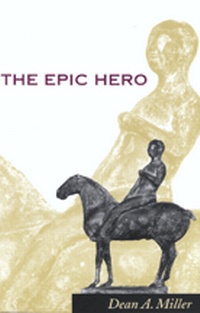
The Epic Hero
Published on 17. July 2003
520 pages
978-0-8018-7792-6 (ISBN)
Description

Selected by Choice Magazine as an Outstanding Academic Title
From Odysseus to Aeneas, from Beowulf to King Arthur, from the Mahabharata to the Ossetian "Nart" tales, epic heroes and their stories have symbolized the power of the human imagination. Drawing on diverse disciplines including classics, anthropology, psychology, and literary studies, this product of twenty years' scholarship provides a detailed typology of the hero in Western myth: birth, parentage, familial ties, sexuality, character, deeds, death, and afterlife. Dean A. Miller examines the place of the hero in the physical world (wilderness, castle, prison cell) and in society (among monarchs, fools, shamans, rivals, and gods). He looks at the hero in battle and quest; at his political status; and at his relationship to established religion. The book spans Western epic traditions, including Greek, Roman, Nordic, and Celtic, as well as the Indian and Persian legacies. A large section of the book also examines the figures who modify or accompany the hero: partners, helpers (animals and sometimes monsters), foes, foils, and even antitypes. The Epic Hero provides a comprehensive and provocative guide to epic heroes, and to the richly imaginative tales they inhabit.
From Odysseus to Aeneas, from Beowulf to King Arthur, from the Mahabharata to the Ossetian "Nart" tales, epic heroes and their stories have symbolized the power of the human imagination. Drawing on diverse disciplines including classics, anthropology, psychology, and literary studies, this product of twenty years' scholarship provides a detailed typology of the hero in Western myth: birth, parentage, familial ties, sexuality, character, deeds, death, and afterlife. Dean A. Miller examines the place of the hero in the physical world (wilderness, castle, prison cell) and in society (among monarchs, fools, shamans, rivals, and gods). He looks at the hero in battle and quest; at his political status; and at his relationship to established religion. The book spans Western epic traditions, including Greek, Roman, Nordic, and Celtic, as well as the Indian and Persian legacies. A large section of the book also examines the figures who modify or accompany the hero: partners, helpers (animals and sometimes monsters), foes, foils, and even antitypes. The Epic Hero provides a comprehensive and provocative guide to epic heroes, and to the richly imaginative tales they inhabit.
Reviews / Votes
The range is vast and covers most of Western epic literature-Greek, Celtic, Nordic, Roman, Persian, and Indian . . . [Miller] has provided not only a wealth of information on the epic hero, but he shows why the hero presented in the epic mode has held human imagination for so long.-Religious Studies Review Miller boldly but intelligently maps out a variety of aspects under which both epic heroism in general and particular can fruitfully be considered. He also discusses an almost intimidating range of material . . . For Miller, rather refreshingly, the real heroes are Homer's Achilles and his counterparts in, say, Icelandic sagas, not such tricksters, politicians, and priests as Odysseus, Hector, and Aeneas. Miller rightly refocuses attention, furthermore, not only on such well-documented elements of this warrior-hero as his ambivalence and liminality, but also on his enduring, if disturbing, appeal.
-B. D. A. Tipping, Journal of Roman Studies Miller commands an impressive range of material, and his original synthesis offers valuable insights to students of ancient and medieval literature.
-Choice Why does an epic hero tend to act so arrogantly and destructively? Miller offers a convincing answer to this question, which arises with the emergence of modern consciousness, in light of the hero's functional social position an dhis essentially adolescent, flat interior . . . with thoughtful insight and thorough scholarship, Miller's book is a major piece of research that cannot be ignored in any future discussion of the epic and its ever-dazzling hero.
-Masaki Mori, The Comparatist This study, rich and plentiful but also subtle and suggestive, will serve as a reference work for a broad range of researchers in contiguous disciplines (ancient studies, comparative religion, history, philosophy).
-Francois Ripoll, Latomus Given his wide reading and his instinct for the telling detail, Miller's observations are truly pregnant; they stimulate the mind to incubate new connections.
-Norman Austin, International Journal of the Classical Tradition
More details
Language
English
Place of publication
Baltimore, MD
United States
Target group
Professional and scholarly
File size
18,19 MB
ISBN-13
978-0-8018-7792-6 (9780801877926)
DOI
10.1353/book.75287
Copyright in bibliographic data and cover images is held by Nielsen Book Services Limited or by the publishers or by their respective licensors: all rights reserved.
Schweitzer Classification
Other editions
Additional editions

Dean A. Miller
The Epic Hero
Book
12/2002
Johns Hopkins University Press
€42.00
Article not available for order
Dean A. Miller
The Epic Hero
Book
06/2000
Johns Hopkins University Press
€76.50
Article exhausted; check different version
Person
Dean A. Miller is a professor emeritus of history and comparative religion at the University of Rochester.
Content
Introduction. The Book of the Hero
Chapter 1. The Hero from on High
Chapter 2. The Heroic Biography
Chapter 3. The Framework of Adventure
Chapter 4. The Hero "Speaks"
Chapter 5. Foils, Fools, and Antiheroes
Chapter 6. Tertium Quid: Aspects of Liminality
Chapter 7. The Final Hero: Beyond Immortality
Notes
Index
Chapter 1. The Hero from on High
Chapter 2. The Heroic Biography
Chapter 3. The Framework of Adventure
Chapter 4. The Hero "Speaks"
Chapter 5. Foils, Fools, and Antiheroes
Chapter 6. Tertium Quid: Aspects of Liminality
Chapter 7. The Final Hero: Beyond Immortality
Notes
Index
