

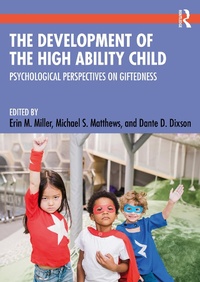
The Development of the High Ability Child
Psychological Perspectives on Giftedness
1st Edition
Published on 22. December 2021
204 pages
978-1-000-48765-7 (ISBN)
Description

This valuable text will help readers to understand the physical, social, and cognitive development of high ability children. Written by experts in the fields of education and psychology, each chapter applies core principles of psychology to the development of gifted and talented children. Through the content, readers will be shown how these children are like all children as well as the ways in which their development is unique.
Covering the psychology of learning and learners, personality differences, language and physical development, problem solving, and motivation of high ability children, this book provides readers with a strong foundation for supporting and developing advanced learners. The text also includes Field Notes and Eye for Diversity sections to enable readers to put into practice, and recognize, important issues being discussed.
Throughout, the editors blend discussions of research with practical advice for individuals charged with nurturing children with advanced cognitive potential. It is an essential read for students, counsellors, administrators, therapists, and parents seeking to support high ability children and their needs.
Covering the psychology of learning and learners, personality differences, language and physical development, problem solving, and motivation of high ability children, this book provides readers with a strong foundation for supporting and developing advanced learners. The text also includes Field Notes and Eye for Diversity sections to enable readers to put into practice, and recognize, important issues being discussed.
Throughout, the editors blend discussions of research with practical advice for individuals charged with nurturing children with advanced cognitive potential. It is an essential read for students, counsellors, administrators, therapists, and parents seeking to support high ability children and their needs.
Reviews / Votes
'This book will become the definitive resource on the physical, social, and cognitive development of advanced learners. It provides an honest accounting of how they are unique, where they are not, and what questions remain unanswered.'Scott J. Peters, Ph.D., Professor of Assessment and Research Methodology, University of Wisconsin-Whitewater
'This book takes the most in-depth look at the field of developmental psychology applied to the study of children with high ability of any book on the market. This is a must read for folks interested in the psychology of high ability.'
Anne N. Rinn, Ph.D., Professor of Educational Psychology, University of North Texas
More details
Edition
1. Auflage
Language
English
Place of publication
London
United Kingdom
Publishing group
Taylor & Francis Ltd
Target group
College/higher education
Illustrations
22 Tables, black and white; 7 Halftones, black and white; 7 Illustrations, black and white
ISBN-13
978-1-000-48765-7 (9781000487657)
Copyright in bibliographic data and cover images is held by Nielsen Book Services Limited or by the publishers or by their respective licensors: all rights reserved.
Schweitzer Classification
Other editions
Additional editions
Erin M. Miller | Michael S. Matthews | Dante D. Dixson
The Development of the High Ability Child
Psychological Perspectives on Giftedness
Book
12/2021
1st Edition
Routledge
€59.80
Shipment within 15-20 days
Erin M. Miller | Michael S. Matthews | Dante D. Dixson
The Development of the High Ability Child
Psychological Perspectives on Giftedness
Book
12/2021
1st Edition
Routledge
€179.51
Shipment within 15-20 days
Persons
Erin M. Miller has a doctorate in Educational Psychology with a specialization in gifted and talented children from the University of Virginia. She has been active in the field of gifted education for 15 years, presenting at the National Association for Gifted Children (NAGC) each of those years. She has held multiple leadership positions for NAGC and AERA and is currently the Associate Editor for the Journal of Advanced Academics. She holds an associate professor of psychology position at Bridgewater College where she teaches General Psychology, Memory and Cognition, Biology of the Mind, Creativity and Problem-Solving, and Measurement and Statistics courses.
Michael S. Matthews is a Professor and Program Director for the Academically/Intellectually Gifted graduate programs at UNC Charlotte where he teaches courses related to various aspects of gifted education. He is co-editor of Gifted Child Quarterly and has served as a Board Member of the National Association for Gifted Children. He is also past Chair of the Research on Giftedness, Creativity, and Talent group of the American Educational Research Association, and a former board member for the Metrolina Scholars Academy charter school and the North Carolina Association for the Gifted & Talented. He is author or editor of five books, around 45 peer reviewed articles, and over a dozen book chapters. He presents regularly at state, national, and international conferences, and his scholarship has been recognized with the Early Scholar Award (NAGC), the Pyryt Collaboration Award (AERA), and the Legacy Book Award from the Texas Association for the Gifted and Talented in the category of "Best Scholarly Work".
Dante D. Dixson is an Assistant Professor of School and Educational Psychology at Michigan State University. He currently serves on the editorial boards of Gifted Child Quarterly, the Journal for the Education of the Gifted, School Psychology Review, and the Journal of Black Psychology. In addition, he is a board member for the Roeper Institute and the Michigan Association of Gifted Children. Dr. Dixson's areas of expertise include the role of hope in the educational and psychological functioning of children and adolescents, psychosocial precursors of achievement, and the underrepresentation of minority and disadvantaged youth in gifted education.
Michael S. Matthews is a Professor and Program Director for the Academically/Intellectually Gifted graduate programs at UNC Charlotte where he teaches courses related to various aspects of gifted education. He is co-editor of Gifted Child Quarterly and has served as a Board Member of the National Association for Gifted Children. He is also past Chair of the Research on Giftedness, Creativity, and Talent group of the American Educational Research Association, and a former board member for the Metrolina Scholars Academy charter school and the North Carolina Association for the Gifted & Talented. He is author or editor of five books, around 45 peer reviewed articles, and over a dozen book chapters. He presents regularly at state, national, and international conferences, and his scholarship has been recognized with the Early Scholar Award (NAGC), the Pyryt Collaboration Award (AERA), and the Legacy Book Award from the Texas Association for the Gifted and Talented in the category of "Best Scholarly Work".
Dante D. Dixson is an Assistant Professor of School and Educational Psychology at Michigan State University. He currently serves on the editorial boards of Gifted Child Quarterly, the Journal for the Education of the Gifted, School Psychology Review, and the Journal of Black Psychology. In addition, he is a board member for the Roeper Institute and the Michigan Association of Gifted Children. Dr. Dixson's areas of expertise include the role of hope in the educational and psychological functioning of children and adolescents, psychosocial precursors of achievement, and the underrepresentation of minority and disadvantaged youth in gifted education.
Content
Introduction 1. Key Methodological Issues in Researching Gifted Education and Advanced Academics 2. Physical Development of Gifted Students 3. The Psychology of Learning: Modalities and Their Application to Advanced Academics 4. The Role of Superior Attention and Memory Abilities in the Lives of Cognitively Advanced Individuals 5. Language Development and Education of Advanced Learners and Precocious Readers 6. Problem-Solving Characteristics in Gifted and Advanced Learners 7. Motivation and Achievement in Gifted and Advanced Learners 8. Individual Differences in Personality Among Cognitively Advanced Learners 9. The Psychological Adjustment of Gifted Children and Individuals with High Intellectual Ability 10. Conclusions and Implications for the Future
