

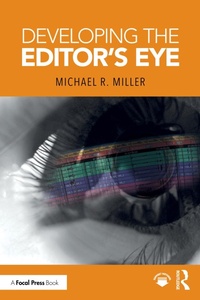
Developing the Editor's Eye
Published on 14. April 2026
200 pages
978-1-040-53413-7 (ISBN)
Description

In this accessible and informative text, Michael R. Miller draws on his extensive experience working on award-winning films, to help readers develop their 'eye' for editing.
The book begins by emphasizing the need for editors to pay attention to the emotional and aesthetic tone of a project and scene, before it explores what makes great editing in a feature film. This includes editing approaches founded on deep appreciation for actors' performances and directors' philosophies, trimming or even deleting footage that weighs down the narrative, refining character point of view, the importance of opening scenes, the role of sound, and much more. Throughout the text, the Miller draws on insights from editors such as Paul Hirsch, ACE, Susan E. Morse, ACE and Thelma Schoonmaker, ACE to provide readers with a deep understanding of how and why "movies are made in the cutting room".
This is a perfect resource for intermediate and advanced editing students, as well as professional editors hoping to improve their craft and learn from the masters. Miller's emphasis on what editors feel while watching dailies, his focus on performance quality, his assertions that, paradoxically, a picture might be improved when a great scene, or even a considerable number are deleted - will be eye-opening for one and all.
The book begins by emphasizing the need for editors to pay attention to the emotional and aesthetic tone of a project and scene, before it explores what makes great editing in a feature film. This includes editing approaches founded on deep appreciation for actors' performances and directors' philosophies, trimming or even deleting footage that weighs down the narrative, refining character point of view, the importance of opening scenes, the role of sound, and much more. Throughout the text, the Miller draws on insights from editors such as Paul Hirsch, ACE, Susan E. Morse, ACE and Thelma Schoonmaker, ACE to provide readers with a deep understanding of how and why "movies are made in the cutting room".
This is a perfect resource for intermediate and advanced editing students, as well as professional editors hoping to improve their craft and learn from the masters. Miller's emphasis on what editors feel while watching dailies, his focus on performance quality, his assertions that, paradoxically, a picture might be improved when a great scene, or even a considerable number are deleted - will be eye-opening for one and all.
More details
Language
English
Place of publication
London
United Kingdom
Publishing group
Taylor & Francis Ltd
Target group
College/higher education
Professional and scholarly
Illustrations
34 Halftones, black and white; 34 Illustrations, black and white
File size
5,72 MB
ISBN-13
978-1-040-53413-7 (9781040534137)
Copyright in bibliographic data and cover images is held by Nielsen Book Services Limited or by the publishers or by their respective licensors: all rights reserved.
Schweitzer Classification
Other editions
Additional editions
Michael R. Miller
Developing the Editor's Eye
Book
approx. 05/2026
1st Edition
Routledge
€52.50
Not yet published
Michael R. Miller
Developing the Editor's Eye
Book
approx. 05/2026
1st Edition
Routledge
€190.50
Not yet published
Person
Michael R. Miller has had a dream career in film editing. After graduating from Cornell University, he landed the plum job of assistant to editor Susan E. Morse, ACE. He worked in the same capacity for Thelma Schoonmaker, ACE on Martin Scorsese's Raging Bull. Subsequently Mr. Miller became a sound editor on Joel and Ethan Coen's Blood Simple and went on to collaborate with "the boys" as editor of Raising Arizona and Miller's Crossing. His many other cutting credits include Terry Zwygoff's Ghost World, Keenan Wayans' I'm Gonna Git You, Sucka, Herbert Ross' Boys on the Side, Thomas Carter's Swing Kids, Paul Dinello's Strangers With Candy (starring Dinello, Stephen Colbert and Amy Sedaris), Michael Bay's Armageddon, Rupert Wainwright's Stigmata, Jesse Torero's Soul Plane, and Anthony Hopkins' Slipstream. He also edited Josh Radnor's happythankyoumoreplease, winner of the 2010 Sundance Film Festival Audience Award, Mr. Radnor's well-reviewed Liberal Arts, which premiered at Sundance in 2012, and Maya Forbes' Infinitely Polar Bear, which screened there in 2014. In all, he's edited 8 official Sundance Selections. Mr. Miller also edited Angus MacLaughlin's Abundant Acreage Available, which won Best Original Screenplay at the 2017 Tribeca Film Festival. He is currently Professor of filmmaking at University of North Carolina School of the Arts, where he also serves as the Editing Department chair. In 2024, he received the school's Excellence in Teaching Award.
Content
INTRODUCTION:
Why Editing Now Requires Formal Training
CHOOSING THE BEST MOMENT:
What moves you?
THE PRIMACY OF PERFORMANCE:
Authentic Acting is the Trump Card
EDITING AS THE FOUNDATION OF RHYTHM AND PACE:
The Next Hand's Trump Card
OTHER EDITING CONCEPTS: TRANSITIONS, PARALLEL CONSTRUCTION, THE AXIS, MOTIVATED CUTS, INTERCUTTING, ETC.:
Pudovkin, Eisenstein and All the Usual Suspects
CHARACTER POINT OF VIEW AND HOW TO CREATE IT:
Who's Telling This Story
THE IMPORTANCE OF OPENING SCENES:
And Why They're Assembled Toward the End of Post
THE MANY ROLES OF MUSIC:
Score, Source, "Scource" and Much, Much More
THE ROLE OF SOUND:
Developing the Editor's Ear
EDITING AS THE FINAL REWRITE:
The First Assembly is the First Draft
BREAKING THE RULES:
That's What They're Made For... Until They Become the New Ones
CONCLUSION
Why Editing Now Requires Formal Training
CHOOSING THE BEST MOMENT:
What moves you?
THE PRIMACY OF PERFORMANCE:
Authentic Acting is the Trump Card
EDITING AS THE FOUNDATION OF RHYTHM AND PACE:
The Next Hand's Trump Card
OTHER EDITING CONCEPTS: TRANSITIONS, PARALLEL CONSTRUCTION, THE AXIS, MOTIVATED CUTS, INTERCUTTING, ETC.:
Pudovkin, Eisenstein and All the Usual Suspects
CHARACTER POINT OF VIEW AND HOW TO CREATE IT:
Who's Telling This Story
THE IMPORTANCE OF OPENING SCENES:
And Why They're Assembled Toward the End of Post
THE MANY ROLES OF MUSIC:
Score, Source, "Scource" and Much, Much More
THE ROLE OF SOUND:
Developing the Editor's Ear
EDITING AS THE FINAL REWRITE:
The First Assembly is the First Draft
BREAKING THE RULES:
That's What They're Made For... Until They Become the New Ones
CONCLUSION
