

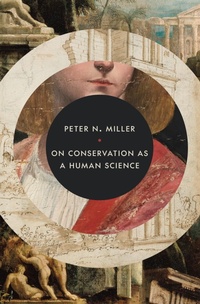
On Conservation as a Human Science
1st Edition
Published on 7. April 2026
288 pages
978-0-691-26382-3 (ISBN)
Description

Conservators as first responders in a world where our cultural heritage is increasingly at risk
Conservation can be understood as a form of knowing; conservators extract meaning about the past from what remains, while noting what is missing and sometimes repairing it. In this erudite and virtuosic book, the historian Peter N. Miller imagines the outlines of a new, expansive notion of conservation that links the world around us-natural and man-made-to the world inside us-our genome, our memories. Putting the work of conservation into conversation with history, philosophy, and literature yields a shift in perspective. It raises questions central to the work of the humanities: What does time mean? How do we write about knowledge? How does care connect humans not just with the world but also with each other? And where does freedom exist in a world of things?
Miller casts conservators as first responders in a world as fragile as the things they work on. He argues that a broader conception of conservation can provide the necessary intellectual resources for grappling with the scale of the enormous challenges ahead. Offering a kind of sketch of a curriculum for that future, Miller suggests that shaping the person of the conservator is as important as shaping the field. For only those trained to think about change through the painstaking labor of preserving and restoring will be able to do the work of policy and advocacy required by our uncertain future.
Conservation can be understood as a form of knowing; conservators extract meaning about the past from what remains, while noting what is missing and sometimes repairing it. In this erudite and virtuosic book, the historian Peter N. Miller imagines the outlines of a new, expansive notion of conservation that links the world around us-natural and man-made-to the world inside us-our genome, our memories. Putting the work of conservation into conversation with history, philosophy, and literature yields a shift in perspective. It raises questions central to the work of the humanities: What does time mean? How do we write about knowledge? How does care connect humans not just with the world but also with each other? And where does freedom exist in a world of things?
Miller casts conservators as first responders in a world as fragile as the things they work on. He argues that a broader conception of conservation can provide the necessary intellectual resources for grappling with the scale of the enormous challenges ahead. Offering a kind of sketch of a curriculum for that future, Miller suggests that shaping the person of the conservator is as important as shaping the field. For only those trained to think about change through the painstaking labor of preserving and restoring will be able to do the work of policy and advocacy required by our uncertain future.
More details
Language
English
Place of publication
Princeton, NJ
United States
Publishing group
De Gruyter
Target group
Professional and scholarly
Edition type
Digital original
Product notice
Reflowable
Illustrations
15 b/w illus.
File size
19,11 MB
ISBN-13
978-0-691-26382-3 (9780691263823)
Schweitzer Classification
Other editions
Additional editions
Peter N. Miller
On Conservation as a Human Science
Book
04/2026
Princeton University Press
€35.00
Shipment within 10-20 days
Person
Peter N. Miller is the President of the American Academy in Rome and former dean of the Bard Graduate Center. He is the author of Peiresc's Europe, Peiresc's Mediterranean World, and History and Its Objects, among other books, and the coeditor of Conserving Active Matter.
Content
- Cover
- Contents
- Illustrations
- Preface
- Conservation History 1
- Introduction: Pushing the Horizon
- Conservation History 2
- Chapter 1: Conservation as History: Studying Activity
- Conservation History 3
- Chapter 2: Schelling and Active Matter
- Conservation History 4
- Chapter 3: History as Conservation: "O Great and Utterly Divine Power
- Conservation History 5
- Chapter 4: Cesare Brandi as a Historical Thinker
- Conservation History 6
- Chapter 5: What Are Conservators For?
- Conservation History 7
- Chapter 6: Heidegger and Care
- Conservation History 8
- Chapter 7: Writing Conservation
- or, The Conservator as Author
- Conservation History 9
- Conclusion: Wanting to Know More
- Conservation History 10
- Acknowledgments
- Bibliography
- Index
