

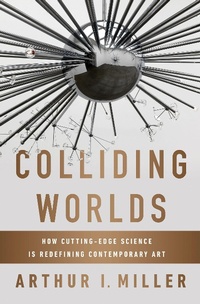
Colliding Worlds
How Cutting-Edge Science Is Redefining Contemporary Art
Published on 16. June 2014
352 pages
978-0-393-24425-0 (ISBN)
Description

A dazzling look at the artists working on the frontiers of science.
In recent decades, an exciting new art movement has emerged in which artists utilize and illuminate the latest advances in science. Some of their provocative creations—a live rabbit implanted with the fluorescent gene of a jellyfish, a gigantic glass-and-chrome sculpture of the Big Bang (pictured on the cover)—can be seen in traditional art museums and magazines, while others are being made by leading designers at Pixar, Google's Creative Lab, and the MIT Media Lab. In Colliding Worlds, Arthur I. Miller takes readers on a wild journey to explore this new frontier.Miller, the author of Einstein, Picasso and other celebrated books on science and creativity, traces the movement from its seeds a century ago—when Einstein's theory of relativity helped shape the thinking of the Cubists—to its flowering today. Through interviews with innovative thinkers and artists across disciplines, Miller shows with verve and clarity how discoveries in biotechnology, cosmology, quantum physics, and beyond are animating the work of designers like Neri Oxman, musicians like David Toop, and the artists-in-residence at CERN's Large Hadron Collider.
From NanoArt to Big Data, Miller reveals the extraordinary possibilities when art and science collide.
More details
Language
English
Place of publication
United States
Product notice
Windows
Illustrations
Illustrations, unspecified
ISBN-13
978-0-393-24425-0 (9780393244250)
Copyright in bibliographic data and cover images is held by Nielsen Book Services Limited or by the publishers or by their respective licensors: all rights reserved.
Schweitzer Classification
Other editions
Additional editions
Book
07/2014
WW Norton & Co
€33.00
Shipment within 15-20 days
Person
Arthur I. Miller is a professor emeritus at University College London. He has published many critically acclaimed books, including Einstein, Picasso; Empire of the Stars; and 137. He lives in London.
Content
- Intro
- Title
- Epigraph
- Contents
- List of Illustrations
- Preface
- 1 In Search of the Invisible
- 2 Montmartre in New York
- 3 The Computer Meets Art
- 4 Computer Art Morphs into Media Art
- 5 Visualizing the Invisible
- 6 Intermezzo: How Science Helped Resolve the World's Greatest Art Scandal
- 7 Imagining and Designing Life
- 8 Hearing as Seeing
- 9 The Art of Visualizing Data
- 10 Comrades-in-Arms: Encouraging, Funding, and Housing Artsci
- 11 In the Eye of the Beholder?
- 12 The Coming of a Third Culture
- Illustrations
- Notes
- Bibliography
- Illustration Credits
- Acknowledgments
- Index
- Copyright
