

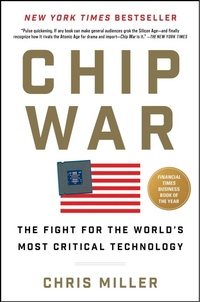
Chip War
The Fight for the World's Most Critical Technology
Published on 4. October 2022
464 pages
978-1-9821-7202-2 (ISBN)
Description

The Financial Times Business Book of the Year, this epic account of the decades-long battle to control one of the world's most critical resources?microchip technology?with the United States and China increasingly in fierce competition is "pulse quickening…a nonfiction thriller" (The New York Times).
You may be surprised to learn that microchips are the new oil?the scarce resource on which the modern world depends. Today, military, economic, and geopolitical power are built on a foundation of computer chips. Virtually everything?from missiles to microwaves?runs on chips, including cars, smartphones, the stock market, even the electric grid. Until recently, America designed and built the fastest chips and maintained its lead as the #1 superpower, but America's edge is in danger of slipping, undermined by players in Taiwan, Korea, and Europe taking over manufacturing. Now, as Chip War reveals, China, which spends more on chips than any other product, is pouring billions into a chip-building initiative to catch up to the US. At stake is America's military superiority and economic prosperity.
Economic historian Chris Miller explains how the semiconductor came to play a critical role in modern life and how the US became dominant in chip design and manufacturing and applied this technology to military systems. America's victory in the Cold War and its global military dominance stems from its ability to harness computing power more effectively than any other power. Until recently, China had been catching up, aligning its chip-building ambitions with military modernization. Here, in this paperback edition of the book, the author has added intriguing new material focused on "America's Chip Comeback," which overviews the global consequences of the just passed CHIPS Act, the new export controls on China, and the effort to rally allies to better guard chip technology.
Illuminating, timely, and fascinating, Chip War is "an essential and engrossing landmark study" (The Times, London).
You may be surprised to learn that microchips are the new oil?the scarce resource on which the modern world depends. Today, military, economic, and geopolitical power are built on a foundation of computer chips. Virtually everything?from missiles to microwaves?runs on chips, including cars, smartphones, the stock market, even the electric grid. Until recently, America designed and built the fastest chips and maintained its lead as the #1 superpower, but America's edge is in danger of slipping, undermined by players in Taiwan, Korea, and Europe taking over manufacturing. Now, as Chip War reveals, China, which spends more on chips than any other product, is pouring billions into a chip-building initiative to catch up to the US. At stake is America's military superiority and economic prosperity.
Economic historian Chris Miller explains how the semiconductor came to play a critical role in modern life and how the US became dominant in chip design and manufacturing and applied this technology to military systems. America's victory in the Cold War and its global military dominance stems from its ability to harness computing power more effectively than any other power. Until recently, China had been catching up, aligning its chip-building ambitions with military modernization. Here, in this paperback edition of the book, the author has added intriguing new material focused on "America's Chip Comeback," which overviews the global consequences of the just passed CHIPS Act, the new export controls on China, and the effort to rally allies to better guard chip technology.
Illuminating, timely, and fascinating, Chip War is "an essential and engrossing landmark study" (The Times, London).
More details
Other editions
Person
Chris Miller is Professor of International History at the Fletcher School at Tufts University. He also serves as non-resident Senior Fellow at the American Enterprise Institute, and as a Director at Greenmantle, a New York and London-based macroeconomic and geopolitical consultancy. He is the author of three previous books-Putinomics, The Struggle to Save the Soviet Economy, and We Shall Be Masters-and he frequently writes for The New York Times, The Wall Street Journal, Foreign Affairs, Foreign Policy, The American Interest, and other outlets. He received a PhD in history from Yale University and a BA in history from Harvard University. Visit his website at ChristopherMiller.net and follow him on X @CRMiller1.
Content
- Intro
- Title Page
- Dedication
- Cast of Characters
- Glossary
- Introduction
- Part I: Cold War Chips
- Chapter 1: From Steel to Silicon
- Chapter 2: The Switch
- Chapter 3: Noyce, Kilby, and the Integrated Circuit
- Chapter 4: Liftoff
- Chapter 5: Mortars and Mass Production
- Chapter 6: "I. WANT. TO. GET. RICH"
- Part II: The Circuitry of the American World
- Chapter 7: Soviet Silicon Valley
- Chapter 8: "Copy It"
- Chapter 9: The Transistor Salesman
- Chapter 10: "Transistor Girls"
- Chapter 11: Precision Strike
- Chapter 12: Supply Chain Statecraft
- Chapter 13: Intel's Revolutionaries
- Chapter 14: The Pentagon's Offset Strategy
- Part III: Leadership Lost?
- Chapter 15: "That Competition Is Tough"
- Chapter 16: "At War with Japan"
- Chapter 17: "Shipping Junk"
- Chapter 18: The Crude Oil of the 1980s
- Chapter 19: Death Spiral
- Chapter 20: The Japan That Can Say No
- Part IV: America Resurgent
- Chapter 21: The Potato Chip King
- Chapter 22: Disrupting Intel
- Chapter 23: "My Enemy's Enemy": The Rise of Korea
- Chapter 24: "This Is the Future"
- Chapter 25: The KGB's Directorate T
- Chapter 26: "Weapons of Mass Destruction": The Impact of the Offset
- Chapter 27: War Hero
- Chapter 28: "The Cold War Is Over and You Have Won"
- Part V: Integrated Circuits, Integrated World?
- Chapter 29: "We Want a Semiconductor Industry in Taiwan"
- Chapter 30: "All People Must Make Semiconductors"
- Chapter 31: "Sharing God's Love with the Chinese"
- Chapter 32: Lithography Wars
- Chapter 33: The Innovator's Dilemma
- Chapter 34: Running Faster?
- Part VI: Offshoring Innovation?
- Chapter 35: "Real Men Have Fabs"
- Chapter 36: The Fabless Revolution
- Chapter 37: Morris Chang's Grand Alliance
- Chapter 38: Apple Silicon
- Chapter 39: EUV
- Chapter 40: "There Is No Plan B"
- Chapter 41: How Intel Forgot Innovation
- Part VII: China's Challenge
- Chapter 42: Made in China
- Chapter 43: "Call Forth the Assault"
- Chapter 44: Technology Transfer
- Chapter 45: "Mergers Are Bound to Happen"
- Chapter 46: The Rise of Huawei
- Chapter 47: The 5G Future
- Chapter 48: The Next Offset
- Part VIII: The Chip Choke
- Chapter 49: "Everything We're Competing On"
- Chapter 50: Fujian Jinhua
- Chapter 51: The Assault on Huawei
- Chapter 52: China's Sputnik Moment?
- Chapter 53: Shortages and Supply Chains
- Chapter 54: The Taiwan Dilemma
- Conclusion
- Photographs
- Acknowledgments
- About the Author
- Notes
- Index
- Copyright
