

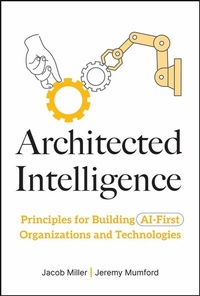
Architected Intelligence
Description

Transform AI potential into organizational results through the Architected Intelligence framework.
The gap between a dazzling "cool demo" and a reliable, production-grade system is a chasm that is swallowing teams and entire organizations. Architected Intelligence is your definitive map at both the organizational and tactical levels to cross this divide. Drawing on their experience building the world's largest ecommerce accelerator, authors Jacob Miller and Jeremy Mumford deliver actionable guidance for organizations struggling to turn proofs of concept into production systems.
Whether you are competing in the age of AI or looking to establish technology leadership in your sector, this book organizes AI success around a unified framework of five core components:
- Design AI Systems to Deliver Impactful Output
- Power AI with High-Quality Input Data
- Engineer, Optimize, and Integrate AI Models
- Create Trust through Observability
- Scale Transformation through AI Enablement
The book also provides:
Practical Roadmaps for Both AI Products and AI Automation: The book provides concrete implementation roadmaps for two of the most critical AI use cases: AI as product features and AI for process automation. Readers leave equipped to avoid the all-or-nothing trap through incremental development and to build systems that perform even as the technology landscape rapidly evolves.
A Toolkit for Trust, Unstructured Data Governance, and Evaluation: Readers learn how to disaggregate trust into its underlying elements, establish comprehensive and feasible unstructured data governance for organizations of any size, and apply a full suite of evaluation methods to determine whether AI systems are genuinely performing.
Built for Technical Executives and the Engineers Who Implement, Architected Intelligence is perfect for technical CEOs, CTOs, product managers, leaders in data science, directors of engineering, and anyone responsible for execution seeking to understand the wider vision. If you want to lead out on AI, this foundational reference will equip you with the mental models and practical tools needed to build AI systems that ship, scale, and succeed.
More details
Other editions
Additional editions
Persons
JACOB MILLER is the Vice President of Data Science at Pattern, the world's largest e-commerce accelerator. He has assisted organizations and leaders implementing AI solutions with demonstrable and immediate benefits.
JEREMY MUMFORD is the Lead AI Engineer at Pattern. He brings together data and software engineering with formal training in databases and data science to build production-ready generative AI systems.
Content
Dedication v
Acknowledgments ix
Introduction 1
COMPONENT 1: DESIGN AI SYSTEMS TO DELIVER IMPACTFUL OUTPUT
Chapter 1: Design for AI 19
Chapter 2: The AI Opportunity Funnel - From Possibilities to Priority 47
Chapter 3: Building Battle-tested AI-first Workflows and Agents 79
COMPONENT 2: POWER AI WITH HIGH-QUALITY INPUT DATA
Chapter 4: AI Unlocks the Potential of Untapped Data 125
Chapter 5: Connect Your Data in Your AI-First Organization 151
Chapter 6: Accelerate Knowledge Transformation with Curation and Feedback Systems 173
COMPONENT 3: ENGINEER, OPTIMIZE, AND INTEGRATE AI MODELS
Chapter 7: Maximizing Model Performance with Input Data 205
Chapter 8: Select and Optimize the Best Models 233
COMPONENT 4: CREATE TRUST THROUGH ROBUST OBSERVABILITY
Chapter 9: Adapting Software Engineering Observability Practices for AI Systems 261
Chapter 10: Adopting Data Science Observability Practices 293
COMPONENT 5: SCALE TRANSFORMATION THROUGH AI ENABLEMENT
Chapter 11: The People to Enable AI Transformations 335
Chapter 12: The Platforms that Power AI-First Organizations 361
Index 387
