

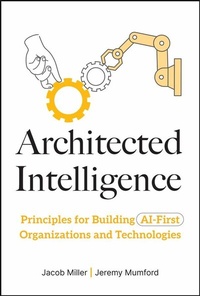
Architected Intelligence
Description

Transform AI potential into organizational results through the Architected Intelligence framework.
The gap between a dazzling "cool demo" and a reliable, production-grade system is a chasm that is swallowing teams and entire organizations. Architected Intelligence is your definitive map at both the organizational and tactical levels to cross this divide. Drawing on their experience building the world's largest ecommerce accelerator, authors Jacob Miller and Jeremy Mumford deliver actionable guidance for organizations struggling to turn proofs of concept into production systems.
Whether you are competing in the age of AI or looking to establish technology leadership in your sector, this book organizes AI success around a unified framework of five core components:
- Design AI Systems to Deliver Impactful Output
- Power AI with High-Quality Input Data
- Engineer, Optimize, and Integrate AI Models
- Create Trust through Observability
- Scale Transformation through AI Enablement
The book also provides:
Practical Roadmaps for Both AI Products and AI Automation: The book provides concrete implementation roadmaps for two of the most critical AI use cases: AI as product features and AI for process automation. Readers leave equipped to avoid the all-or-nothing trap through incremental development and to build systems that perform even as the technology landscape rapidly evolves.
A Toolkit for Trust, Unstructured Data Governance, and Evaluation: Readers learn how to disaggregate trust into its underlying elements, establish comprehensive and feasible unstructured data governance for organizations of any size, and apply a full suite of evaluation methods to determine whether AI systems are genuinely performing.
Built for Technical Executives and the Engineers Who Implement, Architected Intelligence is perfect for technical CEOs, CTOs, product managers, leaders in data science, directors of engineering, and anyone responsible for execution seeking to understand the wider vision. If you want to lead out on AI, this foundational reference will equip you with the mental models and practical tools needed to build AI systems that ship, scale, and succeed.
More details
Other editions
Additional editions
Persons
JACOB MILLER is the Vice President of Data Science at Pattern, the world's largest e-commerce accelerator. He has assisted organizations and leaders implementing AI solutions with demonstrable and immediate benefits.
JEREMY MUMFORD is the Lead AI Engineer at Pattern. He brings together data and software engineering with formal training in databases and data science to build production-ready generative AI systems.
Content
Dedication v
Acknowledgments ix
Introduction 1
COMPONENT 1: DESIGN AI SYSTEMS TO DELIVER IMPACTFUL OUTPUT
Chapter 1: Design for AI 19
Chapter 2: The AI Opportunity Funnel - From Possibilities to Priority 47
Chapter 3: Building Battle-tested AI-first Workflows and Agents 79
COMPONENT 2: POWER AI WITH HIGH-QUALITY INPUT DATA
Chapter 4: AI Unlocks the Potential of Untapped Data 125
Chapter 5: Connect Your Data in Your AI-First Organization 151
Chapter 6: Accelerate Knowledge Transformation with Curation and Feedback Systems 173
COMPONENT 3: ENGINEER, OPTIMIZE, AND INTEGRATE AI MODELS
Chapter 7: Maximizing Model Performance with Input Data 205
Chapter 8: Select and Optimize the Best Models 233
COMPONENT 4: CREATE TRUST THROUGH ROBUST OBSERVABILITY
Chapter 9: Adapting Software Engineering Observability Practices for AI Systems 261
Chapter 10: Adopting Data Science Observability Practices 293
COMPONENT 5: SCALE TRANSFORMATION THROUGH AI ENABLEMENT
Chapter 11: The People to Enable AI Transformations 335
Chapter 12: The Platforms that Power AI-First Organizations 361
Index 387
Introduction
ON NOVEMBER 30, 2022, ChatGPT took both the AI community and the general internet by storm. While previous models seemed like impressive parlor tricks or academic curiosities, this moment marked the dawn of a new general-purpose technology that would irrevocably weave itself into the fabric of our lives.
For the next few years, the capabilities of artificial intelligence (AI) compounded at a rate that felt impossible to keep track of. A decade's worth of progress would advance every three to six months. Our job, much like yours, was to navigate our company as it surfed the technological tsunami.
We found ourselves responsible for architecting the AI foundation for Pattern, a growing tech company with billions in revenue. On one side, the wave of AI progress relentlessly continued. On the other, Pattern sustained over 30% year-over-year growth despite its size. Handling the dual challenges of growth and generational technology initially felt overwhelming, forcing us to dismantle our previous assumptions and rethink our strategy from the ground up.
If you have picked up this book, you may feel "behind," overwhelmed, or perhaps even paralyzed by the fast-changing AI landscape. We want to assure you that this reaction is normal. In fact, even the researchers and engineers at the forefront of this technology feel the same. This book's purpose is to provide a foundation and a set of multidisciplinary principles to help you analyze opportunities, make calculated bets, and execute AI-First transformations and technologies as both a technical team and wider organization. Even as the specific tools and model architectures shift, certain enduring principles and frameworks will remain solid to support you through this journey.
Our approach to AI is the product of two unique perspectives. One perspective stems from decades of experience in enterprise technology, academic data science, and leadership. The other is born from a pure obsession with the bleeding edge of AI, deep fakes, and large language models (LLMs). Our viewpoints frequently clashed, iterated, and eventually evolved into a cohesive approach. We have made our share of mistakes, and we've witnessed the mistakes of others. We've experienced victories and seen peers achieve similar wins. Some victories were temporary, evaporating as soon as the technology shifted, while others proved to be more lasting.
Yet, even between our two perspectives, we felt inadequate to create the framing necessary to navigate the maze of opportunities and trade-offs that presented themselves. We realized that because of AI's breadth, success in this field is inherently multidisciplinary. Consequently, over the last few years we collected the mental models and frameworks from a variety of disciplines, including knowledge systems, governance strategies, and change management, to adapt and anchor lasting principles to the new AI landscape.
We call this multidisciplinary and practical approach Architected Intelligence. It is a methodology that can be understood at a surface level in minutes, provide a working foundation in a few weeks, and facilitate a depth of mastery that extends well beyond what is covered in this book over the course of years.
Regardless of whether you're aiming for a wide foundation or specializing in just one aspect, the vision of how the interlocking pieces fit together to create intelligent systems will accelerate your journey.
ONE USEFUL DEFINITION OF AI
Social media platforms and industry forums are currently overflowing with contentious debates regarding the precise taxonomy of AI, machine learning, data science, and business intelligence. Commentators frequently argue over when AI truly started or if current models even qualify for the title. However, as practitioners, we find little value in drawing overly theoretical lines that do not serve the end product. In this book, we adopt a functional definition grounded in how these technologies are deployed across businesses, nonprofits, governments, startups, and even households.
Artificial intelligence is a dynamic system that processes inputs, recognizes complex patterns, and generates valuable outputs. At its core, AI transforms inputs into value, such as generating new insights, content, or autonomous actions. This output could take the form of a prediction, a creative asset, or a synthesized analyst report.
To distill this concept to its essence, the Architected Intelligence framework views these systems through a mathematical lens. You may recognize this fundamental structure from your high school algebra class:
Where is the model that processes inputs that produces a desired result . In practice, this function operates as follows:
- AI (Symptoms + Travel History) = Recommends a medical test for fungal infection
- AI (Customer Question + Product Diagnostics + Product Knowledge) = Drafts a troubleshooting response suggesting an application reinstall
- AI (Detailed Description of a Scene) = Generates a video of a waterfall
- AI (Industry Reports + Market Commentary) = Predicts emerging industry trends
This book is dedicated to the craft of architecting AI systems and organizations. While you do not need a deep background in math or even software engineering to lead AI initiatives, it is imperative to have a structured approach to designing, scaling, and governing AI systems.
Regardless of whether AI's future capabilities plateau, steadily improve, or make large irregular leaps, the underlying challenges of implementation, scalability, and governance will remain consistent. This book serves as a practical reference for decision-makers facing those challenges.
PATTERNS OF ENDURING SUCCESS IN AI
Across companies and industries, we have observed that enduring success follows a distinct pattern. We refer to those who consistently deploy valuable AI initiatives as AI Builders. These practitioners interrogate their work, either intuitively or explicitly, according to the below five foundational questions (mapped out in Figure I.1) before and during each initiative:
- Does the initiative deliver value?
- Is it powered by high-quality and relevant data?
- Have we configured and optimized the right model for the task?
- Do we have the observability required to create and preserve trust?
- Have we built on an enablement structure to scale?
FIGURE I.1 The five questions AI builders ask.
Each question maps directly to one of the components of the Architected Intelligence framework that forms the structure of this book. While each component stands on its own, and every chapter within that component addresses a specific challenge, the framework is designed to be modular. You can start with the chapter that is most relevant to you and apply its insights immediately.
However, while specific chapters may address immediate needs, AI leaders are best served by cultivating a holistic vision that complements their domain expertise. Even if your primary responsibility lies within a specific area, such as data engineering or product management, understanding how AI systems connect upstream and downstream is critical. In our experience, many AI failures occur at the "seams" between teams rather than within any single function. Leaders who recognize these dependencies are uniquely positioned to anticipate challenges and drive sustained AI implementation.
THE FIVE COMPONENTS OF ARCHITECTED INTELLIGENCE
To transform these abstract questions into a concrete architecture, we have codified them into five components that mirror the workflow of AI Builders, visualized in Figure I.2. The first three components - Output, Input, and Model - comprise the operational core of any AI system. This is the implementation of the equation. The final two components - Observability and Enablement - act as the binding agents that ensure AI is reliable, scalable, and effectively integrated into the business. Using these five components, we can disaggregate complex AI opportunities, balancing strategic intent with technical execution.
FIGURE I.2 A visual framing of the five components of architected intelligence.
The Five Components of Architected Intelligence:
- Component One: Output - Design AI systems to deliver impactful output.
- Component Two: Input - Power AI with high-quality input data.
- Component Three: Model - Engineer, optimize, and integrate AI models.
- Component Four: Observability - Create trust through robust observability.
- Component Five: Enablement - Scale transformation through AI enablement.
Adopting these components accelerates AI-First transformation and delivers key advantages to organizations:
- Comprehensive: It addresses every major aspect of AI initiatives from the perspective of a technical architecture.
- Clear: Each element of an AI initiative fits naturally within one of these principles, providing structure without unnecessary complexity.
- Flexible: The framework applies across diverse AI use cases and contexts, from early-stage startups to global enterprises.
- Unifying: It aligns organization-wide AI strategy while also guiding individual AI applications.
Component One: Output - Design AI Systems to Deliver Impactful Output
A successful AI initiative begins with intent....
