

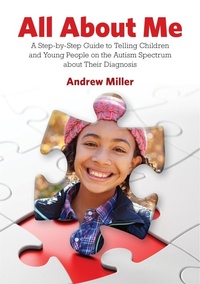
All About Me
A Step-by-Step Guide to Telling Children and Young People on the Autism Spectrum about Their Diagnosis
Published on 18. January 2018
256 pages
978-1-78450-393-2 (ISBN)
Description

Based on direct work with over 250 individual children, Andrew Miller wrote this book in order to provide parents and professionals with information, tools and guidance to help introduce children to autism in the absence of specialist support. This in-depth guide describes the practicalities of disclosure, including when to tell, who should do it and what they need to know beforehand with strategies to tailor your approach as every child's experience will be different. Step-by-step instructions detail how to deliver the programme and produce with a child a personalised booklet containing information about their personal attributes and their autism.
These booklets and follow-up material help make disclosure a positive and constructive experience for everyone. Accompanying material can be downloaded online including questionnaires, examples of children's booklets and flexible templates.
These booklets and follow-up material help make disclosure a positive and constructive experience for everyone. Accompanying material can be downloaded online including questionnaires, examples of children's booklets and flexible templates.
Reviews / Votes
If you're asking, "How do I tell children and young people on the autism spectrum about their diagnosis?" this book is key. Andrew Miller has created a brilliant step by step guide with supporting resources to help make this a positive experience for all involved. This programme was invaluable to my own work and this book is highly recommended. -- Suzanne Goddard, Advisory Teacher for Autism The book is divided into two parts, with the first focusing on preparations to deliver the programme and the second on providing an overview of its teaching methods and introducing the associated electronic resources... There is detailed information about delivering the All About Me programme, that is influenced by the work of recognized experts in this field, and Miller explains the steps to supporting children in the process of completing an editable computer template to produce a unique narrative about themselves and their autism, rather than a generic social story.There are links in the book to on-line resources and sample and templates booklets are available for download, along with additional resources and questionnaires. -- SEN Magazine This fantastic 'how to' book takes adults step by step through the process of telling a child about their autism diagnosis. Written by an author who clearly has a lot of experience in this area, it is sensitively and reassuringly done, and includes lots of the simple, positive, neurodiverse language. -- Davida Hartman, Senior educational psychologist, lecturer, trainer and author specialising in autism
More details
Edition
Digital original
Language
English
Place of publication
London
United Kingdom
Target group
College/higher education
Professional and scholarly
Primary & secondary/elementary & high school
Edition type
Digital original
File size
0,86 MB
ISBN-13
978-1-78450-393-2 (9781784503932)
Copyright in bibliographic data and cover images is held by Nielsen Book Services Limited or by the publishers or by their respective licensors: all rights reserved.
Schweitzer Classification
Other editions
Additional editions
Andrew Miller
All About Me
A Step-by-Step Guide to Telling Children and Young People on the Autism Spectrum about Their Diagnosis
Book
01/2018
Jessica Kingsley Publishers
€38.50
Shipment within 15-20 days
Person
Andrew Miller has worked as an autism advisory teacher in London for 12 years and as an assistant head teacher at a special school for children with autism.
Content
- Intro
- All About Me - A Step-by-Step Guide to TellingChildren and Young People on theAutism Spectrum about their Diagnosis, by Andrew Miller
- Acknowledgements
- Part I - Getting ready to deliver the programme - considerations, decisions and preparation
- Chapter 1 - Introduction
- 1.1 Opening remarks
- 1.2 Terms and definitions used in this book
- 1.3 How All About Me came about
- 1.4 A short description of All About Me and what it intends to do
- 1.5 Who All About Me can be used with
- 1.6 An overview of the book
- 1.7 Research into the effectiveness of All About Me
- Chapter 2 - Arguments for and against telling children about their autism
- 2.1 Introduction
- 2.2 A brief review of the literature surrounding individuals' responses to finding out about their autism diagnosis, or having it withheld
- 2.3 Potential benefits of disclosing a child's diagnosis
- 2.4 Potential risks of disclosing a child's diagnosis
- 2.5 Potential risks of withholding a child's diagnosis
- 2.6 Conclusion
- Chapter 3 - The pre-programme work
- 3.1 Introduction
- 3.2 Deciding when a child should be told about their autism and identifying if they are ready
- 3.3 Identifying whether parents are ready for their child to be told, and how professionals can help them reach this stage
- 3.4 How to identify when the professionals are ready to tell the child
- 3.5 Deciding who should lead the work and who else might need to be involved
- 3.6 Gathering and sharing essential information about the child
- 3.7 Criteria for deciding whether All About Me would be suitable for a child
- 3.8 Deciding where the work should take place: identifying and preparing the right environment
- 3.9 Deciding when the work should take place: choosing the right time for the sessions
- 3.10 Deciding how to present the work to the child
- 3.11 Conclusion
- Part II - Teaching and following up All About Me
- Chapter 4 - An overview of the programme's teaching methods, content and framework
- 4.1 Introduction
- 4.2 The programme's design and teaching methods
- 4.3 A brief overview of the programme content and framework
- Chapter 5 - Teaching Session 1: Creating the context for disclosing the child's diagnosis
- 5.1 Introduction
- 5.2 Teaching and learning objectives for Session 1
- 5.3 Required resources
- 5.4 Introducing the child to All About Me
- 5.5 Introducing Session 1
- 5.6 Stage 1: Exploring the child on the outside
- 5.7 Stage 2: Exploring the child as a person on the inside
- 5.8 Stage 3: Exploring and identifying the child's areas of strength
- 5.9 Stage 4: Identifying the child's challenges
- 5.10 Session summary: What we learned today
- 5.11 Assessing the session and deciding how to proceed
- Chapter 6 - Teaching Sessions 2 and 3: Disclosing and explaining the child's diagnosis
- 6.1 Introduction
- 6.2 Teaching and learning objectives
- 6.3 Preparing for Session 2
- 6.4 The final pre-disclosure meeting with the child's parents
- 6.5 Introducing the child to Session 2
- 6.6 Stage 5: 'I have autism' (disclosing the diagnosis)
- 6.7 Stage 6: other people with autism
- 6.8 Stage 7: Explaining autism to the child
- 6.9 Stage 8: Informing the child about their support network
- 6.10 Stage 9: Autism and special interests
- 6.11 Stage 10: 'Who am I?'
- 6.12 Monitoring and supporting the child between Sessions 2 and 3
- 6.13 Making the booklet in preparation for Session 3
- 6.14 Session 3: Revision and assessment session
- 6.15 Addressing key issues that can occur and persist across Sessions 2 and 3
- 6.16 Summary
- Chapter 7 - Differentiating All About Me to make it accessible to more children
- 7.1 Introduction
- 7.2 Meeting individual children's cognitive, communication and literacy needs
- 7.3 Strategies for including children with behavioural issues
- 7.4 Conclusion
- Chapter 8 - What next?
- 8.1 Introduction
- 8.2 Continuing the processes of teaching children about their autism and helping them learn to understand and live with their diagnosis
- 8.3 Developing a child's engagement with their school work, support, and planning for the future
- 8.4 Sharing the diagnosis with siblings, other family members and friends
- 8.5 Informing school staff and other professionals about a child's diagnosis
- 8.6 Sharing a child's diagnosis with their classmates
- 8.7 Proving to the child that it is okay to have autism
- Chapter 9 - A brief guide to the electronic resources
- 9.1 Introduction
- 9.2 Section A: Pre-programme information-gathering and recording forms
- 9.3 Section B: Example All About Me booklets
- 9.4 Section C: All About Me booklet templates
- 9.5 Section D: Teaching and learning prompts
- 9.6 Section E: Resources for follow-up initiatives
- References
- Bibliography for the electronic resources
- Blank Page
