

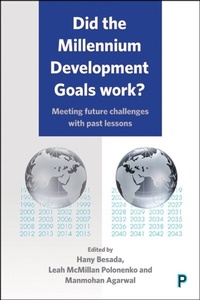
Did the Millennium Development Goals Work?
Meeting Future Challenges with Past Lessons
Policy Press
1st Edition
Published on 20. September 2017
512 pages
978-1-4473-3571-9 (ISBN)
Description

With the target date for the Millennium Development Goals (MDGs) behind us, this book asks did they work? And what happens next? Arguing that to effectively look forward, we must first look back, the editors of this insightful book gather leading scholars and practitioners from a range of backgrounds and regions to provide an in-depth exploration of the MDG project and its impact.
Contributors use region-specific case studies to explore the effectiveness of the MDGs in addressing the root causes of poverty, including resource geographies, early childhood development and education, women's rights and disability rights as well as the impact of the global financial crisis and Arab Spring on MDG attainment.
Providing a critical assessment that seeks to inform future policy decisions, the book will be valuable to those working in the development community as well as to academics and students of international development, international relations and development economics.
Contributors use region-specific case studies to explore the effectiveness of the MDGs in addressing the root causes of poverty, including resource geographies, early childhood development and education, women's rights and disability rights as well as the impact of the global financial crisis and Arab Spring on MDG attainment.
Providing a critical assessment that seeks to inform future policy decisions, the book will be valuable to those working in the development community as well as to academics and students of international development, international relations and development economics.
Reviews / Votes
"Assessing the MDGs is a vital undertaking. Consideration of its success, failures and lessons will light the way forward." Professor Matthew Clarke, Deakin UniversityMore details
Edition
First Edition
Language
English
Place of publication
Bristol
United Kingdom
Publishing group
Bristol University Press
Target group
Professional and scholarly
Illustrations
29 s/w Abbildungen, 34 s/w Tabellen
34 Tables, black and white; 29 Illustrations, black and white
ISBN-13
978-1-4473-3571-9 (9781447335719)
DOI
https://doi.org/10.51952/9781447335719
Copyright in bibliographic data and cover images is held by Nielsen Book Services Limited or by the publishers or by their respective licensors: all rights reserved.
Schweitzer Classification
Other editions
Additional editions
Did the Millennium Development Goals Work?
Meeting Future Challenges with Past Lessons
Book
09/2017
1st Edition
Policy Press
€111.40
Shipment within 15-20 days
Did the Millennium Development Goals Work?
Meeting Future Challenges with Past Lessons
E-Book
09/2017
1st Edition
Policy Press
€54.99
Available for download
Persons
Hany Besada is Deputy Executive Director, Diamond Development Initiative (DDI) and Research Professor at the Institute of African Studies, Carleton University. He is also Non-Resident Senior Research Fellow with the UN University Institute for Natural Resources in Africa, United Nations, and a Senior Fellow with the Centre on Governance at the University of Ottawa.
Dr. Leah McMillan Polonenko is a research consultant and project evaluator with over a decade experience assessing implications of social policies in Africa. She is Project Coordinator for the Kenyan Portfolio of Edu-Vision 2020 and a Research Fellow with the Tshepo Institute for the Study of Contemporary Africa. She is a visiting lecturer at several universities.
Professor Manmohan Agarwal teaches at the Centre of International Trade and Development, Jawaharlal Nehru University, India. He has also worked at the World Bank and the IMF.
Dr. Leah McMillan Polonenko is a research consultant and project evaluator with over a decade experience assessing implications of social policies in Africa. She is Project Coordinator for the Kenyan Portfolio of Edu-Vision 2020 and a Research Fellow with the Tshepo Institute for the Study of Contemporary Africa. She is a visiting lecturer at several universities.
Professor Manmohan Agarwal teaches at the Centre of International Trade and Development, Jawaharlal Nehru University, India. He has also worked at the World Bank and the IMF.
Content
Foreword ~ Timothy M Shaw;
Introduction: Meeting Future Challenges with Past Lessons ~ Leah McMillan Polonenko and Hany Besada;
Part One: Global Challenges;
Antipoverty Transfers and Zero Extreme Poverty Targets ~ Armando Barrientos;
Fragile and Conflict-affected Situations and the post-2015 Development Agenda ~ Clare Lockhart and Samuel Vincent;
The Impact of the Global Financial Crisis on Millennium Development Goal Attainment in Africa ~ Leah McMillan Polonenko;
Resource Geographies in Urban Spaces: Insights from Developing Countries in the Post-2015 Era ~ Cristina D'Alessandro;
Part Two: Minority Groups;
The Millennium Development Goals, Disability Rights and Special Needs Education in Ethiopia: A Case Study of the Oromiya Region ~ Jeff Grischow;
Facing the Global Challenge of Youth Employment ~ Ragui Assaad and Deborah Levison;
Women's Role in Economic Development: Overcoming the Constraints ~ Sarah Bradshaw with Joshua Castellino and Bineta Diop;
Marginalised Minorities in Conflict: Women and Millennium Development Goals ~ Sarah Hoesch and Alireza Saniei-Pour;
Part Three: Micro Challenges
Ideas from Early Childhood Development Approaches to Contribute to Millennium Development Goals' Achievements in Latin America ~ Laura Agosta;
Exploring the National Economic Empowerment and Development Strategy (NEEDS) as a micro-Millennium Development Goals' Framework in Nigeria ~ Adebusuyi Isaac Adeniran;
Developmental Crises affecting the United Nations Millennium Development Goals Achievements in Bangladesh: A Critical Perspective ~ Saleh Ahmed;
Between Progress, Stasis and Reversals: An Analysis of the Millennium Development Goals in Nigeria ~ Olabanji Akinola;
North Africa and Middle East: Economic Performance and Social Progress ~ Manmohan Argarwal and Badye Essid;
Part Four: Looking Forward;
United Nations Millennium Development Goals (UN MDGs) and the Arab Spring: Shedding Light on the Preludes? ~ M. Evren Tok, Nancy Elbassiouny, Sofia Samper and Mohammed Sayeed Showkath;
Food Security, Inclusive Growth, Sustainability, and the Sustainable Development Agenda ~ Craig Hanson with contributions from Tim Searchinger, Richard Waite, Betsy Otto, Brian Lipinski and Kelly Levin;
Outlook for Global Development Finance - Excess or Shortage? ~ Andrew Sheng;
Conclusion ~ Jason McFarlane, Hany Besada, Kathryn Anne Brunton and Alireza Saniei-Pour.
Introduction: Meeting Future Challenges with Past Lessons ~ Leah McMillan Polonenko and Hany Besada;
Part One: Global Challenges;
Antipoverty Transfers and Zero Extreme Poverty Targets ~ Armando Barrientos;
Fragile and Conflict-affected Situations and the post-2015 Development Agenda ~ Clare Lockhart and Samuel Vincent;
The Impact of the Global Financial Crisis on Millennium Development Goal Attainment in Africa ~ Leah McMillan Polonenko;
Resource Geographies in Urban Spaces: Insights from Developing Countries in the Post-2015 Era ~ Cristina D'Alessandro;
Part Two: Minority Groups;
The Millennium Development Goals, Disability Rights and Special Needs Education in Ethiopia: A Case Study of the Oromiya Region ~ Jeff Grischow;
Facing the Global Challenge of Youth Employment ~ Ragui Assaad and Deborah Levison;
Women's Role in Economic Development: Overcoming the Constraints ~ Sarah Bradshaw with Joshua Castellino and Bineta Diop;
Marginalised Minorities in Conflict: Women and Millennium Development Goals ~ Sarah Hoesch and Alireza Saniei-Pour;
Part Three: Micro Challenges
Ideas from Early Childhood Development Approaches to Contribute to Millennium Development Goals' Achievements in Latin America ~ Laura Agosta;
Exploring the National Economic Empowerment and Development Strategy (NEEDS) as a micro-Millennium Development Goals' Framework in Nigeria ~ Adebusuyi Isaac Adeniran;
Developmental Crises affecting the United Nations Millennium Development Goals Achievements in Bangladesh: A Critical Perspective ~ Saleh Ahmed;
Between Progress, Stasis and Reversals: An Analysis of the Millennium Development Goals in Nigeria ~ Olabanji Akinola;
North Africa and Middle East: Economic Performance and Social Progress ~ Manmohan Argarwal and Badye Essid;
Part Four: Looking Forward;
United Nations Millennium Development Goals (UN MDGs) and the Arab Spring: Shedding Light on the Preludes? ~ M. Evren Tok, Nancy Elbassiouny, Sofia Samper and Mohammed Sayeed Showkath;
Food Security, Inclusive Growth, Sustainability, and the Sustainable Development Agenda ~ Craig Hanson with contributions from Tim Searchinger, Richard Waite, Betsy Otto, Brian Lipinski and Kelly Levin;
Outlook for Global Development Finance - Excess or Shortage? ~ Andrew Sheng;
Conclusion ~ Jason McFarlane, Hany Besada, Kathryn Anne Brunton and Alireza Saniei-Pour.
