

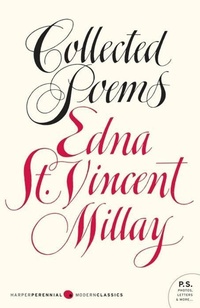
Collected Poems
Description

Edna St. Vincent Millay (1892-1950), winner in 1923 of the second annual Pulitzer Prize for Poetry, was a daring, versatile writer whose work includes plays, essays, short stories, songs, and the libretto to an opera that premiered at New York's Metropolitan Opera House to rave reviews.
Millay infused new life into traditional poetic forms, bringing new hope to a generation of youth disillusioned by the political and social upheaval of the First World War. She ventured fearlessly beyond familiar poetic subjects to tackle political injustice, social discrimination, and women's sexuality in her poems and prose. In the 1920s and '30s, Millay was considered a spokesperson for personal freedom in America, particularly for women, and we turn to her lines to illuminate the social history of the period and the Bohemian lifestyle she and her friends enjoyed.
Yet Millay's poetry is still decisively modern in its message, and it continues to resonate with readers facing personal and moral issues that defy the test of time: romantic love, loss, betrayal, compassion for one another, social equality, patriotism, and the stewardship of the natural world.
Collected Poems features Millay's incisive and impassioned lyric poetry and sonnets, many of which are considered among the finest in the language, as well as the poet's last volume, Mine the Harvest, compiled and published in 1956 by her sister Norma Millay.
More details
Other editions
Additional editions
Person
After graduating in 1917 she lived in Greenwich Village in New York for a few years, acting, writing satirical pieces for journals (usually under a pseudonym), and continuing to work at her poetry. She traveled in Europe throughout 1921-22 as a "foreign correspondent" for Vanity Fair. Her collection A Few Figs from Thistles (1920) gained her a reputation for hedonistic wit and cynicism, but her other collections (including the earlier Renascence and Other Poems [1917]) are without exception more seriously passionate or reflective.
In 1923 she married Eugene Boissevain and -- after further travel -- embarked on a series of reading tours which helped to consolidate her nationwide renown. From 1925 onwards she lived at Steepletop, a farmstead in Austerlitz, New York, where her husband protected her from all responsibilities except her creative work. Often involved in feminist or political causes (including the Sacco-Vanzetti case of 1927), she turned to writing anti-fascist propaganda poetry in 1940 and further damaged a reputation already in decline. In her last years of her life she became more withdrawn and isolated, and her health, which had never been robust, became increasingly poor.
She died in 1950.
