

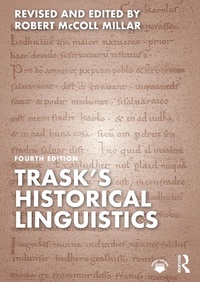
Trask's Historical Linguistics
4th Edition
Published on 18. May 2023
410 pages
978-1-000-86111-2 (ISBN)
Description

Trask's Historical Linguistics provides an accessible introduction to historical linguistics - the study of language change over time. This engaging book is illustrated with language examples from all six continents, and covers the fundamental concepts of language change, methods for historical linguistics, linguistic reconstruction, sociolinguistic aspects of language change, language contact, the birth and death of languages, language and prehistory, and the issue of very remote relations.
The fourth edition of this renowned textbook is fully revised and updated and covers the most recent developments in historical linguistics, including:
A thorough reworking of sections on morphological and syntactic change, incorporating progress in areas such as grammaticalization and the discussion of the Indo-European 'homeland'
Discussion and analysis of 'folk' historical linguistics and its connection with some of the more eccentric views of professional linguists
An expanded discussion of language contact, historical sociolinguistics, and language planning, including a discussion of contemporary competing views on the genesis and nature of creoles, and their importance in our understanding of radical linguistic change
Updated support material including suggestions for essay questions and a larger number of supporting examples of the phenomena described in the book
Trask's Historical Linguistics is essential reading for advanced undergraduate and postgraduate students of historical linguistics as well as any student looking for a grounded introduction to the English language.
The fourth edition of this renowned textbook is fully revised and updated and covers the most recent developments in historical linguistics, including:
A thorough reworking of sections on morphological and syntactic change, incorporating progress in areas such as grammaticalization and the discussion of the Indo-European 'homeland'
Discussion and analysis of 'folk' historical linguistics and its connection with some of the more eccentric views of professional linguists
An expanded discussion of language contact, historical sociolinguistics, and language planning, including a discussion of contemporary competing views on the genesis and nature of creoles, and their importance in our understanding of radical linguistic change
Updated support material including suggestions for essay questions and a larger number of supporting examples of the phenomena described in the book
Trask's Historical Linguistics is essential reading for advanced undergraduate and postgraduate students of historical linguistics as well as any student looking for a grounded introduction to the English language.
Reviews / Votes
Since its first publication in 1996, Trask's Historical Linguistics has been the resource for teaching historical linguistics. It's great to have a new edition, carefully updated and revised by language change expert McColl Millar, so that future generations can also work with this gem of a textbook!Professor Alexander Bergs, Osnabrueck University, Germany
Trask's Historical Linguistics is that rare thing: a wide-ranging textbook for both undergraduates and postgraduates that is not only as an authoritative introduction to the topic but also offers new insights into major research problems. Robert McColl Millar's latest revision is a tour-de-force of clear, up-to-date and indeed inspirational exposition. It can be heartily recommended.
Jeremy J. Smith, University of Glasgow, Scotland
More details
Edition
4th edition
Language
English
Place of publication
London
United Kingdom
Publishing group
Taylor & Francis Ltd
Target group
College/higher education
Illustrations
76 Tables, black and white; 32 Line drawings, black and white; 32 Illustrations, black and white
ISBN-13
978-1-000-86111-2 (9781000861112)
Copyright in bibliographic data and cover images is held by Nielsen Book Services Limited or by the publishers or by their respective licensors: all rights reserved.
Schweitzer Classification
Other editions
Additional editions
Robert McColl Millar | R. L. Trask
Trask's Historical Linguistics
Book
05/2023
4th Edition
Routledge
€59.20
Shipment within 15-20 days
Robert McColl Millar | R. L. Trask
Trask's Historical Linguistics
Book
05/2023
4th Edition
Routledge
€197.40
Shipment within 15-20 days
Persons
Robert McColl Millar is Professor of Linguistics and Scottish Language at the University of Aberdeen, Scotland. He has published widely on, amongst other things, linguistic contact and rapid language change, the sociology of language, and dialectology. His most recent publications include Contact: The Interaction of Closely Related Linguistic Varieties and the History of English (2016) and A Sociolinguistic History of Scotland (2020). He has recently completed A History of the Scots Language, which will be published in 2023.
R L Trask was Professor of Linguistics at the University of Sussex, UK, and a leading authority on Basque language and historical linguistics. His book The History of Basque (1997) is an essential reference on diachronic Basque linguistics, and probably the best-known introduction to Basque linguistics. He also wrote about the problem of the origin of language and, amongst his other publications, the very successful foundational text, Language: The Basics (1995).
R L Trask was Professor of Linguistics at the University of Sussex, UK, and a leading authority on Basque language and historical linguistics. His book The History of Basque (1997) is an essential reference on diachronic Basque linguistics, and probably the best-known introduction to Basque linguistics. He also wrote about the problem of the origin of language and, amongst his other publications, the very successful foundational text, Language: The Basics (1995).
Content
List of illustrations
To the reader
To the teacher
Acknowledgements
Abbreviations
1. The fact of language change
1.1 Irregardless
1.2 English then and now
1.3 Attitudes to language change
1.4 The inevitability of change
Case-study: kind regards
Further reading
Exercises
2. Lexical and semantic change
2.1 Borrowing
2.2 Phonological treatment of loans
2.3 Morphological treatment of loans
2.4 Formation of new words
2.5 Change in word-meaning
Case study: nice
Further reading
Exercises
3. Phonological change 1: Change in pronunciation
3.1 The phonetic basis of phonological change
3.2 Assimilation and dissimilation
3.3 Lenition and fortition
3.4 Addition and removal of phonetic features
3.5 Vowels and syllable structure
3.6 Whole-segment processes
3.7 The regularity issue: a first look
Case study: Germanic */xw/ in the present-day dialects
3.8 Summary
Further reading
Exercises
4. Phonological change II: Change in phonological systems
4.1 Conditioning and rephonologization
4.2 Phonological space
4.3 Chain shifts
Case study: large scale change in the Germanic consonant system - Grimm's Law and Verner's Law
4.4 Summary
Further reading
Exercises
5. Morphological change
5.1 Reanalysis
5.2 Analogy and levelling
5.3 Universal principles of analogy
5.4 Morphologization
5.5 Morphologization of phonological rules
5.6 Change in morphological type
Case study: The evolution of the definite article from the demonstrative paradigm in English
Further reading
Exercises
6. Syntactic change
6.1 Reanalysis of surface structure
6.2 Shift of markedness
6.3 Grammaticalization
6.4 Typological harmony
6.5 Syntactic change as restructuring of grammars
Case study: the rise of ergativity
Further reading
Exercises
7. Relatedness between languages
7.1 The origin of dialects
7.2 Dialect geography
7.4 Tree model and wave model
7.5 The language families of the world
Case study: A Martian's view on the Germanic language family
Further reading
Exercises
8. The comparative method
8.1 Systematic correspondences
8.2 Comparative reconstruction
8.3 Pitfalls and limitations
8.4 The Neogrammarian Hypothesis
8.5 Semantic reconstruction
8.6 The use of typology and universals
8.7 Reconstructing grammar
8.8 The reality of proto-languages
Case study: A reconstruction too far?
Further reading
Exercises
9. Internal Reconstruction
9.1 A first look at the internal method
9.2 Alternations and internal reconstruction
9.3 Internal reconstruction of grammar and lexicon
Case study: The laryngeal theory of PIE
Further reading
Exercises
10. The origin and propagation of change
10.1 The Saussurean paradox
10.2 Variation and social stratification
10.3 Variation as the vehicle of change
10.4 Lexical diffusion
10.5 Near-mergers
Case study: historical sociolinguistics
Further reading
Exercises
11. Social and historical pressures upon language
11.1 Linguistic contact
11.2 Linguistic areas
11.3 Language birth: pidgins and creoles
11.4 Language planning
11.5 Language death
Case study: the genesis and development of American and New Zealand English
Further reading
Exercises
12. Language and pre-history
12.1 Introduction
12.2 Linguistic palaeontology
12.3 Links with archaeology
12.4 Statistical methods
Case study: Greenberg's mass comparison
Further reading
Exercises
Appendix: The Swadesh 200-word list
References
Index
To the reader
To the teacher
Acknowledgements
Abbreviations
1. The fact of language change
1.1 Irregardless
1.2 English then and now
1.3 Attitudes to language change
1.4 The inevitability of change
Case-study: kind regards
Further reading
Exercises
2. Lexical and semantic change
2.1 Borrowing
2.2 Phonological treatment of loans
2.3 Morphological treatment of loans
2.4 Formation of new words
2.5 Change in word-meaning
Case study: nice
Further reading
Exercises
3. Phonological change 1: Change in pronunciation
3.1 The phonetic basis of phonological change
3.2 Assimilation and dissimilation
3.3 Lenition and fortition
3.4 Addition and removal of phonetic features
3.5 Vowels and syllable structure
3.6 Whole-segment processes
3.7 The regularity issue: a first look
Case study: Germanic */xw/ in the present-day dialects
3.8 Summary
Further reading
Exercises
4. Phonological change II: Change in phonological systems
4.1 Conditioning and rephonologization
4.2 Phonological space
4.3 Chain shifts
Case study: large scale change in the Germanic consonant system - Grimm's Law and Verner's Law
4.4 Summary
Further reading
Exercises
5. Morphological change
5.1 Reanalysis
5.2 Analogy and levelling
5.3 Universal principles of analogy
5.4 Morphologization
5.5 Morphologization of phonological rules
5.6 Change in morphological type
Case study: The evolution of the definite article from the demonstrative paradigm in English
Further reading
Exercises
6. Syntactic change
6.1 Reanalysis of surface structure
6.2 Shift of markedness
6.3 Grammaticalization
6.4 Typological harmony
6.5 Syntactic change as restructuring of grammars
Case study: the rise of ergativity
Further reading
Exercises
7. Relatedness between languages
7.1 The origin of dialects
7.2 Dialect geography
7.4 Tree model and wave model
7.5 The language families of the world
Case study: A Martian's view on the Germanic language family
Further reading
Exercises
8. The comparative method
8.1 Systematic correspondences
8.2 Comparative reconstruction
8.3 Pitfalls and limitations
8.4 The Neogrammarian Hypothesis
8.5 Semantic reconstruction
8.6 The use of typology and universals
8.7 Reconstructing grammar
8.8 The reality of proto-languages
Case study: A reconstruction too far?
Further reading
Exercises
9. Internal Reconstruction
9.1 A first look at the internal method
9.2 Alternations and internal reconstruction
9.3 Internal reconstruction of grammar and lexicon
Case study: The laryngeal theory of PIE
Further reading
Exercises
10. The origin and propagation of change
10.1 The Saussurean paradox
10.2 Variation and social stratification
10.3 Variation as the vehicle of change
10.4 Lexical diffusion
10.5 Near-mergers
Case study: historical sociolinguistics
Further reading
Exercises
11. Social and historical pressures upon language
11.1 Linguistic contact
11.2 Linguistic areas
11.3 Language birth: pidgins and creoles
11.4 Language planning
11.5 Language death
Case study: the genesis and development of American and New Zealand English
Further reading
Exercises
12. Language and pre-history
12.1 Introduction
12.2 Linguistic palaeontology
12.3 Links with archaeology
12.4 Statistical methods
Case study: Greenberg's mass comparison
Further reading
Exercises
Appendix: The Swadesh 200-word list
References
Index
