

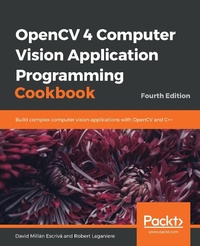
OpenCV 4 Computer Vision Application Programming Cookbook
Build complex computer vision applications with OpenCV and C++
4th Edition
Published on 23. September 2024
494 pages
978-1-78934-528-5 (ISBN)
Description

Discover interesting recipes to help you understand the concepts of object detection, image processing, and facial detection
Key Features
Explore the latest features and APIs in OpenCV 4 and build computer vision algorithms
Develop effective, robust, and fail-safe vision for your applications
Build computer vision algorithms with machine learning capabilities
Book DescriptionOpenCV is an image and video processing library used for all types of image and video analysis. Throughout the book, you'll work with recipes to implement a variety of tasks. With 70 self-contained tutorials, this book examines common pain points and best practices for computer vision (CV) developers. Each recipe addresses a specific problem and offers a proven, best-practice solution with insights into how it works, so that you can copy the code and configuration files and modify them to suit your needs. This book begins by guiding you through setting up OpenCV, and explaining how to manipulate pixels. You'll understand how you can process images with classes and count pixels with histograms. You'll also learn detecting, describing, and matching interest points. As you advance through the chapters, you'll get to grips with estimating projective relations in images, reconstructing 3D scenes, processing video sequences, and tracking visual motion. In the final chapters, you'll cover deep learning concepts such as face and object detection. By the end of this book, you'll have the skills you need to confidently implement a range of computer vision algorithms to meet the technical requirements of your complex CV projects.What you will learn
Install and create a program using the OpenCV library
Segment images into homogenous regions and extract meaningful objects
Apply image filters to enhance image content
Exploit image geometry to relay different views of a pictured scene
Calibrate the camera from different image observations
Detect people and objects in images using machine learning techniques
Reconstruct a 3D scene from images
Explore face detection using deep learning
Who this book is forIf you're a CV developer or professional who already uses or would like to use OpenCV for building computer vision software, this book is for you. You'll also find this book useful if you're a C++ programmer looking to extend your computer vision skillset by learning OpenCV.
Key Features
Explore the latest features and APIs in OpenCV 4 and build computer vision algorithms
Develop effective, robust, and fail-safe vision for your applications
Build computer vision algorithms with machine learning capabilities
Book DescriptionOpenCV is an image and video processing library used for all types of image and video analysis. Throughout the book, you'll work with recipes to implement a variety of tasks. With 70 self-contained tutorials, this book examines common pain points and best practices for computer vision (CV) developers. Each recipe addresses a specific problem and offers a proven, best-practice solution with insights into how it works, so that you can copy the code and configuration files and modify them to suit your needs. This book begins by guiding you through setting up OpenCV, and explaining how to manipulate pixels. You'll understand how you can process images with classes and count pixels with histograms. You'll also learn detecting, describing, and matching interest points. As you advance through the chapters, you'll get to grips with estimating projective relations in images, reconstructing 3D scenes, processing video sequences, and tracking visual motion. In the final chapters, you'll cover deep learning concepts such as face and object detection. By the end of this book, you'll have the skills you need to confidently implement a range of computer vision algorithms to meet the technical requirements of your complex CV projects.What you will learn
Install and create a program using the OpenCV library
Segment images into homogenous regions and extract meaningful objects
Apply image filters to enhance image content
Exploit image geometry to relay different views of a pictured scene
Calibrate the camera from different image observations
Detect people and objects in images using machine learning techniques
Reconstruct a 3D scene from images
Explore face detection using deep learning
Who this book is forIf you're a CV developer or professional who already uses or would like to use OpenCV for building computer vision software, this book is for you. You'll also find this book useful if you're a C++ programmer looking to extend your computer vision skillset by learning OpenCV.
More details
Edition
4th Revised edition
Language
English
Place of publication
Birmingham
United Kingdom
Target group
Professional and scholarly
US School Grade: College Graduate Student
Edition type
Revised edition
File size
34,52 MB
ISBN-13
978-1-78934-528-5 (9781789345285)
Copyright in bibliographic data and cover images is held by Nielsen Book Services Limited or by the publishers or by their respective licensors: all rights reserved.
Schweitzer Classification
Other editions
Additional editions
David Millan Escriva | Robert Laganiere
OpenCV 4 Computer Vision Application Programming Cookbook
Build complex computer vision applications with OpenCV and C++
Book
05/2019
4th Edition
Packt Publishing
€52.60
Shipment within 3-4 weeks
Persons
Millan Escriva David :
David Millan Escriva was 8 years old when he wrote his first program on an 8086 PC in Basic, which enabled the 2D plotting of basic equations. In 2005, he finished his studies in IT with honors, through the Universitat Politecnica de Valencia, in human-computer interaction supported by computer vision with OpenCV (v0.96). He has worked with Blender, an open source, 3D software project, and on its first commercial movie, Plumiferos, as a computer graphics software developer. David has more than 10 years' experience in IT, with experience in computer vision, computer graphics, pattern recognition, and machine learning, working on different projects, and at different start-ups, and companies. He currently works as a researcher in computer vision.Laganiere Robert :
Robert Laganiere is a professor at the School of Electrical Engineering and Computer Science of the University of Ottawa, Canada. He is also a faculty member of the VIVA research lab and is the co-author of several scientific publications and patents in content based video analysis, visual surveillance, driver-assistance, object detection, and tracking. Robert authored the OpenCV2 Computer Vision Application Programming Cookbook in 2011 and co-authored Object Oriented Software Development published by McGraw Hill in 2001. He co-founded Visual Cortek in 2006, an Ottawa-based video analytics start-up that was later acquired by iwatchlife.com in 2009. He is also a consultant in computer vision and has assumed the role of Chief Scientist in a number of start-up companies such as Cognivue Corp, iWatchlife, and Tempo Analytics. Robert has a Bachelor of Electrical Engineering degree from Ecole Polytechnique in Montreal (1987) and MSc and PhD degrees from INRS-Telecommunications, Montreal (1996). You can visit the author's website at laganiere.name.
David Millan Escriva was 8 years old when he wrote his first program on an 8086 PC in Basic, which enabled the 2D plotting of basic equations. In 2005, he finished his studies in IT with honors, through the Universitat Politecnica de Valencia, in human-computer interaction supported by computer vision with OpenCV (v0.96). He has worked with Blender, an open source, 3D software project, and on its first commercial movie, Plumiferos, as a computer graphics software developer. David has more than 10 years' experience in IT, with experience in computer vision, computer graphics, pattern recognition, and machine learning, working on different projects, and at different start-ups, and companies. He currently works as a researcher in computer vision.Laganiere Robert :
Robert Laganiere is a professor at the School of Electrical Engineering and Computer Science of the University of Ottawa, Canada. He is also a faculty member of the VIVA research lab and is the co-author of several scientific publications and patents in content based video analysis, visual surveillance, driver-assistance, object detection, and tracking. Robert authored the OpenCV2 Computer Vision Application Programming Cookbook in 2011 and co-authored Object Oriented Software Development published by McGraw Hill in 2001. He co-founded Visual Cortek in 2006, an Ottawa-based video analytics start-up that was later acquired by iwatchlife.com in 2009. He is also a consultant in computer vision and has assumed the role of Chief Scientist in a number of start-up companies such as Cognivue Corp, iWatchlife, and Tempo Analytics. Robert has a Bachelor of Electrical Engineering degree from Ecole Polytechnique in Montreal (1987) and MSc and PhD degrees from INRS-Telecommunications, Montreal (1996). You can visit the author's website at laganiere.name.
Content
Table of Contents
Playing with Images
Manipulating the Pixels
Processing Color Images with Classes
Counting the Pixels with Histograms
Transforming Images with Morphological Operations
Filtering the Images
Extracting Lines, Contours, and Components
Detecting Interest Points
Describing and Matching Interest Points
Estimating Projective Relations in Images
Reconstructing 3D Scenes
Processing Video Sequences
Tracking Visual Motion
Learning from Examples
OpenCV Advanced Features
Playing with Images
Manipulating the Pixels
Processing Color Images with Classes
Counting the Pixels with Histograms
Transforming Images with Morphological Operations
Filtering the Images
Extracting Lines, Contours, and Components
Detecting Interest Points
Describing and Matching Interest Points
Estimating Projective Relations in Images
Reconstructing 3D Scenes
Processing Video Sequences
Tracking Visual Motion
Learning from Examples
OpenCV Advanced Features
