

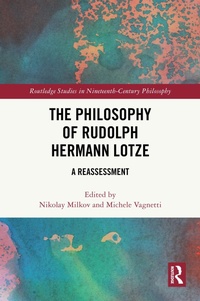
The Philosophy of Rudolph Hermann Lotze
A Reassessment
1st Edition
Published on 4. March 2026
342 pages
978-1-040-53544-8 (ISBN)
Description

Rudolph Hermann Lotze (1817-1881) was a leading figure of late 19th-century German philosophy. This volume provides a comprehensive reassessment of Lotze's thought and analyzes the many different aspects of his logic, metaphysics, epistemology, and philosophy of mind.
Lotze reconsidered the philosophy of German Idealism and initiated an objectivist turn that was instrumental in the development of leading philosophical movements of the 20th century, including analytic philosophy, phenomenology, and pragmatism. This volume seeks to demonstrate the importance of Lotze's thought to the history of philosophy. Part 1 addresses Lotze's influence on and relatedness to the thought of Franz Brentano, Thomas Hill Green, Francis Herbert Bradley, James Ward, Emily Elizabeth Constance Jones, William James, Edmund Husserl, Wilhelm Windelband, Gottlob Frege and Ludwig Wittgenstein and to two philosophers who brought Lotze to his turn in philosophy, Jakob Friedrich Fries and Johann Friedrich Herbart. Part 2 focuses on the connection between metaphysics and epistemology in the early Lotze, on the problem of value in Lotze's "greater" Logik, on his explorations on the foundations of mathematics, on the relationship between thought and language, on human sentience, on the method of hypotheses in science, and on Lotze's logic of existence and existence-entailing concepts.
The Philosophy of Rudolph Hermann Lotze will appeal to scholars and graduate students interested in the history of philosophy, particularly 19th-century German philosophy and the history of analytic philosophy and phenomenology.
Lotze reconsidered the philosophy of German Idealism and initiated an objectivist turn that was instrumental in the development of leading philosophical movements of the 20th century, including analytic philosophy, phenomenology, and pragmatism. This volume seeks to demonstrate the importance of Lotze's thought to the history of philosophy. Part 1 addresses Lotze's influence on and relatedness to the thought of Franz Brentano, Thomas Hill Green, Francis Herbert Bradley, James Ward, Emily Elizabeth Constance Jones, William James, Edmund Husserl, Wilhelm Windelband, Gottlob Frege and Ludwig Wittgenstein and to two philosophers who brought Lotze to his turn in philosophy, Jakob Friedrich Fries and Johann Friedrich Herbart. Part 2 focuses on the connection between metaphysics and epistemology in the early Lotze, on the problem of value in Lotze's "greater" Logik, on his explorations on the foundations of mathematics, on the relationship between thought and language, on human sentience, on the method of hypotheses in science, and on Lotze's logic of existence and existence-entailing concepts.
The Philosophy of Rudolph Hermann Lotze will appeal to scholars and graduate students interested in the history of philosophy, particularly 19th-century German philosophy and the history of analytic philosophy and phenomenology.
Reviews / Votes
"No one interested in the philosophy of Lotze should miss reading this definitive survey of his thought and intellectual legacy."Federico Boccaccini, University of Liege, Belgium
More details
Series
Edition
1. Auflage
Language
English
Place of publication
London
United Kingdom
Publishing group
Taylor & Francis Ltd
Target group
College/higher education
Illustrations
1 Line drawings, black and white; 1 Illustrations, black and white
File size
3,18 MB
ISBN-13
978-1-040-53544-8 (9781040535448)
Copyright in bibliographic data and cover images is held by Nielsen Book Services Limited or by the publishers or by their respective licensors: all rights reserved.
Schweitzer Classification
Other editions
Additional editions
Book
approx. 03/2026
1st Edition
Routledge
€212.00
Not yet published
Persons
Nikolay Milkov is Professor of Philosophy at the University of Paderborn, Germany. He is the author of seven books including Early Analytic Philosophy and the German Philosophical Tradition (2020), Hermann Lotze's Influence on Twentieth Century Philosophy (2023) and The Tractatus, Wittgenstein's Method and Analytic Philosophy (2025).
Michele Vagnetti is a Research Associate at the University of Florence. He is the author of Hermann Lotze on the Mind-Body Problem and the 19th Century Philosophy and Psychology: With Special Attention to William James (doctoral dissertation, 2020).
Michele Vagnetti is a Research Associate at the University of Florence. He is the author of Hermann Lotze on the Mind-Body Problem and the 19th Century Philosophy and Psychology: With Special Attention to William James (doctoral dissertation, 2020).
Content
Introduction Nikolay Milkov and Michele Vagnetti Part 1: Lotze and Other Philosophers 1. Fries and Lotze Michele Vagnetti 2. On Lotze's Role in the Psychologismusstreit: Between Herbart and Beneke Mario Ariel Gonzalez Porta 3. Green, Bradley, and Lotze Giulio M. Cavalli 4. The Lotze-Ward Project: A Defense of Antinaturalism and Panpsychism Arnauld Dewalque 5. E. E. Constance Jones and Hermann Lotze Karen Green 6. Lotze and James: A (Somewhat) Neglected Line of Influence on Pragmatism Sebastian Luft 7. Lotze and Brentano as Teachers of Metaphysics: Considerations Based on their Lectures and Stumpf's Application of their Phenomenology Robin D. Rollinger 8. Lotze, Platonism, and Husserl's Anti-psychologism Mirja Hartimo 9. Lotze and Windelband Jacinto Paez Bonifaci 10. Hermann Lotze's Philosophy of Language and its Influence on Frege Gottfried Gabriel 11. Lotze and Wittgenstein Nikolay Milkov Part 2: Topics of Lotze's Systematic Philosophy 12. From the Medical Dissertation to the Lesser Metaphysics of the Young Lotze: How Metaphysics and Epistemology of the Natural Sciences Permeate Charlotte Morel 13. Lotze's Ideenwelt David Sullivan 14. Lotze on (Non)Existence and Reality Dolf Rami 15. The Great Delusion: Lotze on the Role of Sensory Feeling in the Genesis of our Concept of Externality Mark Textor 16. Lotze's Logik in the Light of Modern Developments in the Foundations of Mathematics Kai Hauser 17. Hermann Lotze's Theory of Scientific Explanation: Sources and Reception William R. Woodward
