

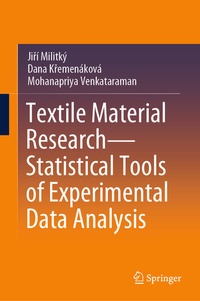
Textile Material Research-Statistical Tools of Experimental Data Analysis
Description

This book presents the effective combination of mathematical statistics, general metrology, and textile metrology to allow data analysis with regard to the evaluation of parameters of fibrous structures. Specialists working in material sciences, where fibrous structures are used, comprehensively understand the specifics of the fabric evaluation and manage in the context of rational use of selected mathematical and statistical methods. In this book, selected methods that are advantageous for data analysis, regardless of whether they are elementary or advanced are presented. The so-called computer-intensive methods are used in many situations when classical statistics is unable to offer a solution, or the solution is too complicated.
More details
Other editions
Additional editions
Persons
Prof. Ing. Jirí Militký is a university professor in the Department of Material Engineering, Faculty of Textile Engineering, Technical University of Liberec, Czech Republic. He is a renowned contributor in the field of Textile Sciences. His scientific activities are mainly in the areas of textile physics, textile material engineering, nanocomposites, and statistical data treatment. In 2018, he was recognized at AUTEX in recognition of his decades of high-quality contribution to textile sciences, famously known as "TEXTILE OSCAR."
Assoc. prof. Dana Kremenakova, PhD. She is working in the field of Textile Sciences, especially textile materials and technology in the Department of Material Engineering, Faculty of Textile Engineering, Technical University of Liberec, Czech Republic. She is focusing mainly on thermal transport properties and barrier properties of fibrous structures, development of special metrology, prediction of geometrical and mechanical properties of fibrous assemblies, modelling of textile structures in line fibre - yarn - fabrics, prediction of thermal comfort, optical and mechanical properties of side emitting polymeric optical fibres and their application in textile structures. She is guarantor and lecturer of the subject "Nanotechnology in the Textile Branch" within the study program WE-TEAM Erasmus Mundus Joint Master Degree (AUTEX).
Dr. Mohanapriya Venkataraman is a passionate textile material scientist, working as an assistant professor in the Department of Material Engineering, Faculty of Textile Engineering, Technical University of Liberec, Czech Republic. Her teaching and research areas include textile materials, thermodynamic analysis, micro-and nanoporous materials, heat transfer, polymers, and composites. She is a leader and team member of multiple international research projects funded by the EU, the Technology Agency of the Czech Republic (TA CR), and the Czech Science Foundation (GA CR).
Content
Basics of probability and statistics.- Basics of metrology.- Measurement Scales.- Measurement models.
