

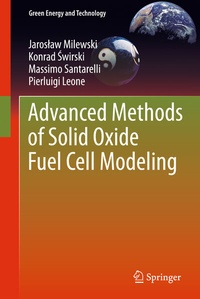
Advanced Methods of Solid Oxide Fuel Cell Modeling
Description

Fuel cells are widely regarded as the future of the power and transportation industries. Intensive research in this area now requires new methods of fuel cell operation modeling and cell design. Typical mathematical models are based on the physical process description of fuel cells and require a detailed knowledge of the microscopic properties that govern both chemical and electrochemical reactions. Advanced Methods of Solid Oxide Fuel Cell Modeling proposes the alternative methodology of generalized artificial neural networks (ANN) solid oxide fuel cell (SOFC) modeling.
Advanced Methods of Solid Oxide Fuel Cell Modeling provides a comprehensive description of modern fuel cell theory and a guide to the mathematical modeling of SOFCs, with particular emphasis on the use of ANNs. Up to now, most of the equations involved in SOFC models have required the addition of numerous factors that are difficult to determine. The artificial neural network (ANN) can be applied to simulate an object's behavior without an algorithmic solution, merely by utilizing available experimental data.
The ANN methodology discussed in Advanced Methods of Solid Oxide Fuel Cell Modeling can be used by both researchers and professionals to optimize SOFC design. Readers will have access to detailed material on universal fuel cell modeling and design process optimization, and will also be able to discover comprehensive information on fuel cells and artificial intelligence theory.
More details
Other editions
Additional editions
Persons
Jaroslaw Milewski is a doctor of engineering and an associate professor in the Power Division of the Institute of Heat Engineering, Faculty of Power and Aeronautical Engineering at Warsaw University of Technology. He has research experience in fuel cell modeling (especially solid oxide fuel cell hybrid systems and molten carbonate fuel cell hybrid systems) and advanced power systems, as well as classic power generation systems.
Konrad Swirski is a doctor of engineering and an associate professor in the Power Division of the Institute of Heat Engineering, Faculty of Power and Aeronautical Engineering at Warsaw University of Technology. His research focuses on artificial intelligence (especially bio-inspired solutions like artificial neural networks, genetics algorithms, and artifcial immunological control systems) and its application in power systems modeling, control and optimization.
Pierluigi Leone is a doctor of engineering and an assistant professor in applied physics at the Department of Energy of Politecnico of Turin. His research focuses on the engineering and testing of advanced energy systems based on high temperature fuel cells; in particular on the characterization of the electrochemical and mechanical properties of advanced single SOFCs, on the engineering of a planar SOFC micro-CHP unit and on the assessment of the in-operation homogeneity of large SOFC systems.
Massimo Santarelli is a doctor of engineering and an associate professor in thermodynamics and heat transfer, Department of Energy, Politecnico di Torino. His research focuses on fuel cells and hydrogen, and their integration with renewable sources: experimental activity and modeling of SOFC generators and the balance of plants; experimental activity and modeling of PEMFC and DMFC single cells and stacks; experimental activity and modeling of high pressure
electrolysis fed by renewable sources; modellng, analysis and optimization ofenergy systems based on integration of RES and H2.
