

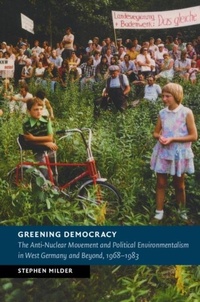
Greening Democracy
The Anti-Nuclear Movement and Political Environmentalism in West Germany and Beyond, 1968-1983
Published on 4. May 2017
978-1-108-22962-3 (ISBN)
Description

Greening Democracy explains how nuclear energy became a seminal political issue and motivated new democratic engagement in West Germany during the 1970s. Using interviews, as well as the archives of environmental organizations and the Green party, the book traces the development of anti-nuclear protest from the grassroots to parliaments. It argues that worries about specific nuclear reactors became the basis for a widespread anti-nuclear movement only after government officials' unrelenting support for nuclear energy caused reactor opponents to become concerned about the state of their democracy. Surprisingly, many citizens thought transnationally, looking abroad for protest strategies, cooperating with activists in other countries, and conceiving of 'Europe' as a potential means of circumventing recalcitrant officials. At this nexus between local action and global thinking, anti-nuclear protest became the basis for citizens' increasing engagement in self-governance, expanding their conception of democracy well beyond electoral politics and helping to make quotidian personal concerns political.
Reviews / Votes
'This is what democracy looks like! Milder magnificently brings together politics from all quarters, offering fresh and compelling insights into democratic practice and how change happens. A must-read for scholars of contemporary Germany and Europe - and for students of social change.' Belinda Davis, Rutgers University, New Jersey 'Greening Democracy will make the reading list of anyone interested in the post-war transformation of West Germany. In this well-argued and deeply researched book, Stephen Milder probes the relationship between environmental protest and democracy and shows that anti-nuclear activism in the 1970s not only transformed the party political landscape but broadened the possibilities of political engagement as such. Faced with impenetrable technocratic decision-making processes that took no heed of local concerns, residents embraced liberal democracy to counter such illiberal tendencies. Milder reminds us of the radical democratic potential that inhabited the protest movements.' Astrid M. Eckert, Emory University, Georgia 'Greening Democracy offers a fresh perspective on West German anti-nuclear protest and environmental politics of the 1970s by recovering the voices and aspirations of the grassroots activists who transformed their 'kitchen table' concerns about nuclear power in the Rhine Valley into a transnational coalition. Moving beyond tired debates about the supposed narrowness of 'post-material' environmental concerns or lamentations over the co-opting of the emancipatory potential of the '68 New Left by the traditional party system, Milder shows the radical potential of the heterogeneous group of provincials who came together at Wyhl and other sites to foster new and inclusive forms of democracy and challenge what they perceived as an unfeeling 'atomic state'. The other major contribution of the book is to use the grassroots perspective to situate the 1970s as a unique moment of environmental coalition building generated by new citizen initiatives with its own dynamics and integrity - not an outgrowth of traditional nature conservation in Germany but also not something that emerged suddenly as a result of Stockholm and the OPEC crisis.' Thomas Lekan, University of South Carolina 'Stephen Milder's impressive new book seeks to recast our understanding of this history on multiple fronts. He breaks not only with conventional narratives that explain 1970s environmentalism by way of elite ideas and international organizations but also with social movement research confined to a national framework ... This book makes an important intervention with which not only scholars of the environmental movement and the nuclear age but also anyone interested in protest, popular politics and political imaginaries in post-war Western Europe should contend.' Sean Forner, German History 'In his searching, informative account of resistance toward Swiss, French, and West German nuclear reactor projects along the Upper Rhine, Stephen Milder's Greening Democracy recounts how strange bedfellows - radical students and conservative locals - planted the seeds of Germany's Green Party and ecological politics throughout Western Europe.' Jonathan Hunt, Environmental History '... inspiring regional approach ... an important book.' Jan Kellershohn, Moving the SocialMore details
Series
Language
English
Place of publication
Cambridge
United Kingdom
Target group
Professional and scholarly
Illustrations
Worked examples or Exercises; 23 Halftones, black and white
File size
6,19 MB
ISBN-13
978-1-108-22962-3 (9781108229623)
Copyright in bibliographic data and cover images is held by Nielsen Book Services Limited or by the publishers or by their respective licensors: all rights reserved.
Schweitzer Classification
Other editions
Additional editions
Stephen Milder
Greening Democracy
The Anti-Nuclear Movement and Political Environmentalism in West Germany and Beyond, 1968-1983
Book
04/2017
Cambridge University Press
€122.50
Shipment within 15-20 days
Person
Stephen Milder is an Assistant Professor of Politics and Society in the Department of European Languages and Cultures, Rijksuniversiteit Groningen, The Netherlands.
Content
Introduction: taking the democratic dimensions of antinuclear activism; 1. 'Today the fish, tomorrow us:' the threatened Upper Rhine and the grassroots origins of West European environmentalism; 2. A different watch on the Rhine: how antinuclear activists imagined the Alemannic community and united a region in resistance; 3. Onto the site and into significance? The Wyhl Occupation in its contexts, from Strasbourg to Kaiseraugst and Constance to Kiel; 4. 'Wyhl and then what ...?' Between grassroots activism and mass protest; 5. Political questions, grassroots answers: shaping an environmental approach to electoral politics; 6. Organizing a 'decisive battle against nuclear power plants': Europe and the nationalization of Green politics in West Germany; Conclusion: protesting nuclear energy, Greening democracy.
