

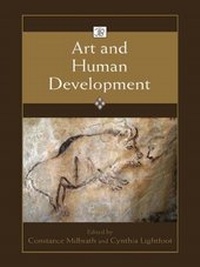
Art and Human Development
1st Edition
Published on 13. May 2013
302 pages
978-1-136-64304-0 (ISBN)
Description

This interdisciplinary volume explores art, its development, and its role in the construction of knowledge. Presenting theory and research on artistic development as a cultural and creative endeavor, contributors examine the origins of human art during the Paleolithic cultural revolution, as part of a modern cultural transformation, in the growth of a creative artist, and in developing children.
Target chapters expressing the disciplinary perspectives of psychology, archaeology, communications, education, and the performing arts are followed by commentaries from internationally acclaimed scholars of human development. Part 1 explores how cultures harness and exploit the arts to give expression to values, social practices, and traditions. This section traces the emergence of new art forms that arose during social unrest, including the symbolization of spiritual beliefs expressed on the walls of Paleolithic caves, and the racial identity and cultural values expressed in the media of the hip-hop generation. Part 2 examines the journeys of a composer and a group of students to highlight the process of becoming an artist and the role education plays in its development. The book concludes with a focus on the development of aesthetic appreciation and artistic activity in childhood and adolescence, including, for example, how a child's developing theory of mind affects appreciation for the arts, and how developing empathy and emotional regulation contribute to the cognitive and affective underpinnings of acting in adolescence. As a whole contributors explore the developmental, sociocultural, and evolutionary processes that make the creation and experience of art possible.
Intended for researchers and advanced students in both human development and the arts, this book will also serve as a textbook for advanced courses on psychology and the arts and/or special topics courses in cognitive and/or human development.
Target chapters expressing the disciplinary perspectives of psychology, archaeology, communications, education, and the performing arts are followed by commentaries from internationally acclaimed scholars of human development. Part 1 explores how cultures harness and exploit the arts to give expression to values, social practices, and traditions. This section traces the emergence of new art forms that arose during social unrest, including the symbolization of spiritual beliefs expressed on the walls of Paleolithic caves, and the racial identity and cultural values expressed in the media of the hip-hop generation. Part 2 examines the journeys of a composer and a group of students to highlight the process of becoming an artist and the role education plays in its development. The book concludes with a focus on the development of aesthetic appreciation and artistic activity in childhood and adolescence, including, for example, how a child's developing theory of mind affects appreciation for the arts, and how developing empathy and emotional regulation contribute to the cognitive and affective underpinnings of acting in adolescence. As a whole contributors explore the developmental, sociocultural, and evolutionary processes that make the creation and experience of art possible.
Intended for researchers and advanced students in both human development and the arts, this book will also serve as a textbook for advanced courses on psychology and the arts and/or special topics courses in cognitive and/or human development.
Reviews / Votes
"This text is aimed at researchers and advanced students in the arts and human development. It can also serve as a text for courses in the psychology of art and special topics courses in human development and cognition. ... The contributors to Art and Human Development each make explicit, whether discussing cave art, hip-hop, the art of composing music, literary reasoning, or acting as social cognition, that the act of making meaning of our realities and of ourselves is a creative experience." - Robert B. Faux, Ph.D., University of Pittsburgh, in PsycCRITIQUES"This book goes beyond describing and explaining how individuals develop normative knowledge about the world as it is. It offers intriguing accounts of how individuals are able to use the visual arts, theatre, literature, and music to represent the world as it could be." - Lynn S. Liben, Pennsylvania State University, USA
"Milbrath and Lightfoot present us with an engrossing and wide-ranging series of ... articles related to the arts. This book will be of great value to school-based educators and cognitive researchers who wish to engage with current issues at the intersection of the arts, cognition and social development." - David Pariser, Professor of Art Education, Faculty of Fine Arts, Concordia University, Canada
"This book is a jewel in disguise. By bringing the issue of art back ... the editors make it possible... to return to the study of ... higher-order psychological constructions such as aesthetic experiences... Art becomes a matter of everyday creativity of human beings in their lives. Psychology needs to start-rather than finish-with phenomena of art in its coverage, and this book may be a small step for its authors but a giant step for psychology." - Jaan Valsiner, Clark University
More details
Series
Language
English
Place of publication
London
United Kingdom
Publishing group
Taylor & Francis Ltd
Target group
College/higher education
Product notice
Reflowable
Illustrations
3 s/w Tabellen
3 Tables, black and white
File size
4,13 MB
ISBN-13
978-1-136-64304-0 (9781136643040)
Copyright in bibliographic data and cover images is held by Nielsen Book Services Limited or by the publishers or by their respective licensors: all rights reserved.
Schweitzer Classification
Other editions
Additional editions
Constance Milbrath | Cynthia Lightfoot
Art and Human Development
Book
07/2012
1st Edition
Psychology Press Ltd
€69.00
Shipment within 15-20 days
Constance Milbrath | Cynthia Lightfoot
Art and Human Development
Book
12/2009
1st Edition
Psychology Press Ltd
€193.50
Shipment within 15-20 days
Persons
Constance Milbrath is a senior researcher at the Human Early Learning Partnership at the University of British Columbia. She received her Ph.D. in Developmental Psychology from the University of Wisconsin, Madison. Her research focuses on individual differences in the underpinnings of drawing and aesthetic competence in children, the influence of cultural differences on adolescent relationships, and the development of a clinical instrument aimed at assessing structure of personality. A Fellow of the APA, Dr. Milbrath is also a member of Division 10, the Society for the Psychology of Aesthetics, Creativity and the Arts.
Cynthia Lightfoot is a Professor and Program Director of Human Development and Family Studies at Penn State University, Brandywine. She received her Ph.D. from the University of North Carolina, Chapel Hill. Her research focuses on the cultural contexts of development. She has served as Vice President to, and is currently on the Board of Directors of the Jean Piaget Society.
Cynthia Lightfoot is a Professor and Program Director of Human Development and Family Studies at Penn State University, Brandywine. She received her Ph.D. from the University of North Carolina, Chapel Hill. Her research focuses on the cultural contexts of development. She has served as Vice President to, and is currently on the Board of Directors of the Jean Piaget Society.
Content
C. Lightfoot, C. Milbrath, Introduction. Part 1. Art in the Context of Culture J.D. Lewis-Williams, Science, Religion and Pictures: an Origin of Image-Making. C. Milbrath, Commentary: Comparative Developmental And Social Perspectives On The Mystery Of Upper Paleolithic Art. M. Forman, Hip-Hop Culture, Youth Creativity, and the Generational Crossroads. B. Tinsley, S. Wilson, M.B. Spencer, Commentary: Hip-Hop Culture, Youth Creativity and the Generational Crossroads from a Human Development Perspective. Part 2. Educating the Artists and Using the Arts to Educate G. Levinson, "Why Should I Write?" asked the Pencil. "What Else Can You Do?" said the Knife. Or, Why I Can't Tell You Why I Am a Composer. J. Bamberger, Commentary: A View of Levinson's Development. C. Lee, Every Shut Eye Ain't Sleep: Modeling the "Scientific" from the Everyday as Cultural Process. C. Daiute, Commentary: Adolescents' Purposeful Uses of Culture. Part 3. Artistic Development N. Freeman, Children as Intuitive Art Critics. A. Costal, Commentary: But is It Art? T.R. Goldstein, E. Winner, A New Lens on the Development of Social Cognition: The Study of Acting. J. Peskin, R.A. Mar, T. Bischoff, Commentary: Advanced Social Cognition in the Literary Arts.
