

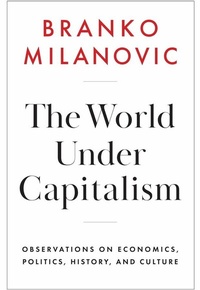
The World Under Capitalism
Observations on Economics, Politics, History, and Culture
1st Edition
Published on 7. April 2025
636 pages
978-1-5095-6777-5 (ISBN)
Description

Branko Milanovic is best known as one of the world's leading experts on global inequality. But he is also an unusually wide-ranging and penetrating commentator on subjects across economics and beyond, in politics, history, and culture. This book brings together his most searching, provocative, and entertaining articles of recent years, providing an abundance of vital insights into the evolution and dynamics of the world under capitalism.
The volume features important ideas about the struggle to achieve a more equal and prosperous world against not only the predictable forces of deregulation and distraction but new ideas about shrinking the economy to protect the environment. Further from Milanovic's speciality, readers will find an extraordinary array of reflections on subjects including migration, globalization, the politics and economics of Russia and China, the crisis of liberal democracy, economic and literary history, and the intellectual giants of economics. The pieces are united by Milanovic's distinctive voice - humane, wry, and realistic - and by remarkable erudition worn lightly whether the topic is the fall of Constantinople, Jane Austen, or the mores of contemporary soccer.
No one can fail to learn from the book, while the sparkling prose, unexpected observations, and sheer importance of the subjects at hand make it a compelling read from start to finish.
The volume features important ideas about the struggle to achieve a more equal and prosperous world against not only the predictable forces of deregulation and distraction but new ideas about shrinking the economy to protect the environment. Further from Milanovic's speciality, readers will find an extraordinary array of reflections on subjects including migration, globalization, the politics and economics of Russia and China, the crisis of liberal democracy, economic and literary history, and the intellectual giants of economics. The pieces are united by Milanovic's distinctive voice - humane, wry, and realistic - and by remarkable erudition worn lightly whether the topic is the fall of Constantinople, Jane Austen, or the mores of contemporary soccer.
No one can fail to learn from the book, while the sparkling prose, unexpected observations, and sheer importance of the subjects at hand make it a compelling read from start to finish.
More details
Other editions
Additional editions
Branko Milanovic
The World Under Capitalism
Observations on Economics, Politics, History, and Culture
Book
04/2025
1st Edition
Polity Press
€37.50
Available immediately
Person
Branko Milanovic is Research Professor at the Graduate Center, City University of New York.
Content
Preface
PART I: THE WORLD UNDER CAPITALISM
Chapter One: Growth and Climate Change
Chapter Two: Migration
Chapter Three: Politics
PART II: INEQUALITY
Chapter Four: Inequality within Nations
Chapter Five: Global Inequality
Chapter Six: Wealth inequality
Chapter Seven: Inequality and Literature
PART III: GLOBALIZATION AND MULTI-POLAR WORLD
Chapter Eight: Globalization
Chapter Nine: China
Chapter Ten: Russia
PART IV: HISTORY
Chapter Eleven: Economic History
Chapter Twelve: Adam Smith
Chapter Thirteen: Ricardo and Marx
Chapter Fourteen: Communism
Chapter Fifteen: Transition to Capitalism
PART V: REFLECTIONS
Chapter Sixteen: Reflections
References
Index
PART I: THE WORLD UNDER CAPITALISM
Chapter One: Growth and Climate Change
Chapter Two: Migration
Chapter Three: Politics
PART II: INEQUALITY
Chapter Four: Inequality within Nations
Chapter Five: Global Inequality
Chapter Six: Wealth inequality
Chapter Seven: Inequality and Literature
PART III: GLOBALIZATION AND MULTI-POLAR WORLD
Chapter Eight: Globalization
Chapter Nine: China
Chapter Ten: Russia
PART IV: HISTORY
Chapter Eleven: Economic History
Chapter Twelve: Adam Smith
Chapter Thirteen: Ricardo and Marx
Chapter Fourteen: Communism
Chapter Fifteen: Transition to Capitalism
PART V: REFLECTIONS
Chapter Sixteen: Reflections
References
Index
DETAILED CONTENTS
- Preface
- Acknowledgments
- Part I The World Under Capitalism
- 1 Growth and Climate Change
- 1.1 The illusion of "degrowth" in a poor and unequal world
- 1.2 Degrowth: Solving the impasse by magical thinking
- 1.3 Climate change, covid, and global inequality
- 1.4 Is Norway the new East India Company?
- 1.5 And does growth in the North by itself make Africa poorer?
- 1.6 Kate Raworth's economics of miracles
- 1.7 Abundance, capitalism, and climate change
- 2 Migration
- 2.1 Should some countries cease to exist?
- 2.2 Migration into Europe: A problem with no solution
- 2.3 Migration's economic positives and negatives
- 2.4 Trade and migration: Substitutes or complements?
- 2.5 Habermas and pimps: The world of the day and the world of the night
- 2.6 The simplicity of views regarding civil conflicts
- 3 Politics
- 3.1 What is a paleo-left agenda?
- 3.2 Toward global progressiveness
- 3.3 Democracy or dictatorship: Which works better?
- 3.4 How is the world ruled?
- 3.5 Multi-party kleptocracies rather than illiberal democracies
- 3.6 Thinkin' 'bout a revolution
- 3.7 There is no exit for dictators
- 3.8 Trump as the ultimate triumph of neoliberalism
- 3.9 What we owe to Donald Trump: A different angle
- 3.10 The comprador intelligentsia
- Part II Inequality
- 4 Inequality Within Nations
- 4.1 Why inequality matters
- 4.2 In defence of equality (without welfare economics)
- 4.3 Why twentieth-century tools cannot be used to address twenty-first-century income inequality
- 4.4 The welfare state in the age of globalization
- 4.5 All our needs are social
- 4.6 Why the focus on horizontal inequality undermines efforts to reduce overall inequality
- 4.7 Basic difference between wage inequality and income inequality studies
- 4.8 Distinguishing incomes from capital and labor
- 4.9 Why "Make America Denmark Again" will not happen
- 4.10 À la recherche of the roots of US inequality "exceptionalism"
- 4.11 What are the limits of Europe?
- 4.12 The role of economics
- 5 Global Inequality
- 5.1 The history of global inequality studies
- 5.2 Athenian dialogues on global income inequality
- 5.3 How much of your income is due to your citizenship?
- 5.4 Is citizenship just a rent?
- 5.5 Why foreign aid cannot be regressive
- 5.6 Formal and actual similarities between climate change and global inequality, and suboptimality of the nation-state
- 6 Wealth inequality
- 6.1 What is wealth?
- 6.2 Historical wealth: How to compare Croesus and Bezos
- 6.3 My wealth and the lives of others
- 6.4 Dutiful dirges of Davos
- 6.5 On luxury
- 6.6 Absurdity of World Bank wealth accounting
- 6.7 Repeat after me: Wealth is not income and income is not consumption
- 6.8 Was everybody under socialism a millionaire?
- 7 Inequality and Literature
- Part III Globalization and Multi-Polar World
- 8 Globalization
- 9 China
- 9.1 Socialism with Chinese characteristics for the young person: A review of the book of Xi Jinping's sayings
- 9.2 The long NEP, China, and Xi
- 9.3 Hayekian communism
- 9.4 The World Turned Upside Down: A critical review
- 9.5 License to kill: The World Turned Upside Down: A laudatory review
- 9.6 Interpreting or misinterpreting China's success
- 10 Russia
- 10.1 Russia's circular economic history
- 10.2 The lessons and implications of seizing Russian oligarchs' assets
- 10.3 The novelty of technologically regressive import substitution
- 10.4 Russia's economic prospects: The short-run
- 10.5 Long term: Difficulties of import substitution and delocalization
- 10.6 What if Putin's true goals are different?
- Part IV History
- 11 Economic History
- 11.1 Byzantium: Economic reflections on the Fall of Constantinople
- 11.2 Global poverty over the long term: Legitimate issues
- 11.3 On Eurocentrism in economics
- 11.4 Net economic output in history: Why we work
- 11.5 Capital as a historical concept
- 11.6 The plight of late industrializers: What if peasants do not want to move to cities?
- 11.7 Can Black Death explain the Industrial Revolution?
- 11.8 Why were the Balkans underdeveloped? A geographical hypothesis
- 12 Adam Smith
- 12.1 Through the glass, darkly: Trying to figure out Adam Smith, the person
- 12.2 America's Adam Smith: A review of Glory M. Liu's Adam Smith's America
- 12.3 People, associations, and government policy in Adam Smith
- 12.4 Is democracy always better for the poor?
- 12.5 Why slave-owners never willingly emancipated their slaves
- 12.6 How Adam Smith proposed to have his cake and eat it too
- 13 Ricardo and Marx
- 13.1 Ricardo, Marx, and interpersonal inequality
- 13.2 Reading David Ricardo's letters
- 13.3 The Ricardian windfall: David Ricardo and the absence of the equity-efficiency trade-off
- 13.4 The influence of Karl Marx-a counterfactual
- 13.5 Marx for me (and hopefully for others too)
- 13.6 Marx on income inequality under capitalism
- 13.7 Transcending capitalism: Three different ways?
- 13.8 On unproductive labor
- 13.9 When Tocqueville and Marx agreed
- 13.10 A short essay on the differences between Marx and Keynes
- 13.11 Marx in Amerika
- 14 Communism
- 14.1 A secular religion that lasted one century
- 14.2 State capitalism one hundred years ago and today
- 14.3 Milton Friedman and labor-managed enterprises
- 14.4 Socialist enterprise power structure and the soft-budget constraint
- 14.5 Disciplining workers in a workers' state
- 14.6 How I lost my past
- 14.7 The red bourgeoisie
- 14.8 On charisma and greyness under communism
- 14.9 Trotsky after Kolakowski
- 14.10 Notes on Fanon
- 14.11 The book of the dead: Victor Serge's Notebooks 1936-1947
- 14.12 Did socialism keep capitalism equal?
- 14.13 Gorbachev: A politician who did not want to rule
- 14.14 Did post-Marxist theories destroy communist regimes?
- 15 Transition to Capitalism
- Part V Reflections
- 16 Reflections
- 16.1 Non-exemplary lives
- 16.2 The perverse seductiveness of Fernando Pessoa
- 16.3 Henry and Kant: Outsourcing morality
- 16.4 The mistake of using the Kantian criterion in ordinary economic life
- 16.5 Is liberal democracy part of human development?
- 16.6 Living in own ideology . until it falls apart
- 16.7 Freedom to be "wrong": The greatest advantage of democracy
- 16.8 99 percent Utopia and money
- 16.9 On the general futility of political discussions with people
- 16.10 The many in one: A review of Amartya Sen's Home in the World: A Memoir
- 16.11 Du passé faisons table rase
- 16.12 English language and American solipsism
- 16.13 The problems of authenticity under capitalism
- 16.14 The abolition of paper and the pompous rule of the present
- 16.15 Who are...
