

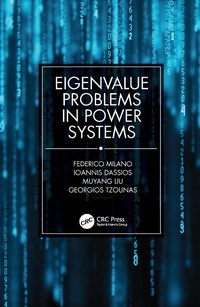
Eigenvalue Problems in Power Systems
1st Edition
Published on 22. December 2020
406 pages
978-1-000-33520-0 (ISBN)
Description

The book provides a comprehensive taxonomy of non-symmetrical eigenvalues problems as applied to power systems. The book bases all formulations on mathematical concept of "matrix pencils" (MPs) and considers both regular and singular MPs for the eigenvalue problems. Each eigenvalue problem is illustrated with a variety of examples based on electrical circuits and/or power system models and controllers and related data are provided in the appendices of the book. Numerical methods for the solution of all considered eigenvalue problems are discussed. The focus is on large scale problems and, hence, attention is dedicated to the performance and scalability of the methods. The target of the book are researchers and graduated students in Electrical & Computer Science Engineering, both taught and research Master programmes as well as PhD programmes and it:
explains eigenvalue problems applied into electrical power systems
explains numerical examples on applying the mathematical methods, into studying small signal stability problems of realistic and large electrical power systems
includes detailed and in-depth analysis including non-linear and other advanced aspects
provides theoretical understanding and advanced numerical techniques essential for secure operation of power systems
provides a comprehensive set of illustrative examples that support theoretical discussions
explains eigenvalue problems applied into electrical power systems
explains numerical examples on applying the mathematical methods, into studying small signal stability problems of realistic and large electrical power systems
includes detailed and in-depth analysis including non-linear and other advanced aspects
provides theoretical understanding and advanced numerical techniques essential for secure operation of power systems
provides a comprehensive set of illustrative examples that support theoretical discussions
More details
Edition
1. Auflage
Language
English
Place of publication
London
United Kingdom
Publishing group
Taylor & Francis Ltd
Target group
College/higher education
Illustrations
50 Illustrations, black and white
ISBN-13
978-1-000-33520-0 (9781000335200)
Copyright in bibliographic data and cover images is held by Nielsen Book Services Limited or by the publishers or by their respective licensors: all rights reserved.
Schweitzer Classification
Other editions
Additional editions
Federico Milano | Ioannis Dassios | Muyang Liu
Eigenvalue Problems in Power Systems
Book
09/2023
1st Edition
CRC Press
€80.60
Shipment within 15-20 days
Federico Milano | Ioannis Dassios | Muyang Liu
Eigenvalue Problems in Power Systems
Book
01/2021
1st Edition
CRC Press
€243.00
Shipment within 15-20 days
Persons
Federico Milano received from the University of Genoa, Italy, the ME and Ph.D. in Electrical Eng. in 1999 and 2003, respectively. From 2001 to 2002 he was with the University of Waterloo, Canada, as a Visiting Scholar. From 2003 to 2013, he was with the University of Castilla-La Mancha, Spain. In 2013, he joined the Univ. College Dublin, Ireland, where he is currently Professor of Power Systems Control and Protections and Head of Electrical Engineering. His research interests include power system modelling, control and stability analysis. A Fellow of the IEEE and the IET, he has been an editor for several journals published by IEEE, IET, Elsevier and Springer, including the IEEE Transactions on Power Systems and IET Generation, Transmission & Distribution. He has authored or co-authored about 150 peer reviewed journal and conference papers, several book chapters and three books (published by Springer, McGraw Hill and Cambridge University Press) and edited one book (published by IET).
Ioannis Dassios is currently a UCD Research Fellow at AMPSAS, University College Dublin, Ireland. He studied Mathematics and completed a two-year MSc in Applied Mathematics & Numerical Analysis at the Department of Mathematics, University of Athens, Greece with grade "Excellent" (highest mark in the Greek system). As a MSc student he received a travel grant to visit the Department of Mathematics at the University of North Texas, USA. In July 2013 he received his PhD in Mathematics from the Department of Mathematics, University of Athens, Greece, focusing on singular discrete dynamical systems and their applications. Since then, he has been a Post-Doctoral Researcher at MACSI (Mathematics Applications Consortium for Science and Industry), Department of Mathematics & Statistics, University of Limerick, Ireland and a Senior researcher at ERC/ESIPP, University College Dublin, Ireland. Previously, he worked as a Post-Doctoral Research & Teaching Fellow at the School of Mathematics, University of Edinburgh, UK, and for six months as a Post-Doctoral Research Associate at the Modelling and Simulation Centre, University of Manchester, UK. He has published 45 articles (16 single authored, and 29 co-authored with researchers from Universities and Industries) in internationally leading academic journals. He is an Editor in Applied Sciences, Signals, and has also served as a reviewer 333 times in 66 different journals.
Muyang Liu received from University College Dublin, Ireland, the ME in Electrical Energy Engineering in 2016. Since September 2016, she is a Ph.D. student candidate with University College Dublin. Her scholarship is funded through the SFI Investigator Award with title "Advanced Modelling for Power System Analysis and Simulation". Her current research interests include small-signal and transient stability analysis of power systems modelled through functional differential-algebraic equations.
Georgios Tzounas received from National Technical University of Athens, Greece, the ME in Electrical and Computer Engineering in 2017. Since September 2017, he is Ph.D. candidate with University College Dublin. His scholarship is funded through the SFI Investigator Award with title "Advanced Modelling for Power System Analysis and Simulation." His current research interests include eigenvalue problems as well as stability analysis and robust control of power system with inclusion of measurement delays.
Ioannis Dassios is currently a UCD Research Fellow at AMPSAS, University College Dublin, Ireland. He studied Mathematics and completed a two-year MSc in Applied Mathematics & Numerical Analysis at the Department of Mathematics, University of Athens, Greece with grade "Excellent" (highest mark in the Greek system). As a MSc student he received a travel grant to visit the Department of Mathematics at the University of North Texas, USA. In July 2013 he received his PhD in Mathematics from the Department of Mathematics, University of Athens, Greece, focusing on singular discrete dynamical systems and their applications. Since then, he has been a Post-Doctoral Researcher at MACSI (Mathematics Applications Consortium for Science and Industry), Department of Mathematics & Statistics, University of Limerick, Ireland and a Senior researcher at ERC/ESIPP, University College Dublin, Ireland. Previously, he worked as a Post-Doctoral Research & Teaching Fellow at the School of Mathematics, University of Edinburgh, UK, and for six months as a Post-Doctoral Research Associate at the Modelling and Simulation Centre, University of Manchester, UK. He has published 45 articles (16 single authored, and 29 co-authored with researchers from Universities and Industries) in internationally leading academic journals. He is an Editor in Applied Sciences, Signals, and has also served as a reviewer 333 times in 66 different journals.
Muyang Liu received from University College Dublin, Ireland, the ME in Electrical Energy Engineering in 2016. Since September 2016, she is a Ph.D. student candidate with University College Dublin. Her scholarship is funded through the SFI Investigator Award with title "Advanced Modelling for Power System Analysis and Simulation". Her current research interests include small-signal and transient stability analysis of power systems modelled through functional differential-algebraic equations.
Georgios Tzounas received from National Technical University of Athens, Greece, the ME in Electrical and Computer Engineering in 2017. Since September 2017, he is Ph.D. candidate with University College Dublin. His scholarship is funded through the SFI Investigator Award with title "Advanced Modelling for Power System Analysis and Simulation." His current research interests include eigenvalue problems as well as stability analysis and robust control of power system with inclusion of measurement delays.
Content
Part I Introduction
1. Power Systems Outlines
2. Mathematical Outlines
Part II Linear Eigenvalue Problema
3. Di?erential Equations with Regular Pencil
4. Explicit Di?erential-Algebraic Equations
5. Implicit Di?erential-Algebraic Equations
6. Di?erential Equations with Singular Pencil
7. Mobius Transform
8. Participation Factors
Part III Non-Linear Eigenvalue Problems
9. Polynomial Eigenvalue Problem
10. Delay Di?erential Equations
11. Systems with Constant Delays
12. Systems with Time-Varying Delays
Part IV Numerical Methods
13. Numerical Methods for Eigenvalue Problems
14. Open Source Libraries
15. Large Eigenvalue Problems
V Appendices
1. Power Systems Outlines
2. Mathematical Outlines
Part II Linear Eigenvalue Problema
3. Di?erential Equations with Regular Pencil
4. Explicit Di?erential-Algebraic Equations
5. Implicit Di?erential-Algebraic Equations
6. Di?erential Equations with Singular Pencil
7. Mobius Transform
8. Participation Factors
Part III Non-Linear Eigenvalue Problems
9. Polynomial Eigenvalue Problem
10. Delay Di?erential Equations
11. Systems with Constant Delays
12. Systems with Time-Varying Delays
Part IV Numerical Methods
13. Numerical Methods for Eigenvalue Problems
14. Open Source Libraries
15. Large Eigenvalue Problems
V Appendices
