

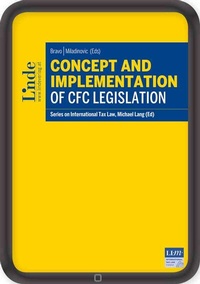
Concept and Implementation of CFC Legislation
Description

An in-depth analysis of various aspects of CFC legislation
This volume provides an in-depth analysis of various aspects of the topic "Concept and Implementation of CFC legislation". The volume is divided into four parts. The first part comprises chapters discussing the historical background, policy considerations, and different CFC approaches that have been implemented in domestic legislation. While the chapters included in the second part focus on the recommendation for the effective design of CFC rules found in BEPS Action 3, the chapters encompassed in the third part analyse the implementation of these criteria in Articles 7 and 8 of the ATAD and the compatibility of these provisions with EU primary law.
Finally, the chapters encompassed in part four deal with selected issues related to CFC rules, including the compatibility of CFC legislation and tax treaties, the relationship between these rules and general anti-abuse rules, the implications of the proposed CCCTB Directive on CFC rules, alternative approaches to CFC legislation (such as the Global Anti-Base Erosion proposal of the OECD/G20), the interrelationship between CFC rules and transfer pricing legislation, and the balance between effective CFC rules and compliance burdens.
More details
Other editions
Additional editions
Persons
Dr. Nathalie Bravo, LL.M. is a lecturer at the Institute for Austrian and International Tax Law, WU (Vienna University of Economics and Business). She currently works with PwC Austria.
Dr. Alexandra Miladinovic, LL.M., LL.B. is a research associate at the Institute for Austrian and International Tax Law, WU (Vienna University of Economics and Business).
