

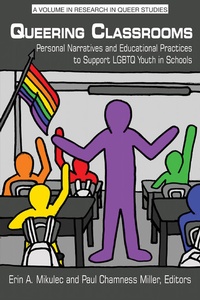
Queering Classrooms
Personal Narratives and Educational Practices to Support LGBTQ Youth in Schools
1st Edition
Published on 11. January 2016
238 pages
978-1-68123-652-0 (ISBN)
Description

Teacher Education programs have largely ignored the needs of LGBTIQ learners in their preparation of pre?service teachers. At best in most of such programs, their needs are addressed in a single chapter in a book or as the topic of discussion in a single class discussion. However, is this minimal discussion enough? What kind of impact does this approach have on future teachers and their future learners?This book engages the reader in a dialogue about why teacher education must address LGBTIQ issues more openly and why teacher education programs should revise their curriculum to more fully integrate the needs of LGBTIQ learners throughout their curriculum, rather than treat such issues as a single, isolated topic in an insignificant manner. Through personal narratives, research, and conceptual chapters, this volume also examines the different ways in which queer youth are present or invisible in schools, the struggles they face, and how teachers can be better prepared to reach them as they should any student, and to make them more visible. The authors of this volume provide insight into the needs of future teachers with the aim of bringing about change in how teacher education programs address LGBTIQ needs to better equip those entering the field of teaching.
All prices
More details
Other editions
Additional editions
Erin A. Mikulec | Paul Chamness Miller
Queering Classrooms
Personal Narratives and Educational Practices to Support LGBTQ Youth in Schools
Book
11/2016
Information Age Publishing
€61.40
Shipment within 3-4 weeks
Content
1 - Front Cover [Seite 1]
2 - Queering Classrooms [Seite 2]
3 - Personal Narratives and Educational Practices to Support LGBTQ Youth in Schools [Seite 2]
3.1 - A Volume in Research in Queer Studies [Seite 2]
3.2 - Series Editors: [Seite 2]
3.3 - Paul Chamness Miller and Hidehiro Endo Akita International University [Seite 2]
4 - CONTENTS [Seite 8]
4.1 - 1. Introduction-Challenging the Status Quo: Transforming and Queering Education [Seite 8]
4.2 - SECTION I: LGBTQ YOUTH AND EDUCATION: HOW FAR HAVE WE COME? [Seite 8]
4.2.1 - 2. A Place Where They Can be Themselves: Issues of LGBTQ Students [Revisited] [Seite 8]
4.2.2 - 3. Situating Ally Identities in Relational Epistemes: Learning With LGBTIQ People in Order to Make Supportive and Inclusive Decisions [Seite 8]
4.2.3 - 4. Constructions of Children and Childhood: Implications for LGBTIQ Inclusion and Teacher Preparation Programs [Seite 8]
4.3 - SECTION II: REFLECTIONS ON PREPARATION: VOICES FROM PRESERVICE AND PRACTICING TEACHERS [Seite 8]
4.3.1 - 5. Hope for a Better Tomorrow: A Personal Narrative on the Need for Acceptance in Teacher Education Programs [Seite 8]
4.3.2 - 6. Advocacy From Adversity: Sculpting an LGBT Identity in Art Education [Seite 9]
4.3.3 - 7. Preparing to Enter the Field: Reflections From Preservice Teachers on Learning to Work With LGBTQ Youth [Seite 9]
4.4 - SECTION III: USING LITERATURE TO ADDRESS ISSUES OF LGBTQ YOUTH IN SCHOOLS: FROM THE CLASSROOM TO THE LIBRARY [Seite 9]
4.4.1 - 8. Reading Them In: Using LGBT Child and Young Adult Literature in Preservice Teacher Education [Seite 9]
4.4.2 - 9. "You Don't Have to Think About It in That Way:" Deconstructing Teacher Assumptions About LGBTIQ Students [Seite 9]
4.4.3 - 10. Teaching Tolerance Through Literature: How Including LGBTIQ Titles in Your Library Can Increase Acceptance [Seite 9]
4.5 - SECTION IV: K-20: CREATING A SAFE AND POSITIVE LEARNING CLIMATE IN ALL EDUCATIONAL SETTINGS [Seite 9]
4.5.1 - 11. What Being a GSA Sponsor Has Done for Me and Others [Seite 9]
4.5.2 - 12. A Call to Action: The Importance of School Climate, Professional Development, and Teacher Education Programs in Fostering LGBT Supportive Educators [Seite 9]
4.5.3 - 13. In Our Own Voice: Campus Climate as a Mediating Factor in the Persistence of LGBT Students, Faculty, and Staff in Higher Education [Seite 9]
4.5.4 - 14. Conclusion-Tying it All Together: Making Meaning and a Call to Action [Seite 9]
4.6 - Research in Queer Studies [Seite 3]
4.7 - Queering Classrooms [Seite 4]
4.8 - Personal Narratives and Educational Practices to Support LGBTQ Youth in Schools [Seite 4]
4.8.1 - Edited by [Seite 4]
4.8.2 - Erin A. Mikulec Illinois State University [Seite 4]
4.8.3 - and [Seite 4]
4.8.4 - Paul Chamness Miller Akita International University, Japan [Seite 4]
4.8.4.1 - Information Age Publishing, Inc. [Seite 4]
4.8.4.2 - Charlotte, North Carolina www.infoagepub.com [Seite 4]
4.8.4.3 - Foreword [Seite 10]
4.8.4.3.1 - Nelson M. Rodriguez The College of New Jersey [Seite 10]
4.9 - CHAPTER 1 [Seite 12]
4.9.1 - Challenging the Status Quo [Seite 12]
4.9.1.1 - Erin A. Mikulec and Paul Chamness Miller [Seite 12]
4.9.1.2 - References [Seite 17]
4.9.2 - SECTION I [Seite 20]
4.9.2.1 - LGBTQ YOUTH AND EDUCATION: HOW FAR HAVE WE COME? [Seite 20]
4.10 - CHAPTER 2 [Seite 22]
4.10.1 - A Place Where They Can Be Themselves [Seite 22]
4.10.1.1 - Michelle L. Knaier [Seite 22]
4.10.1.2 - A Place Where They Can Be Themselves1 [Seite 23]
4.10.1.2.1 - Challenges Faced by LGBTQ Students [Seite 24]
4.10.1.2.2 - Effects on the Lives of LGBTQ Students [Seite 27]
4.10.1.2.3 - Educational Reform is Key [Seite 28]
4.10.1.3 - FOURTEEN YEARS LATER . [Seite 30]
4.10.1.3.1 - Recent Advances and Remaining Challenges [Seite 30]
4.10.1.3.2 - An Attempt to Address Inclusiveness in Teacher Education [Seite 31]
4.10.1.3.3 - Creating and Teaching Inclusive Curricula [Seite 33]
4.10.1.4 - Note [Seite 34]
4.10.1.5 - References [Seite 34]
4.11 - CHAPTER 3 [Seite 38]
4.11.1 - Situating Ally Identities in Relational Epistemes [Seite 38]
4.11.1.1 - Ryan Schey [Seite 38]
4.11.1.2 - Conceptualizing Ally Identities Ontologically: Current Scholarship [Seite 40]
4.11.1.3 - Conceptualizing Ally Identities Epistemologically: Shifting Our Trajectories [Seite 43]
4.11.1.4 - Ryan and Lana's Conversation: An Illustration of Situating Ally Identities in Relational Epistemes [Seite 47]
4.11.1.5 - Conclusion [Seite 51]
4.11.1.6 - ACKNOWLEDGMENT [Seite 53]
4.11.1.7 - Notes [Seite 53]
4.11.1.8 - References [Seite 54]
4.12 - CHAPTER 4 [Seite 56]
4.12.1 - Constructions of Children and Childhood [Seite 56]
4.12.1.1 - Corrine M. Wickens [Seite 56]
4.12.1.2 - Heteronormativity as Ingrained in Society and Education [Seite 57]
4.12.1.3 - Evolving Constructions of Childhood and Children [Seite 58]
4.12.1.4 - Controversial Books, Safe Spaces, and LGBTIQ Inclusion-or Not [Seite 60]
4.12.1.4.1 - Safety From Controversial Materials in Schools [Seite 60]
4.12.1.4.2 - Protection From LGBTIQ-Inclusion [Seite 61]
4.12.1.4.3 - Censorship and the Rise of Children's and Young Adult Literature [Seite 62]
4.12.1.4.4 - Paradox of "Safe" [Seite 64]
4.12.1.4.5 - Ideologies of Protection and Childhood [Seite 65]
4.12.1.5 - Roles of Teacher-Education Programs and Colleges of Education [Seite 66]
4.12.1.6 - Notes [Seite 70]
4.12.1.7 - References [Seite 70]
4.12.2 - SECTION II [Seite 74]
4.12.2.1 - reflections on preparation: voices from preservice and practicing teachers [Seite 74]
4.13 - CHAPTER 5 [Seite 76]
4.13.1 - Hope for a Better Tomorrow [Seite 76]
4.13.1.1 - Angela M. Jaime and Brody C. Tate [Seite 76]
4.13.1.2 - Personal Narrative [Seite 78]
4.13.1.2.1 - Brody [Seite 78]
4.13.1.2.2 - Angela [Seite 81]
4.13.1.3 - Implications for Teacher Education and Conclusion [Seite 86]
4.13.1.4 - References [Seite 86]
4.14 - CHAPTER 6 [Seite 88]
4.14.1 - Advocacy From Adversity [Seite 88]
4.14.1.1 - Jordan DeWilde [Seite 88]
4.14.1.2 - Scared Beginnings [Seite 88]
4.14.1.2.1 - Finding an Ally [Seite 89]
4.14.1.2.2 - Disappointing Opposition [Seite 90]
4.14.1.2.3 - Guided Exploration [Seite 91]
4.14.1.3 - Current Struggles [Seite 93]
4.14.1.3.1 - Positive Representation [Seite 94]
4.14.1.4 - Creative Expression [Seite 96]
4.14.1.5 - Encouraged Research [Seite 97]
4.14.1.6 - Visual Culture [Seite 97]
4.14.1.7 - LGBT-Inclusive Curriculum [Seite 100]
4.14.1.7.1 - Advocacy Opportunities [Seite 101]
4.14.1.7.2 - Transition to the Classroom [Seite 102]
4.14.1.8 - Conclusion [Seite 102]
4.14.1.9 - References [Seite 103]
4.15 - CHAPTER 7 [Seite 104]
4.15.1 - Preparing to Enter the Field [Seite 104]
4.15.1.1 - Nora Dunne, Kevin Goffard, and Jacqueline Svetich [Seite 104]
4.15.1.2 - A Visit to "The School,"1 by Nora Dunne [Seite 104]
4.15.1.3 - Seeing Through a Different Lens, by JaCQUELINE Svetich [Seite 110]
4.15.1.4 - New Understandings About LGBT Youth, by Kevin Goffard [Seite 113]
4.15.1.4.1 - 1. I learned to provide a learning environment that is supportive of all students that allows for those students to grow in a positive direction. No matter what, students need to feel safe. They need to feel that they are welcomed and supported. They... [Seite 116]
4.15.1.4.2 - 2. Not everyone is what he or she appears to be-a simple lesson, but one that I feel is often times overlooked. Everyone has a backstory and everyone's experience is different. By learning to look at that backstory, we can begin to maybe see why ... [Seite 116]
4.15.1.4.3 - 3. Knowing that while there may not appear to be an issue at a school does not mean that it does not exist. Looking back, my high school has made great efforts, but I can begin to see some of these things that LGBT students go through being played ou... [Seite 116]
4.15.1.5 - NOTE [Seite 118]
4.15.2 - SECTION III [Seite 120]
4.15.2.1 - Using Literature to Address Issues of LGBTQ Youth in Schools: From the Classroom to the Library [Seite 120]
4.16 - CHAPTER 8 [Seite 122]
4.16.1 - Reading Them In [Seite 122]
4.16.1.1 - Paul Venzo [Seite 122]
4.16.1.2 - Notes [Seite 136]
4.16.1.3 - References [Seite 136]
4.17 - CHAPTER 9 [Seite 138]
4.17.1 - "You Don't Have to Think About it in That Way" [Seite 138]
4.17.1.1 - Elizabeth Dinkins and Patrick Englert [Seite 138]
4.17.1.2 - Purpose [Seite 140]
4.17.1.2.1 - Context [Seite 141]
4.17.1.3 - Vignettes [Seite 142]
4.17.1.3.1 - Vignette #1: Be Mature [Seite 143]
4.17.1.3.2 - Setting Expectations and Framing Possibilities [Seite 144]
4.17.1.3.3 - Vignette #2: It's a Normal Thing [Seite 146]
4.17.1.3.4 - Examining Assumptions [Seite 147]
4.17.1.3.5 - Vignette #3: Men Wear Pink, Too [Seite 148]
4.17.1.3.6 - Gender Performance and Sexuality [Seite 149]
4.17.1.3.7 - Vignette #4: Defending a Friend [Seite 151]
4.17.1.3.8 - Sense of Agency [Seite 152]
4.17.1.4 - Conclusion [Seite 153]
4.17.1.5 - References [Seite 153]
4.18 - CHAPTER 10 [Seite 156]
4.18.1 - Teaching Tolerance Through Literature [Seite 156]
4.18.1.1 - Tiffany Renee Droege [Seite 156]
4.18.1.2 - Background [Seite 156]
4.18.1.3 - Rationale for LGBTIQ Literature [Seite 157]
4.18.1.4 - Defining LGBTIQ Literature [Seite 158]
4.18.1.5 - Selecting LGBTIQ Literature [Seite 158]
4.18.1.6 - Obtaining LGBTIQ Literature [Seite 159]
4.18.1.7 - Promoting LGBTIQ Literature [Seite 160]
4.18.1.8 - Defending LGBTIQ Literature [Seite 160]
4.18.1.9 - Incorporating LGBTIQ Literature [Seite 162]
4.18.1.10 - Conclusion [Seite 163]
4.18.1.11 - Notes [Seite 164]
4.18.1.12 - References [Seite 165]
4.18.2 - SECTION IV [Seite 166]
4.18.2.1 - K-20: Creating a Safe and Positive Learning Climate in All Educational Settings [Seite 166]
4.19 - CHAPTER 11 [Seite 168]
4.19.1 - What Being a GSA Sponsor Has Done for Me and Others [Seite 168]
4.19.1.1 - Alexandria Henry [Seite 168]
4.19.1.2 - The Need for the First Middle School-Level GSA [Seite 169]
4.19.1.3 - Organizations That Helped Our GSA Be Successful [Seite 169]
4.19.1.4 - The Impact a GSA Can Have Along With the Struggles [Seite 171]
4.19.1.4.1 - Changing the School Climate With Our GSA [Seite 171]
4.19.1.4.2 - Our Middle School Was "Coming Out" [Seite 172]
4.19.1.4.3 - Our GSA Impact on Families and Staff [Seite 174]
4.19.1.5 - Teacher-Education Programs and LGBTIQ Education [Seite 175]
4.19.1.6 - Recommendations for Beginning Educators [Seite 177]
4.19.1.7 - References [Seite 178]
4.20 - CHAPTER 12 [Seite 180]
4.20.1 - A Call to Action [Seite 180]
4.20.1.1 - Melissa Doellman [Seite 180]
4.20.1.2 - The Importance of School Climate for LGBT Youth [Seite 181]
4.20.1.3 - Creating a Positive School Climate [Seite 183]
4.20.1.3.1 - Gay-Straight Alliance Impact on School Climate [Seite 183]
4.20.1.3.2 - Role of Inclusive Curriculum in School Climate [Seite 184]
4.20.1.3.3 - Antibullying and Harassment Policies [Seite 186]
4.20.1.3.4 - Supportive Staff as a Critical Component of Positive School Climate [Seite 187]
4.20.1.3.5 - Factors Influencing Educators' Responses to LGBT Issues [Seite 188]
4.20.1.4 - Implications for Teacher-Education Programs and Educator Professional Development [Seite 190]
4.20.1.4.1 - The Long Road to Change [Seite 192]
4.20.1.4.2 - Future Steps [Seite 193]
4.20.1.5 - Conclusion [Seite 195]
4.20.1.6 - References [Seite 195]
4.21 - CHAPTER 13 [Seite 198]
4.21.1 - In Our Own Voice [Seite 198]
4.21.1.1 - Warren J. Blumenfeld, Genevieve N. Weber, and Susan Rankin [Seite 198]
4.21.1.2 - Introduction and Review of the Literature [Seite 198]
4.21.1.3 - Campus Climate and Student Persistence [Seite 202]
4.21.1.3.1 - Racial Identity and Student Persistence [Seite 202]
4.21.1.3.2 - Gender Identity and Student Persistence [Seite 203]
4.21.1.3.3 - Sexuality, Campus Climate, and Persistence [Seite 203]
4.21.1.4 - The Current Study [Seite 204]
4.21.1.4.1 - Study Design and Data Collection [Seite 204]
4.21.1.4.2 - Qualitative Research Methodology: Phenomenological Grounded Theory [Seite 205]
4.21.1.5 - Results [Seite 206]
4.21.1.5.1 - A Qualitative Look at Intent to Persist: The Impact of Campus Climate [Seite 207]
4.21.1.5.2 - Positive Campus Climate [Seite 208]
4.21.1.5.3 - Safety [Seite 208]
4.21.1.5.4 - On-Campus and Off-Campus Support [Seite 208]
4.21.1.5.5 - Comparative Department to Overall Campus Climate [Seite 209]
4.21.1.5.6 - Institutional Support [Seite 210]
4.21.1.5.6.1 - Negative Campus Climate [Seite 211]
4.21.1.5.7 - Unsafe: "There is a Climate of Fear" [Seite 211]
4.21.1.5.8 - Personal Assessments by Others [Seite 211]
4.21.1.5.9 - On-Campus and Off-Campus Support [Seite 213]
4.21.1.5.10 - Negative Department Climates [Seite 213]
4.21.1.5.11 - Religion [Seite 214]
4.21.1.5.12 - Intersecting Campus Oppressions [Seite 215]
4.21.1.5.13 - Institutional Inaction [Seite 215]
4.21.1.6 - Discussion [Seite 217]
4.21.1.7 - Implications for Further Research [Seite 219]
4.21.1.8 - Notes [Seite 219]
4.21.1.9 - References [Seite 220]
4.22 - CHAPTER 14 [Seite 224]
4.22.1 - Tying it All Together [Seite 224]
4.22.1.1 - Paul Chamness Miller and Erin A. Mikulec [Seite 224]
4.22.1.2 - LGBTQ Youth and Education: How Far Have We Come? [Seite 224]
4.22.1.3 - Reflections on Preparation: Voices From Preservice and Practicing Teachers [Seite 226]
4.22.1.4 - Using Literature to Address Issues of LGBTQ Youth in Schools [Seite 228]
4.22.1.5 - K-20: Creating a Safe and Positive Learning Climate in All Educational Settings [Seite 230]
4.22.1.6 - The Future of Education [Seite 232]
4.22.1.7 - References [Seite 233]
4.22.2 - About the Contributors [Seite 234]
4.22.2.1 - About the Editors [Seite 234]
4.22.2.2 - About the AUTHORS [Seite 235]
4.22.3 - Back Cover [Seite 240]
2 - Queering Classrooms [Seite 2]
3 - Personal Narratives and Educational Practices to Support LGBTQ Youth in Schools [Seite 2]
3.1 - A Volume in Research in Queer Studies [Seite 2]
3.2 - Series Editors: [Seite 2]
3.3 - Paul Chamness Miller and Hidehiro Endo Akita International University [Seite 2]
4 - CONTENTS [Seite 8]
4.1 - 1. Introduction-Challenging the Status Quo: Transforming and Queering Education [Seite 8]
4.2 - SECTION I: LGBTQ YOUTH AND EDUCATION: HOW FAR HAVE WE COME? [Seite 8]
4.2.1 - 2. A Place Where They Can be Themselves: Issues of LGBTQ Students [Revisited] [Seite 8]
4.2.2 - 3. Situating Ally Identities in Relational Epistemes: Learning With LGBTIQ People in Order to Make Supportive and Inclusive Decisions [Seite 8]
4.2.3 - 4. Constructions of Children and Childhood: Implications for LGBTIQ Inclusion and Teacher Preparation Programs [Seite 8]
4.3 - SECTION II: REFLECTIONS ON PREPARATION: VOICES FROM PRESERVICE AND PRACTICING TEACHERS [Seite 8]
4.3.1 - 5. Hope for a Better Tomorrow: A Personal Narrative on the Need for Acceptance in Teacher Education Programs [Seite 8]
4.3.2 - 6. Advocacy From Adversity: Sculpting an LGBT Identity in Art Education [Seite 9]
4.3.3 - 7. Preparing to Enter the Field: Reflections From Preservice Teachers on Learning to Work With LGBTQ Youth [Seite 9]
4.4 - SECTION III: USING LITERATURE TO ADDRESS ISSUES OF LGBTQ YOUTH IN SCHOOLS: FROM THE CLASSROOM TO THE LIBRARY [Seite 9]
4.4.1 - 8. Reading Them In: Using LGBT Child and Young Adult Literature in Preservice Teacher Education [Seite 9]
4.4.2 - 9. "You Don't Have to Think About It in That Way:" Deconstructing Teacher Assumptions About LGBTIQ Students [Seite 9]
4.4.3 - 10. Teaching Tolerance Through Literature: How Including LGBTIQ Titles in Your Library Can Increase Acceptance [Seite 9]
4.5 - SECTION IV: K-20: CREATING A SAFE AND POSITIVE LEARNING CLIMATE IN ALL EDUCATIONAL SETTINGS [Seite 9]
4.5.1 - 11. What Being a GSA Sponsor Has Done for Me and Others [Seite 9]
4.5.2 - 12. A Call to Action: The Importance of School Climate, Professional Development, and Teacher Education Programs in Fostering LGBT Supportive Educators [Seite 9]
4.5.3 - 13. In Our Own Voice: Campus Climate as a Mediating Factor in the Persistence of LGBT Students, Faculty, and Staff in Higher Education [Seite 9]
4.5.4 - 14. Conclusion-Tying it All Together: Making Meaning and a Call to Action [Seite 9]
4.6 - Research in Queer Studies [Seite 3]
4.7 - Queering Classrooms [Seite 4]
4.8 - Personal Narratives and Educational Practices to Support LGBTQ Youth in Schools [Seite 4]
4.8.1 - Edited by [Seite 4]
4.8.2 - Erin A. Mikulec Illinois State University [Seite 4]
4.8.3 - and [Seite 4]
4.8.4 - Paul Chamness Miller Akita International University, Japan [Seite 4]
4.8.4.1 - Information Age Publishing, Inc. [Seite 4]
4.8.4.2 - Charlotte, North Carolina www.infoagepub.com [Seite 4]
4.8.4.3 - Foreword [Seite 10]
4.8.4.3.1 - Nelson M. Rodriguez The College of New Jersey [Seite 10]
4.9 - CHAPTER 1 [Seite 12]
4.9.1 - Challenging the Status Quo [Seite 12]
4.9.1.1 - Erin A. Mikulec and Paul Chamness Miller [Seite 12]
4.9.1.2 - References [Seite 17]
4.9.2 - SECTION I [Seite 20]
4.9.2.1 - LGBTQ YOUTH AND EDUCATION: HOW FAR HAVE WE COME? [Seite 20]
4.10 - CHAPTER 2 [Seite 22]
4.10.1 - A Place Where They Can Be Themselves [Seite 22]
4.10.1.1 - Michelle L. Knaier [Seite 22]
4.10.1.2 - A Place Where They Can Be Themselves1 [Seite 23]
4.10.1.2.1 - Challenges Faced by LGBTQ Students [Seite 24]
4.10.1.2.2 - Effects on the Lives of LGBTQ Students [Seite 27]
4.10.1.2.3 - Educational Reform is Key [Seite 28]
4.10.1.3 - FOURTEEN YEARS LATER . [Seite 30]
4.10.1.3.1 - Recent Advances and Remaining Challenges [Seite 30]
4.10.1.3.2 - An Attempt to Address Inclusiveness in Teacher Education [Seite 31]
4.10.1.3.3 - Creating and Teaching Inclusive Curricula [Seite 33]
4.10.1.4 - Note [Seite 34]
4.10.1.5 - References [Seite 34]
4.11 - CHAPTER 3 [Seite 38]
4.11.1 - Situating Ally Identities in Relational Epistemes [Seite 38]
4.11.1.1 - Ryan Schey [Seite 38]
4.11.1.2 - Conceptualizing Ally Identities Ontologically: Current Scholarship [Seite 40]
4.11.1.3 - Conceptualizing Ally Identities Epistemologically: Shifting Our Trajectories [Seite 43]
4.11.1.4 - Ryan and Lana's Conversation: An Illustration of Situating Ally Identities in Relational Epistemes [Seite 47]
4.11.1.5 - Conclusion [Seite 51]
4.11.1.6 - ACKNOWLEDGMENT [Seite 53]
4.11.1.7 - Notes [Seite 53]
4.11.1.8 - References [Seite 54]
4.12 - CHAPTER 4 [Seite 56]
4.12.1 - Constructions of Children and Childhood [Seite 56]
4.12.1.1 - Corrine M. Wickens [Seite 56]
4.12.1.2 - Heteronormativity as Ingrained in Society and Education [Seite 57]
4.12.1.3 - Evolving Constructions of Childhood and Children [Seite 58]
4.12.1.4 - Controversial Books, Safe Spaces, and LGBTIQ Inclusion-or Not [Seite 60]
4.12.1.4.1 - Safety From Controversial Materials in Schools [Seite 60]
4.12.1.4.2 - Protection From LGBTIQ-Inclusion [Seite 61]
4.12.1.4.3 - Censorship and the Rise of Children's and Young Adult Literature [Seite 62]
4.12.1.4.4 - Paradox of "Safe" [Seite 64]
4.12.1.4.5 - Ideologies of Protection and Childhood [Seite 65]
4.12.1.5 - Roles of Teacher-Education Programs and Colleges of Education [Seite 66]
4.12.1.6 - Notes [Seite 70]
4.12.1.7 - References [Seite 70]
4.12.2 - SECTION II [Seite 74]
4.12.2.1 - reflections on preparation: voices from preservice and practicing teachers [Seite 74]
4.13 - CHAPTER 5 [Seite 76]
4.13.1 - Hope for a Better Tomorrow [Seite 76]
4.13.1.1 - Angela M. Jaime and Brody C. Tate [Seite 76]
4.13.1.2 - Personal Narrative [Seite 78]
4.13.1.2.1 - Brody [Seite 78]
4.13.1.2.2 - Angela [Seite 81]
4.13.1.3 - Implications for Teacher Education and Conclusion [Seite 86]
4.13.1.4 - References [Seite 86]
4.14 - CHAPTER 6 [Seite 88]
4.14.1 - Advocacy From Adversity [Seite 88]
4.14.1.1 - Jordan DeWilde [Seite 88]
4.14.1.2 - Scared Beginnings [Seite 88]
4.14.1.2.1 - Finding an Ally [Seite 89]
4.14.1.2.2 - Disappointing Opposition [Seite 90]
4.14.1.2.3 - Guided Exploration [Seite 91]
4.14.1.3 - Current Struggles [Seite 93]
4.14.1.3.1 - Positive Representation [Seite 94]
4.14.1.4 - Creative Expression [Seite 96]
4.14.1.5 - Encouraged Research [Seite 97]
4.14.1.6 - Visual Culture [Seite 97]
4.14.1.7 - LGBT-Inclusive Curriculum [Seite 100]
4.14.1.7.1 - Advocacy Opportunities [Seite 101]
4.14.1.7.2 - Transition to the Classroom [Seite 102]
4.14.1.8 - Conclusion [Seite 102]
4.14.1.9 - References [Seite 103]
4.15 - CHAPTER 7 [Seite 104]
4.15.1 - Preparing to Enter the Field [Seite 104]
4.15.1.1 - Nora Dunne, Kevin Goffard, and Jacqueline Svetich [Seite 104]
4.15.1.2 - A Visit to "The School,"1 by Nora Dunne [Seite 104]
4.15.1.3 - Seeing Through a Different Lens, by JaCQUELINE Svetich [Seite 110]
4.15.1.4 - New Understandings About LGBT Youth, by Kevin Goffard [Seite 113]
4.15.1.4.1 - 1. I learned to provide a learning environment that is supportive of all students that allows for those students to grow in a positive direction. No matter what, students need to feel safe. They need to feel that they are welcomed and supported. They... [Seite 116]
4.15.1.4.2 - 2. Not everyone is what he or she appears to be-a simple lesson, but one that I feel is often times overlooked. Everyone has a backstory and everyone's experience is different. By learning to look at that backstory, we can begin to maybe see why ... [Seite 116]
4.15.1.4.3 - 3. Knowing that while there may not appear to be an issue at a school does not mean that it does not exist. Looking back, my high school has made great efforts, but I can begin to see some of these things that LGBT students go through being played ou... [Seite 116]
4.15.1.5 - NOTE [Seite 118]
4.15.2 - SECTION III [Seite 120]
4.15.2.1 - Using Literature to Address Issues of LGBTQ Youth in Schools: From the Classroom to the Library [Seite 120]
4.16 - CHAPTER 8 [Seite 122]
4.16.1 - Reading Them In [Seite 122]
4.16.1.1 - Paul Venzo [Seite 122]
4.16.1.2 - Notes [Seite 136]
4.16.1.3 - References [Seite 136]
4.17 - CHAPTER 9 [Seite 138]
4.17.1 - "You Don't Have to Think About it in That Way" [Seite 138]
4.17.1.1 - Elizabeth Dinkins and Patrick Englert [Seite 138]
4.17.1.2 - Purpose [Seite 140]
4.17.1.2.1 - Context [Seite 141]
4.17.1.3 - Vignettes [Seite 142]
4.17.1.3.1 - Vignette #1: Be Mature [Seite 143]
4.17.1.3.2 - Setting Expectations and Framing Possibilities [Seite 144]
4.17.1.3.3 - Vignette #2: It's a Normal Thing [Seite 146]
4.17.1.3.4 - Examining Assumptions [Seite 147]
4.17.1.3.5 - Vignette #3: Men Wear Pink, Too [Seite 148]
4.17.1.3.6 - Gender Performance and Sexuality [Seite 149]
4.17.1.3.7 - Vignette #4: Defending a Friend [Seite 151]
4.17.1.3.8 - Sense of Agency [Seite 152]
4.17.1.4 - Conclusion [Seite 153]
4.17.1.5 - References [Seite 153]
4.18 - CHAPTER 10 [Seite 156]
4.18.1 - Teaching Tolerance Through Literature [Seite 156]
4.18.1.1 - Tiffany Renee Droege [Seite 156]
4.18.1.2 - Background [Seite 156]
4.18.1.3 - Rationale for LGBTIQ Literature [Seite 157]
4.18.1.4 - Defining LGBTIQ Literature [Seite 158]
4.18.1.5 - Selecting LGBTIQ Literature [Seite 158]
4.18.1.6 - Obtaining LGBTIQ Literature [Seite 159]
4.18.1.7 - Promoting LGBTIQ Literature [Seite 160]
4.18.1.8 - Defending LGBTIQ Literature [Seite 160]
4.18.1.9 - Incorporating LGBTIQ Literature [Seite 162]
4.18.1.10 - Conclusion [Seite 163]
4.18.1.11 - Notes [Seite 164]
4.18.1.12 - References [Seite 165]
4.18.2 - SECTION IV [Seite 166]
4.18.2.1 - K-20: Creating a Safe and Positive Learning Climate in All Educational Settings [Seite 166]
4.19 - CHAPTER 11 [Seite 168]
4.19.1 - What Being a GSA Sponsor Has Done for Me and Others [Seite 168]
4.19.1.1 - Alexandria Henry [Seite 168]
4.19.1.2 - The Need for the First Middle School-Level GSA [Seite 169]
4.19.1.3 - Organizations That Helped Our GSA Be Successful [Seite 169]
4.19.1.4 - The Impact a GSA Can Have Along With the Struggles [Seite 171]
4.19.1.4.1 - Changing the School Climate With Our GSA [Seite 171]
4.19.1.4.2 - Our Middle School Was "Coming Out" [Seite 172]
4.19.1.4.3 - Our GSA Impact on Families and Staff [Seite 174]
4.19.1.5 - Teacher-Education Programs and LGBTIQ Education [Seite 175]
4.19.1.6 - Recommendations for Beginning Educators [Seite 177]
4.19.1.7 - References [Seite 178]
4.20 - CHAPTER 12 [Seite 180]
4.20.1 - A Call to Action [Seite 180]
4.20.1.1 - Melissa Doellman [Seite 180]
4.20.1.2 - The Importance of School Climate for LGBT Youth [Seite 181]
4.20.1.3 - Creating a Positive School Climate [Seite 183]
4.20.1.3.1 - Gay-Straight Alliance Impact on School Climate [Seite 183]
4.20.1.3.2 - Role of Inclusive Curriculum in School Climate [Seite 184]
4.20.1.3.3 - Antibullying and Harassment Policies [Seite 186]
4.20.1.3.4 - Supportive Staff as a Critical Component of Positive School Climate [Seite 187]
4.20.1.3.5 - Factors Influencing Educators' Responses to LGBT Issues [Seite 188]
4.20.1.4 - Implications for Teacher-Education Programs and Educator Professional Development [Seite 190]
4.20.1.4.1 - The Long Road to Change [Seite 192]
4.20.1.4.2 - Future Steps [Seite 193]
4.20.1.5 - Conclusion [Seite 195]
4.20.1.6 - References [Seite 195]
4.21 - CHAPTER 13 [Seite 198]
4.21.1 - In Our Own Voice [Seite 198]
4.21.1.1 - Warren J. Blumenfeld, Genevieve N. Weber, and Susan Rankin [Seite 198]
4.21.1.2 - Introduction and Review of the Literature [Seite 198]
4.21.1.3 - Campus Climate and Student Persistence [Seite 202]
4.21.1.3.1 - Racial Identity and Student Persistence [Seite 202]
4.21.1.3.2 - Gender Identity and Student Persistence [Seite 203]
4.21.1.3.3 - Sexuality, Campus Climate, and Persistence [Seite 203]
4.21.1.4 - The Current Study [Seite 204]
4.21.1.4.1 - Study Design and Data Collection [Seite 204]
4.21.1.4.2 - Qualitative Research Methodology: Phenomenological Grounded Theory [Seite 205]
4.21.1.5 - Results [Seite 206]
4.21.1.5.1 - A Qualitative Look at Intent to Persist: The Impact of Campus Climate [Seite 207]
4.21.1.5.2 - Positive Campus Climate [Seite 208]
4.21.1.5.3 - Safety [Seite 208]
4.21.1.5.4 - On-Campus and Off-Campus Support [Seite 208]
4.21.1.5.5 - Comparative Department to Overall Campus Climate [Seite 209]
4.21.1.5.6 - Institutional Support [Seite 210]
4.21.1.5.6.1 - Negative Campus Climate [Seite 211]
4.21.1.5.7 - Unsafe: "There is a Climate of Fear" [Seite 211]
4.21.1.5.8 - Personal Assessments by Others [Seite 211]
4.21.1.5.9 - On-Campus and Off-Campus Support [Seite 213]
4.21.1.5.10 - Negative Department Climates [Seite 213]
4.21.1.5.11 - Religion [Seite 214]
4.21.1.5.12 - Intersecting Campus Oppressions [Seite 215]
4.21.1.5.13 - Institutional Inaction [Seite 215]
4.21.1.6 - Discussion [Seite 217]
4.21.1.7 - Implications for Further Research [Seite 219]
4.21.1.8 - Notes [Seite 219]
4.21.1.9 - References [Seite 220]
4.22 - CHAPTER 14 [Seite 224]
4.22.1 - Tying it All Together [Seite 224]
4.22.1.1 - Paul Chamness Miller and Erin A. Mikulec [Seite 224]
4.22.1.2 - LGBTQ Youth and Education: How Far Have We Come? [Seite 224]
4.22.1.3 - Reflections on Preparation: Voices From Preservice and Practicing Teachers [Seite 226]
4.22.1.4 - Using Literature to Address Issues of LGBTQ Youth in Schools [Seite 228]
4.22.1.5 - K-20: Creating a Safe and Positive Learning Climate in All Educational Settings [Seite 230]
4.22.1.6 - The Future of Education [Seite 232]
4.22.1.7 - References [Seite 233]
4.22.2 - About the Contributors [Seite 234]
4.22.2.1 - About the Editors [Seite 234]
4.22.2.2 - About the AUTHORS [Seite 235]
4.22.3 - Back Cover [Seite 240]

