

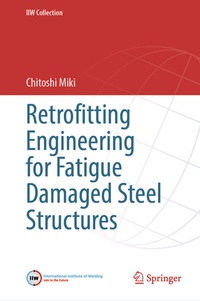
Retrofitting Engineering for Fatigue Damaged Steel Structures
Description

This book summarizes the numerous cases of fatigue damage of steel structures that have been reported over the past years, as well as the repair and retrofitting technologies that have been proposed and applied to solve the issue. It focuses on the causes and repair practices and provides comprehensive information to anyone with interest in the topic. This book was written as part of the activities of the International Institute of Welding (IIW), Commission XIII (Fatigue of Welded Components and Structures) Working Group 5 (Life Extension of Welded Structures by Repair, Retrofitting and Structural Monitoring; hereafter referred to as IIW XIII WG5). The author is the former chairman of IIW XIII WG5.
More details
Other editions
Additional editions
Person
Dr. Chitoshi Miki is the emeritus president of Tokyo City University and emeritus professor of Tokyo Institute of Technology. Dr. Miki was born in 1947. He graduated Tokyo Institute of Technology in 1970. He got a Doctor of Engineering degree in 1979 from the Tokyo Institute of Technology.
He started his career as a research associate at Tokyo Tech from 1972 to1979, working his way up as an assistant professor in 1979 and as an associate professor in 1980 at the University of Tokyo. He was an associate professor at Tokyo Institute of Technology from 1982 until 1990 before being appointed as a professor in 1990 until 2012. He was a dean of Engineering School and an executive vice president at Tokyo Institute of Technology in 2005. In 2012, Dr. Miki joined Tokyo City University as a professor.
Content
Preface .- Chapter 1 Introduction.- Chapter 2 Classification of Fatigue Damage and Repair Methods.- Chapter 3 Database of Fatigue Damage and Repair Cases.- Chapter 4 Existence of Weld Defects.- Chapter 5 Use of Joint Details of Low Fatigue Strength.- Chapter 6 Occurrence of Unexpected Stresses and Deformations.- Chapter 7 Orthotropic Steel Bridge Deck.- Chapter 8 Vibration Fatigue.- Chapter 9 Fatigue Assessment Procedures for Existing Structures.- Chapter 10 Changes in Steel Performance.- Appendix.
