

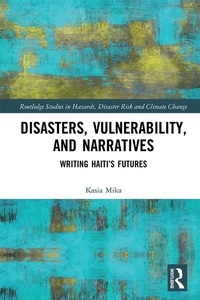
Disasters, Vulnerability, and Narratives
Writing Haiti's Futures
1st Edition
Published on 17. July 2018
244 pages
978-1-351-40304-7 (ISBN)
Description

This book uses narrative responses to the 2010 Haiti earthquake as a starting point for an analysis of notions of disaster, vulnerability, reconstruction and recovery. The turn to a wide range of literary works enables a composite comparative analysis, which encompasses the social, political and individual dimensions of the earthquake.
This book focuses on a vision of an open-ended future, otherwise than as a threat or fear. Mika turns to concepts of hinged chronologies, slow healing and remnant dwelling. Weaving theory with attentive close-readings, the book offers an open-ended framework for conceptualising post-disaster recovery and healing. These processes happen at different times and must entail the elimination of compound vulnerabilities that created the disaster in the first place. Challenging characterisations of the region as a continuous catastrophe this book works towards a bold vision of Haiti's and the Caribbean's futures.
The study shows how narratives can extend some of the key concepts within discipline-bound approaches to disasters, while making an important contribution to the interface between disaster studies, postcolonial ecocriticism and Haitian Studies.
This book focuses on a vision of an open-ended future, otherwise than as a threat or fear. Mika turns to concepts of hinged chronologies, slow healing and remnant dwelling. Weaving theory with attentive close-readings, the book offers an open-ended framework for conceptualising post-disaster recovery and healing. These processes happen at different times and must entail the elimination of compound vulnerabilities that created the disaster in the first place. Challenging characterisations of the region as a continuous catastrophe this book works towards a bold vision of Haiti's and the Caribbean's futures.
The study shows how narratives can extend some of the key concepts within discipline-bound approaches to disasters, while making an important contribution to the interface between disaster studies, postcolonial ecocriticism and Haitian Studies.
Reviews / Votes
"In Disasters, Vulnerability, and Narratives: Writing Haiti's Futures, Kasia Mika makes an important contribution to the still-emerging archive of experience of the Haitian earthquake. In Mika's critical reading of a cross-section of fictional and nonfictional accounts, we get a "bold, future-oriented" account of the catastrophe." Greg Beckett, Author of There Is No More Haiti. "In Disasters, Vulnerability, and Narratives: Writing Haiti's Futures, Kasia Mika makes an important contribution to the still-emerging archive of experience of the Haitian earthquake. In Mika's critical reading of a cross-section of fictional and nonfictional accounts, we get a "bold, future-oriented" account of the catastrophe." Greg Beckett, Author of There Is No More Haiti.More details
Series
Edition
1. Auflage
Language
English
Place of publication
London
United Kingdom
Publishing group
Taylor & Francis Ltd
Target group
College/higher education
File size
3,87 MB
ISBN-13
978-1-351-40304-7 (9781351403047)
Copyright in bibliographic data and cover images is held by Nielsen Book Services Limited or by the publishers or by their respective licensors: all rights reserved.
Schweitzer Classification
Other editions
Additional editions
Book
06/2020
1st Edition
Routledge
€68.40
Shipment within 15-20 days
Book
07/2018
1st Edition
Routledge
€206.40
Shipment within 10-20 days
Person
Kasia Mika is a Lecturer in Comparative Literature at Queen Mary University London. Her research focuses on disaster studies, postcolonial approaches to environmental and medical humanities, and Caribbean and island studies. In Disasters, Vulnerability, and Narratives: Writing Haiti's Futures (Routledge 2019), she turns to narratives of the 2010 Haiti earthquake to conceptualize hinged chronologies, slow healing, and remnant dwelling. Building on this work, she has produced a short documentary, Intranqu'illites (2019; dir. Ed Owles), on art and creativity in Haiti (AHRC Research in Film Award 2019). Her articles appeared in: Area, The Journal of Haitian Studies, Moving Worlds, Modern and Contemporary France.
Content
PART I: DISASTER MAKING 1. January 12 2010: From Hazard to Disaster 2. Disaster's Past, Present and Future: Beyond Exposure, Failure and Resilience 3. Rasanblaj: Scholarship of Care PART II: DISASTER TIME 4. Halting the Tremors 5. Recalling History and Reimagining the Future PART III: DISASTER SPACE 6. Navigating Through the Rubble 7. Future Rebuilding and Reconstructions PART IV: DISASTER SELVES 8. Narrating Conversion and Rescue 9. Imagining Novel Lives Rasanblaj: A Future Reassembled
