

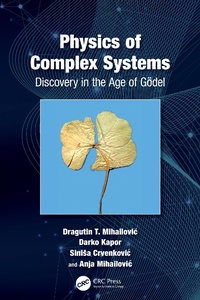
Physics of Complex Systems
Discovery in the Age of Goedel
1st Edition
Published on 1. September 2023
200 pages
978-1-000-92719-1 (ISBN)
Description

This book analyses the physics of complex systems to elaborate the problems encountered in teaching and research. Inspired by the of Kurt Goedel (including his incompleteness theorems) it considers the concept of time, the idea of models and the concept of complexity before trying to assess the state of physics in general. Using both general and practical examples, the idea of information is discussed, emphasizing its physical interpretation, debates ideas in depth using examples and evidence to provide detailed considerations on the topics. Based on the authors' own research on these topics, this book puts forward the idea that the application of information measures can provide new results in the study of complex systems. Helpful for those already familiar with the concepts who wish to deepen their critical understanding, Physics of Complex Systems will be extremely valuable both for people that are already involved in complex systems and also readers beginning their journey into the subject. This work will encourage readers to follow and continue these ideas, enabling them to investigate the various topics further.
More details
Edition
1. Auflage
Language
English
Place of publication
London
United Kingdom
Publishing group
Taylor & Francis Ltd
Target group
College/higher education
Professional and scholarly
Product notice
Reflowable
Illustrations
31 Line drawings, black and white; 26 Halftones, black and white; 57 Illustrations, black and white
ISBN-13
978-1-000-92719-1 (9781000927191)
Copyright in bibliographic data and cover images is held by Nielsen Book Services Limited or by the publishers or by their respective licensors: all rights reserved.
Schweitzer Classification
Other editions
Additional editions
agutin Mihailovic | Darko Kapor | Sinisa Crvenkovic
Physics of Complex Systems
Discovery in the Age of Goedel
Book
04/2025
1st Edition
CRC Press
€79.50
Shipment within 10-20 days
agutin Mihailovic | Darko Kapor | Sinisa Crvenkovic
Physics of Complex Systems
Discovery in the Age of Goedel
Book
09/2023
1st Edition
CRC Press
€196.00
Shipment within 10-20 days
Persons
Dragutin Mihailovic is a retired Professor in Meteorology, Environmental Fluid Mechanics, and Biophysics at the University of Novi Sad (Serbia). He obtained his B.Sc. in Physics and his M.Sc. and Ph.D. in Meteorology at the University of Belgrade (Serbia). He was the Visiting Professor or Researcher at institutions in USA, Netherlands, and Norway. He has more than 200 peer-reviewed scientific papers in international journals and a monograph on subjects related to land-atmosphere processes, air pollution, chemical transport modeling, boundary layer meteorology, physics and modeling of phenomena on environmental interfaces, modeling of complex systems, nonlinear dynamics, and complexity. He was among the editors of six monographs and coauthored a book on the modeling of environmental surfaces (Elsevier). Prof. Mihailovic was the principal investigator in the FP6 project and several international projects (the University of Athens, the Colorado State University, and the University at Albany-SUNY), a member of the Editorial Board of Environmental Modelling and Software (1992-2010), and a reviewer in several international journals.
Darko Kapor is the retired Professor of Theoretical and Mathematical Physics at the University of Novi Sad (Serbia). He received his B.Sc. and Ph.D. in Physics at the University of Novi Sad and M. Sc, at the University of Belgrade (Serbia). His main research interest is Theoretical Condensed Matter Physics. He was the head of several research projects. Later he developed an interest in theoretical meteorology. He has more than 120 peer-reviewed scientific papers in international journals and chapters in research monographs and coauthored a book on environmental surfaces (Elsevier). He spent some time visiting laboratories in France, USA, and Hungary. Prof. Kapor invested much effort in Physics popularization by working with talented pupils and teachers and organizing Physics problems solving contests. His experience from this work was important while coauthoring textbooks in Physics for elementary and secondary schools.
Sinisa Crvenkovic is the retired Professor of Mathematics, the University of Novi Sad (Serbia). He received his B.Sc. and Ph.D. degrees in Mathematics at the University of Novi Sad and M.Sc. at the University of Belgrade (Serbia). Along with his teaching activities at the Department of Mathematics, the University of Novi Sad, he was a Visiting Professor of Mathematics at the Department of Mathematics, the University of Banja Luka, Bosnia and Herzegovina, for 18 years. His main research interests are Algebra and Mathematical Logic, Constructive Mathematics, History, and Philosophy of Mathematics. He was the head of several scientific projects and has more than 100 peer-reviewed scientific papers in scientific journals and chapters in research monographs. He was a postdoc IREX grantee in USA. Prof. Crvenkovic was active in the popularization of Mathematics by working with talented pupils and organizing Serbian Math Olympiads. For several years he was the President of the Board of Trustees of the Serbian Mathematical Society.
Anja Mihailovic completed her M.Sc. in Applied Mathematics at the Faculty of Sciences, the University of Novi Sad (Serbia). She was the External Associate of the Center for Meteorology and Environmental Modelling at the University of Novi Sad. Her scientific research includes 15 peer-reviewed papers primarily focused on complexity, information measures, and their applications.
Darko Kapor is the retired Professor of Theoretical and Mathematical Physics at the University of Novi Sad (Serbia). He received his B.Sc. and Ph.D. in Physics at the University of Novi Sad and M. Sc, at the University of Belgrade (Serbia). His main research interest is Theoretical Condensed Matter Physics. He was the head of several research projects. Later he developed an interest in theoretical meteorology. He has more than 120 peer-reviewed scientific papers in international journals and chapters in research monographs and coauthored a book on environmental surfaces (Elsevier). He spent some time visiting laboratories in France, USA, and Hungary. Prof. Kapor invested much effort in Physics popularization by working with talented pupils and teachers and organizing Physics problems solving contests. His experience from this work was important while coauthoring textbooks in Physics for elementary and secondary schools.
Sinisa Crvenkovic is the retired Professor of Mathematics, the University of Novi Sad (Serbia). He received his B.Sc. and Ph.D. degrees in Mathematics at the University of Novi Sad and M.Sc. at the University of Belgrade (Serbia). Along with his teaching activities at the Department of Mathematics, the University of Novi Sad, he was a Visiting Professor of Mathematics at the Department of Mathematics, the University of Banja Luka, Bosnia and Herzegovina, for 18 years. His main research interests are Algebra and Mathematical Logic, Constructive Mathematics, History, and Philosophy of Mathematics. He was the head of several scientific projects and has more than 100 peer-reviewed scientific papers in scientific journals and chapters in research monographs. He was a postdoc IREX grantee in USA. Prof. Crvenkovic was active in the popularization of Mathematics by working with talented pupils and organizing Serbian Math Olympiads. For several years he was the President of the Board of Trustees of the Serbian Mathematical Society.
Anja Mihailovic completed her M.Sc. in Applied Mathematics at the Faculty of Sciences, the University of Novi Sad (Serbia). She was the External Associate of the Center for Meteorology and Environmental Modelling at the University of Novi Sad. Her scientific research includes 15 peer-reviewed papers primarily focused on complexity, information measures, and their applications.
Content
Chapter 1 Prolegomena
Chapter 2 Goedel's Incompleteness Theorems and physics
Chapter 3 Complex time in physics
Chapter 4 Are model and theory synonymous in physics? Between epistemology and practice
Chapter 5 How to assimilate hitherto inaccessible information in physics?
Chapter 6 Kolmogorov and change complexity and their use in physics
Chapter 7 Separation of scales in complex systems
Chapter 8 Randomness representation of turbulence in fluids
Chapter 9 Physics of complex systems and painting
Chapter 10 Modelling the biophysical complex systems
Chapter 2 Goedel's Incompleteness Theorems and physics
Chapter 3 Complex time in physics
Chapter 4 Are model and theory synonymous in physics? Between epistemology and practice
Chapter 5 How to assimilate hitherto inaccessible information in physics?
Chapter 6 Kolmogorov and change complexity and their use in physics
Chapter 7 Separation of scales in complex systems
Chapter 8 Randomness representation of turbulence in fluids
Chapter 9 Physics of complex systems and painting
Chapter 10 Modelling the biophysical complex systems
