

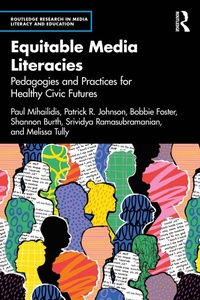
Equitable Media Literacies
Pedagogies and Practices for Healthy Civic Futures
Published on 9. December 2025
162 pages
978-1-040-49400-4 (ISBN)
Description

Interrogating three core assumptions made within the field of media literacy-that media literacy practices empower individuals, support communities, and contribute to engaged citizenship within a democracy-this book presents a new framework for equitable media literacy practices.
Using the results of a large-scale research project to interrogate these long-held assumptions and explore the connection between impactful media literacy practices and equity, the authors demonstrate the crucial need to shift the focus of media literacy practices from that of individual skill transfer to that of equity-driven community-oriented media practices. They offer a clear framework for embracing equity and inclusion at the outset of media literacy intervention, focusing on the Six E's Framework, the Equitable Media Literacy Practice Model, and a Field Guide with the five categories for practice: Where Do I Stand, Who Cares, Imagining Inclusive Futures, With Community, and Where Do We Stand. Each category repositions media literacies with explicit focus on inclusion, justice, and the pursuit of equitable futures.
This book will appeal to students and scholars studying and researching in the space of media literacy, digital culture, social justice, and equity in media and communication studies departments and beyond, as well as those working at the educational and policy level around issues of media literacy, media education, and civic engagement.
Using the results of a large-scale research project to interrogate these long-held assumptions and explore the connection between impactful media literacy practices and equity, the authors demonstrate the crucial need to shift the focus of media literacy practices from that of individual skill transfer to that of equity-driven community-oriented media practices. They offer a clear framework for embracing equity and inclusion at the outset of media literacy intervention, focusing on the Six E's Framework, the Equitable Media Literacy Practice Model, and a Field Guide with the five categories for practice: Where Do I Stand, Who Cares, Imagining Inclusive Futures, With Community, and Where Do We Stand. Each category repositions media literacies with explicit focus on inclusion, justice, and the pursuit of equitable futures.
This book will appeal to students and scholars studying and researching in the space of media literacy, digital culture, social justice, and equity in media and communication studies departments and beyond, as well as those working at the educational and policy level around issues of media literacy, media education, and civic engagement.
More details
Series
Language
English
Place of publication
London
United Kingdom
Publishing group
Taylor & Francis Ltd
Target group
College/higher education
Professional and scholarly
Illustrations
6 Line drawings, black and white; 6 Illustrations, black and white
File size
2,34 MB
ISBN-13
978-1-040-49400-4 (9781040494004)
Copyright in bibliographic data and cover images is held by Nielsen Book Services Limited or by the publishers or by their respective licensors: all rights reserved.
Schweitzer Classification
Other editions
Additional editions
Paul Mihailidis | Patrick R. Johnson | Bobbie Foster
Equitable Media Literacies
Pedagogies and Practices for Healthy Civic Futures
Book
approx. 12/2025
1st Edition
Routledge
€62.70
Not yet published
Paul Mihailidis | Patrick R. Johnson | Bobbie Foster
Equitable Media Literacies
Pedagogies and Practices for Healthy Civic Futures
Book
approx. 12/2025
1st Edition
Routledge
€205.80
Not yet published
Persons
Paul Mihailidis is Professor of Civic Media and Journalism and Interim Dean in the School of Communication at Emerson College in Boston, USA. He has published eight books and over 80 articles and book chapters on the intersection of media literacy, civic media, and engagement in digital culture.
Patrick R. Johnson is an Assistant Professor of Journalism and Media Studies in the Diederich College of Communication at Marquette University in Milwaukee, USA. His research, teaching, and public scholarship operate at the intersection of news literacy, journalism practice, and education. He also studies the LGBTQ+ press and sexuality in media.
Bobbie Foster is an Assistant Professor of Journalism in the School of Journalism and Strategic Media at the University of Arkansas, USA. Her research interests include memes, digital culture, LGBTQ+ media, and cultural heritage studies.
Shannon Burth is a Doctoral Student at the Newhouse School of Public Communications at Syracuse University, USA. Her research focuses on critical media literacy, activism, and critical pedagogy in higher education.
Srividya Ramasubramanian is Newhouse Professor and Endowed Chair at the S.I. Newhouse School of Public Communications at Syracuse University. She is the Founder and Director of CODE^SHIFT (Collaboratory for Data Equity, Social Healing, Inclusive Futures, and Transformation), The Difficult Dialogues Project, and Media Rise. Her scholarship focuses on critical media effects, data justice, antiracism dialogues, and critical media literacy.
Melissa Tully is Professor and Director of the School of Journalism and Mass Communication at the University of Iowa, USA. Her research focuses on news literacy, misinformation, and global media with a particular focus on African media studies.
Patrick R. Johnson is an Assistant Professor of Journalism and Media Studies in the Diederich College of Communication at Marquette University in Milwaukee, USA. His research, teaching, and public scholarship operate at the intersection of news literacy, journalism practice, and education. He also studies the LGBTQ+ press and sexuality in media.
Bobbie Foster is an Assistant Professor of Journalism in the School of Journalism and Strategic Media at the University of Arkansas, USA. Her research interests include memes, digital culture, LGBTQ+ media, and cultural heritage studies.
Shannon Burth is a Doctoral Student at the Newhouse School of Public Communications at Syracuse University, USA. Her research focuses on critical media literacy, activism, and critical pedagogy in higher education.
Srividya Ramasubramanian is Newhouse Professor and Endowed Chair at the S.I. Newhouse School of Public Communications at Syracuse University. She is the Founder and Director of CODE^SHIFT (Collaboratory for Data Equity, Social Healing, Inclusive Futures, and Transformation), The Difficult Dialogues Project, and Media Rise. Her scholarship focuses on critical media effects, data justice, antiracism dialogues, and critical media literacy.
Melissa Tully is Professor and Director of the School of Journalism and Mass Communication at the University of Iowa, USA. Her research focuses on news literacy, misinformation, and global media with a particular focus on African media studies.
Content
Acknowledgements
Preface
Chapter 1: Contemporary Media Environments and the Pursuit of Equitable Media Literacies
Chapter 2: Locating Media Literacies in Contemporary Digital Culture
Chapter 3: Mapping Impact in Media Literacy: A Moving Target
Chapter 4: Impact and Equity in Practice: Talking with Stakeholders
Chapter 5: Re-centering Relation in Media Literacy Practice
Chapter 6: Setting Agendas for Research and Practice in Equitable Media Literacy
Methodology Appendix
Index
Preface
Chapter 1: Contemporary Media Environments and the Pursuit of Equitable Media Literacies
Chapter 2: Locating Media Literacies in Contemporary Digital Culture
Chapter 3: Mapping Impact in Media Literacy: A Moving Target
Chapter 4: Impact and Equity in Practice: Talking with Stakeholders
Chapter 5: Re-centering Relation in Media Literacy Practice
Chapter 6: Setting Agendas for Research and Practice in Equitable Media Literacy
Methodology Appendix
Index
