

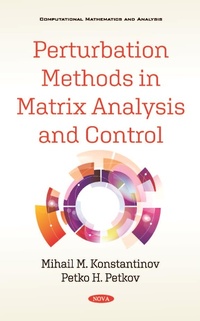
Perturbation Methods in Matrix Analysis and Control
Published on 12. May 2020
281 pages
978-1-5361-7471-7 (ISBN)
Description

The book presents a unified approach to the perturbation analysis in Matrix Analysis and Control, based on the method of splitting operators and Lyapunov majorant functions. Combined with the Schauder or Banach fixed point principles, this approach allows to obtain rigorous non-local perturbation bounds for a set of important objects in Linear Algebra and Control Theory. Among them are the Schur system of a matrix, the QR decomposition of a matrix, the orthogonal canonical forms of time-invariant linear systems, the state and output feedback gains in pole assignment design, the generalized Schur system of a pair of matrices, the Hamiltonian-Schur and block Hamiltonian-Schur forms of Hamiltonian matrices, and others. In this way, the approach proposed can be used as a unified tool in deriving asymptotic and nonlocal perturbation bounds in matrix analysis and control theory. An important technique of the method considered is the construction of an operator equation, which is equivalent to the perturbed problem. It is based on the splitting of a certain linear matrix operator and its argument into strictly lower, diagonal and strictly upper parts, respectively. This allows to unify the perturbation analysis of matrix problems, involving unitary matrices, in which the resulting matrix is upper triangular. Some other issues such as perturbation analysis of problems with non-unique solution and construction of improved asymptotic perturbation bounds are also considered. The book is intended as a reference in the area of matrix computations and control theory. It will be of interest to researchers in the area of matrix analysis, linear control theory and applied mathematics. The book may also be useful for graduate students in the area of applied mathematics.
More details
Other editions
Additional editions
Mihail M. Konstantinov
Perturbation Methods in Matrix Analysis and Control
Book
04/2020
Nova Science Publishers Inc
€256.99
Shipment within 15-20 days
Content
- Intro
- PERTURBATION METHODSIN MATRIX ANALYSISAND CONTROL
- PERTURBATION METHODSIN MATRIX ANALYSISAND CONTROL
- Contents
- Preface
- Chapter 1Introduction
- Chapter 2Notation and Preliminaries
- 1. Matrix Notations
- 2. Notes and References
- Chapter 3Perturbation Problems
- 1. Introductory Notes
- 2. Explicit and Implicit Problems
- 3. Why Perturbations?
- 4. Perturbation Analysis Using Fixed Point Principles
- 5. Basic Perturbation Problems
- 6. Matrix Perturbation Analysis Problems
- 7. Problems with Non-Unique Solution
- 8. Asymptotic and Non-Local Perturbation Bounds
- 8.1. Asymptotic Bounds
- 8.2. Non-Local Bounds
- 9. Notes and References
- Chapter 4Splitting Operators andLyapunov Majorants
- 1. Introductory Notes
- 2. Matrix Splittings
- 3. The Method of Splitting Operators
- 4. Lyapunov Majorants
- 5. Estimation of the Norms of P2(X) and P3(X)
- 6. Case Study: Perturbation Analysis of the QRDecomposition
- 7. Notes and References
- Chapter 5Schur Decomposition
- 1. Introductory Notes
- 2. Schur System of a Matrix
- 3. Perturbation Analysis of the Schur System
- 4. Explicit Perturbation Bounds
- 5. Eigenvalue Conditioning
- 6. Notes and References
- Chapter 6Hamiltonian Matrices. BasicRelations
- 1. Introductory Notes
- 2. Condensed Forms
- 3. Perturbations of the Condensed Forms
- 3.1. Hamiltonian-Schur Form
- 3.2. Block Hamiltonian-Schur Form
- 3.3. Stable Invariant Subspace
- 3.4. Block Schur Form
- 4. Useful Relations
- 4.1. Condensed Forms
- Hamiltonian-Schur Form
- Block Hamiltonian-Schur Form
- Block Schur Form
- 4.2. Parametrization of US(2n)
- 4.3. One-Parameter Perturbations in Condensed Forms
- 5. Notes and References
- Chapter 7Hamiltonian Matrices.Asymptotic Analysis
- 1. Introductory Notes
- 2. Hamiltonian-Schur Form
- 3. Block Hamiltonian-Schur Form
- 4. Block Schur Form
- 5. Summary of the Linear Perturbation Analysis
- 6. Notes and References
- Chapter 8Hamiltonian Matrices.Non-Local Analysis
- 1. Introductory Notes
- 2. Hamiltonian-Schur Form
- 3. Block Hamiltonian-Schur Form
- 4. Block Schur Form
- 5. Summary of the Non-Local Analysis
- 6. Power Series Expansions
- 7. Numerical Example
- 8. Notes and References
- Chapter 9Orthogonal Canonical Forms
- 1. Introductory Notes
- 2. Statement of the Problem
- 3. Abstract Canonical Forms
- 4. Single-Input Systems
- 4.1. Canonical Forms
- 4.2. The Perturbation Problem
- 4.3. Main Relations
- 4.4. Local Estimates
- 4.5. Non-Local Estimates
- 4.6. Numerical Examples
- 5. Multi-Input Systems
- 5.1. Canonical Forms
- 5.2. Perturbation Bounds
- 5.3. Numerical Examples
- 6. Notes and References
- Chapter 10Feedback Synthesis Problem
- 1. Introductory Notes
- 2. Statement of the Problem
- 4. Asymptotic Analysis
- 5. Non-Local Analysis
- 6. Numerical Examples
- 7. Notes and References
- 3. The Perturbation Problem
- References
- About the Authors
- Index
- Blank Page
