

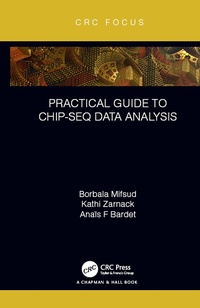
Practical Guide to ChIP-seq Data Analysis
1st Edition
Published on 26. October 2018
112 pages
978-0-429-94639-4 (ISBN)
Description

Chromatin immunoprecipitation sequencing (ChIP-seq), which maps the genome-wide localization patterns of transcription factors and epigenetic marks, is among the most widely used methods in molecular biology. Practical Guide to ChIP-seq Data Analysis will guide readers through the steps of ChIP-seq analysis: from quality control, through peak calling, to downstream analyses. It will help experimental biologists to design their ChIP-seq experiments with the analysis in mind, and to perform the basic analysis steps themselves. It also aims to support bioinformaticians to understand how the data is generated, what the sources of biases are, and which methods are appropriate for different analyses.
Reviews / Votes
I found the book to be very well structured; the topic is presented following a logical progression, guiding the reader through a ChIP-seq experiment, illustrating each step of the analytical workflow. The workflow is nicely divided in smaller blocks, each including the relevant theory and practical exercises (consisting of code) that enable the reader to put the theory intro practice, plus suggestions for additional reading.I particularly appreciated the reference to biases and important issues that need to be considered when planning an experiment, as well as the discussion of data quality issues, extremely relevant to users dealing with publicly available data.
This will be a great resource for teaching, particularly given the use of public data as well as open source software. All that is presented in the book is reproducible, making it an extremely useful resource for any learner. I also appreciated the chapter dedicated to downstream analysis and interpretation - great to see as extremely useful and not often covered to the extent required; similar observation for the integration with other data types, a very timely subject of great interest to many researchers working with different data types and in need of combining the results of different experiment types. This book will be useful to different audiences (experimentalists as well as bioinformaticians) and it is written in a way which is easy to understand for non-technical audiences.
-Gabriella Rustici, University of Cambridge
More details
Series
Edition
1. Auflage
Language
English
Place of publication
London
United Kingdom
Publishing group
Taylor & Francis Ltd
Target group
College/higher education
Product notice
Reflowable
Illustrations
3 Tables, black and white; 10 Illustrations, black and white
File size
0,82 MB
ISBN-13
978-0-429-94639-4 (9780429946394)
Copyright in bibliographic data and cover images is held by Nielsen Book Services Limited or by the publishers or by their respective licensors: all rights reserved.
Schweitzer Classification
Other editions
Additional editions
Borbala Mifsud | Kathi Zarnack | Anais F. Bardet
Practical Guide to ChIP-seq Data Analysis
Book
12/2021
1st Edition
CRC Press
€32.80
Shipment within 10-20 days

Borbala Mifsud | Kathi Zarnack | Anais F. Bardet
Practical Guide to ChIP-seq Data Analysis
Book
11/2018
1st Edition
CRC Press
€96.74
Shipment within 10-20 days
Persons
Borbala Mifsud is an assistant professor in Epigenomics at the Hamad Bin Khalifa University, Doha, Qatar. She is a computational biologist with a background in molecular biology and works on 3D chromatin conformation and the integration of epigenomic data.
Kathi Zarnack is a principal investigator in Computational RNA Biology at the Buchmann Institute for Molecular Life Sciences (BMLS), Goethe University Frankfurt, Germany. She is a computational biologist with a background in molecular biology and broad experience in analysing high-throughput sequencing data.
Anais F Bardet is a tenured researcher at the National Center for Scientific Research (CNRS) at the University of Strasbourg, France. She is a computational biologist and develops projects exploring the regulation of transcription factor binding.
Kathi Zarnack is a principal investigator in Computational RNA Biology at the Buchmann Institute for Molecular Life Sciences (BMLS), Goethe University Frankfurt, Germany. She is a computational biologist with a background in molecular biology and broad experience in analysing high-throughput sequencing data.
Anais F Bardet is a tenured researcher at the National Center for Scientific Research (CNRS) at the University of Strasbourg, France. She is a computational biologist and develops projects exploring the regulation of transcription factor binding.
Content
Chapter 1 Introduction to ChIP-seq
Chapter 2 Getting Started
Chapter 3 General Quality Control
Chapter 4 Genomic Alignment
Chapter 5 ChIP-seq-specific Quality Control
Chapter 6 Peak Calling
Chapter 7 Data visualisation
Chapter 8 Comparative Analysis
Chapter 9 Downstream Analyses
Chapter 2 Getting Started
Chapter 3 General Quality Control
Chapter 4 Genomic Alignment
Chapter 5 ChIP-seq-specific Quality Control
Chapter 6 Peak Calling
Chapter 7 Data visualisation
Chapter 8 Comparative Analysis
Chapter 9 Downstream Analyses
