

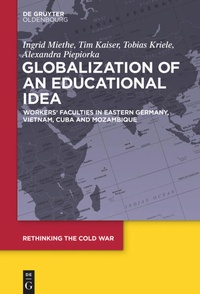
Globalization of an Educational Idea
Description

In this book, authors showcase the worldwide spread of Workers' Faculties as an example of both cooperation between socialist countries in education, and globalization processes in the field of education. Based on extensive research carried out in Cuban, German, Mozambican, and Vietnamese archives as well as expert interviews, it combines detailed case studies of educational transfers and policy implementation with a discussion of theoretical approaches to the study of globalization in and of education.
Research on Workers' Faculties provides an especially interesting example for the study of educational transfer between socialist countries as well as for the interplay of such transfers with processes of globalisation for two reasons. On one hand, the first Workers' Faculties were established already shortly after the October Revolution in Russia, and Workers' Faculties continue to exist in Cuba until today. A study of these institutions therefore provides a dynamic perspective covering the whole period of the existence of the socialist camp. On the other hand, the spread of the Workers' Faculty idea to four continents allows for an analysis that takes into account widely differing local contexts.
This book offers an analysis of general trends and particularities in the history of the global spread of the Workers' Faculty idea and its implementation in local contexts. Finally, it discusses the results with a view towards theories of globalization in the field of education as well as of specificities of processes of "socialist globalization".
Reviews / Votes
"This book is illuminating in terms of work by the authors who succeeded to hold together different settings, topics and methodologies in a captivating discursive manner. Thus, this book is a major contribution to an understanding of how general trends and features of a global educational idea that underpin the realisation of Workers' Faculties were realised and for this it deserves our full attention. As such it is an indispensable contribution to the history of Workers' Faculties in former and present-day socialist countries." Viktor Jakupec in: H-Soz-Kult, 25.01.2021, www.hsozkult.de/publicationreview/id/reb-94051 (12.02.2021)More details
Other editions
Additional editions
Persons
Content
- Intro
- Preface
- Acknowledgments
- Contents
- 1. Introduction
- 2. Theoretical Approaches
- 3. Methodological Considerations and Available Sources
- 4. The Starting Point: The Rabfak in Soviet Russia
- 5. The Global Dissemination of an Educational Idea
- 6. The Workers' Faculties in the German Democratic Republic (GDR)
- 7. The Worker-Peasant Complementary Education Schools of the Democratic Republic of Vietnam
- 8. The Workers' Faculties in Cuba
- 9. The Faculty for Former Combatants and Vanguard Workers in Mozambique
- 10. Theoretical Conclusions
- 11. Appendix
- Persons
- Places
