

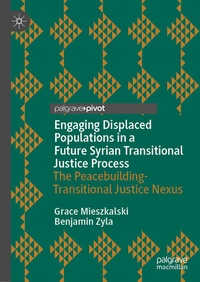
Engaging Displaced Populations in a Future Syrian Transitional Justice Process
Description

This book offers an analysis of a prospective transitional justice process in Syria. As the Syrian conflict enters into its tenth year, this book asks how the sustained human rights violations and war crimes could possibly be addressed in a post-conflict setting, particularly in the context of the widespread displacement crisis. Despite a recent movement in scholarship toward bottom-up peacebuilding approaches and participatory transitional justice models, the transitional justice and local peacebuilding nexus remains under-theorized, particularly as it relates to the engagement of displaced populations. This book seeks to address this gap through the conceptualization of a locally driven transitional justice process for Syria that is founded on the integration of refugees and displaced populations. Through offering a series of policy recommendations on how to implement such a process, it aims to make a contribution to building a bridge of exchange between the policy/practitioner world and the academy in this area of study.
More details
Other editions
Additional editions
Persons
Grace E. Mieszkalski holds a B.Soc.Sc. (2011-2016) and an M.A. in Globalization and International Development from the University of Ottawa, Canada (2016-2018). In 2017, she joined Global Affairs Canada and is currently serving as Senior Policy Analyst for the Middle East and North Africa in the Department's Security and Defence Relations Division. She has also dedicated several years to volunteering at a community-based organization in Ottawa with refugee populations, supporting their transition to Canada.
Benjamin Zyla is Professor in the School of International Development & Global Studies at the University of Ottawa, Canada, and Visiting Scholar in the Department of Government at Harvard University, USA. His research focuses on international organizations, peace- and state-building, post-conflict reconstruction, and foreign policy.
